Mythology
The Twelve Gods
The mythology of Apotheosis is not ornament - it is architecture. Long before the island had its current form, its creators gave it a hidden cosmology: twelve gods, each embodying a distinct force of nature and human experience, arranged in a circle of antagonism and kinship. Their stories explain why the island exists, why its festivals take the shape they do, and why free love and shared joy are treated here not as indulgences but as spiritual imperatives.
Zephyros is heat. He cares about passion, hunger, the kind of intensity that pulls people toward what they truly want. Aetherion is the opposite weather, cool and commanding, the quiet authority of someone who has already chosen and does not need to convince anyone. Together they ask how you move through the world. Do you rush toward what burns, or do you hold the line and let others come to you?
Solaron is the open hand, generous and welcoming, ready to say yes to people and experiences without flinching. Warlor is the harder hand, direct and unsentimental, willing to call a thing what it is and stand behind that call. One leads with welcome, the other with nerve. Both refuse to fake it. They just disagree about whether the world is more often met with warmth or with grit.
Erosia is sensual presence, treating desire as a form of honesty and the body as something with its own intelligence. Regalia is the gracious heart, offering love freely, treating attention as a gift, noticing small kindnesses and naming them. One celebrates wanting. The other celebrates caring. Both live in the part of life where people meet each other openly rather than at arm's length.
Forgeon is the blacksmith. Blunt, warm, allergic to performance, more interested in the rough true thing than the polished lie. Stratara is the curious professor, precise and delighted by ideas, always pulling the next thread to see where it leads. One gives the world what is real. The other gives it what is interesting. Both are generous with themselves, just in different currencies.
Fleetor is quick, irreverent, and charming, a god who believes humor is the sharpest way to see someone clearly. Oceanor is deep and self-contained, calm as open water, comfortable alone and uninterested in seeking anyone's permission. One travels light through life. The other travels deep. Both refuse to be weighed down by other people's expectations, just in different postures.
Harvestia is the deep soil, steady and reliable, reverent of the small consistent things that quietly hold a life together. Lunara is moonlight on water, lyrical and slow, perceptive to grief and longing and whatever sits beneath the surface. One tends what lasts. The other names what is hidden. Both move at their own pace and trust that the important things reveal themselves over time.
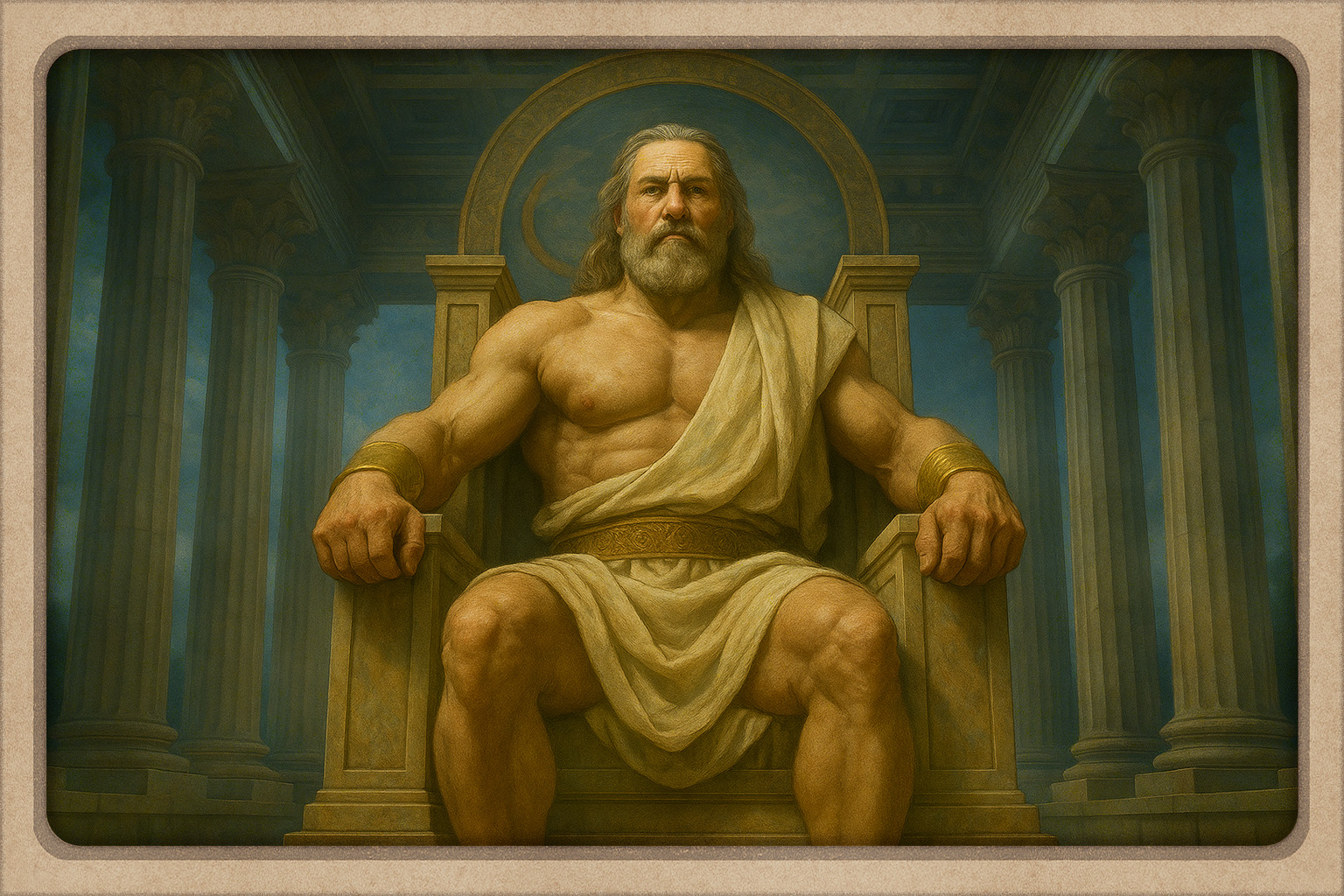
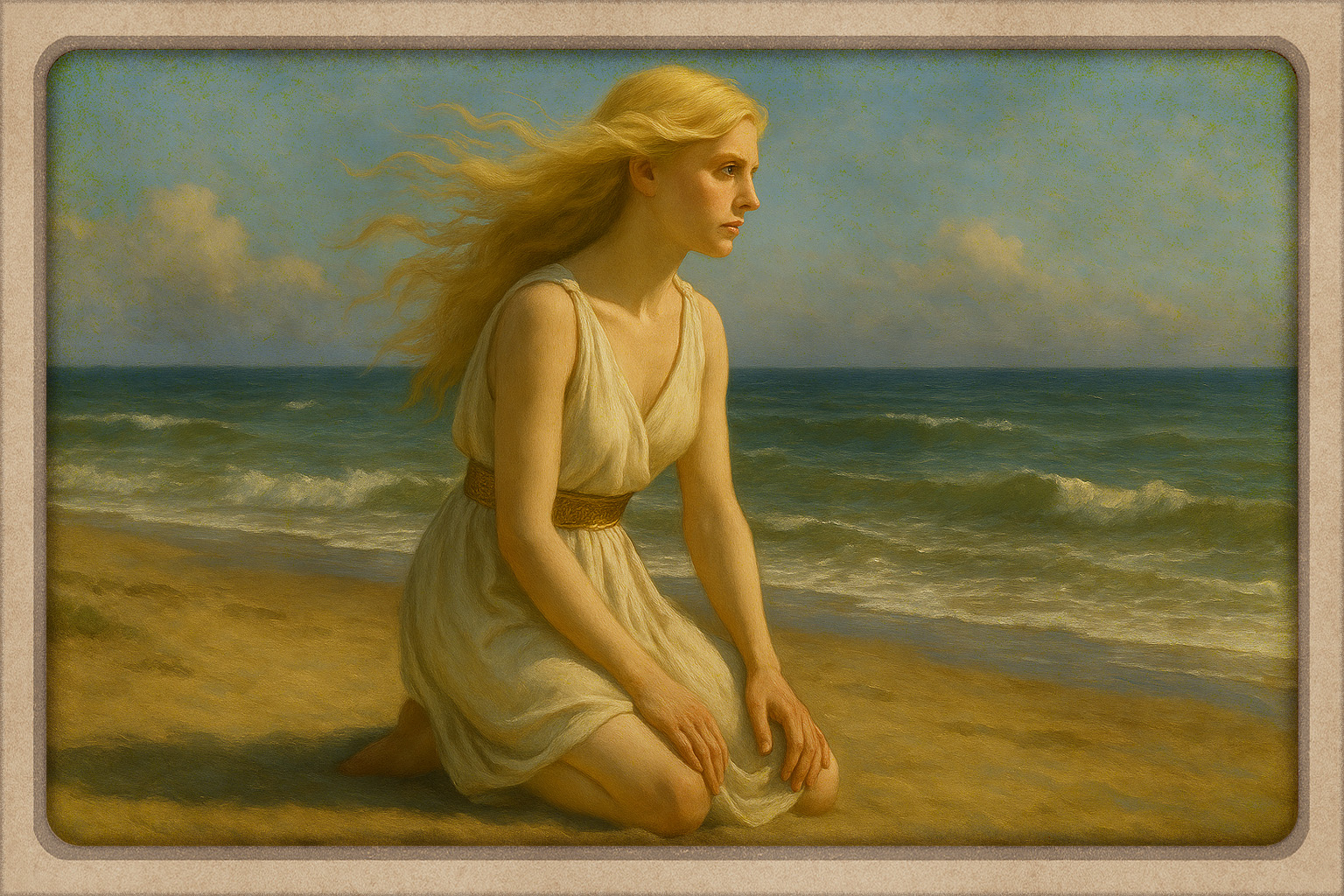
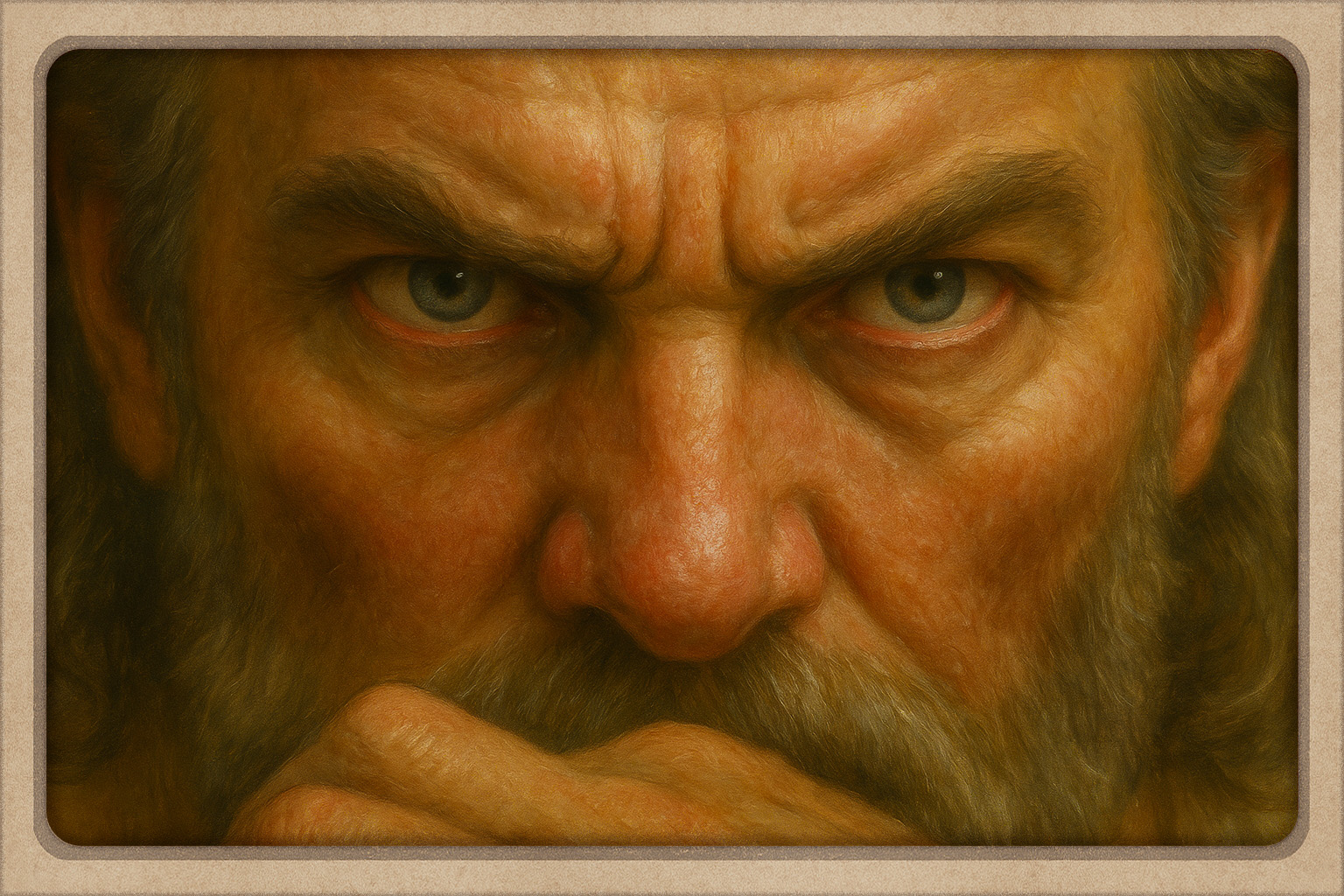
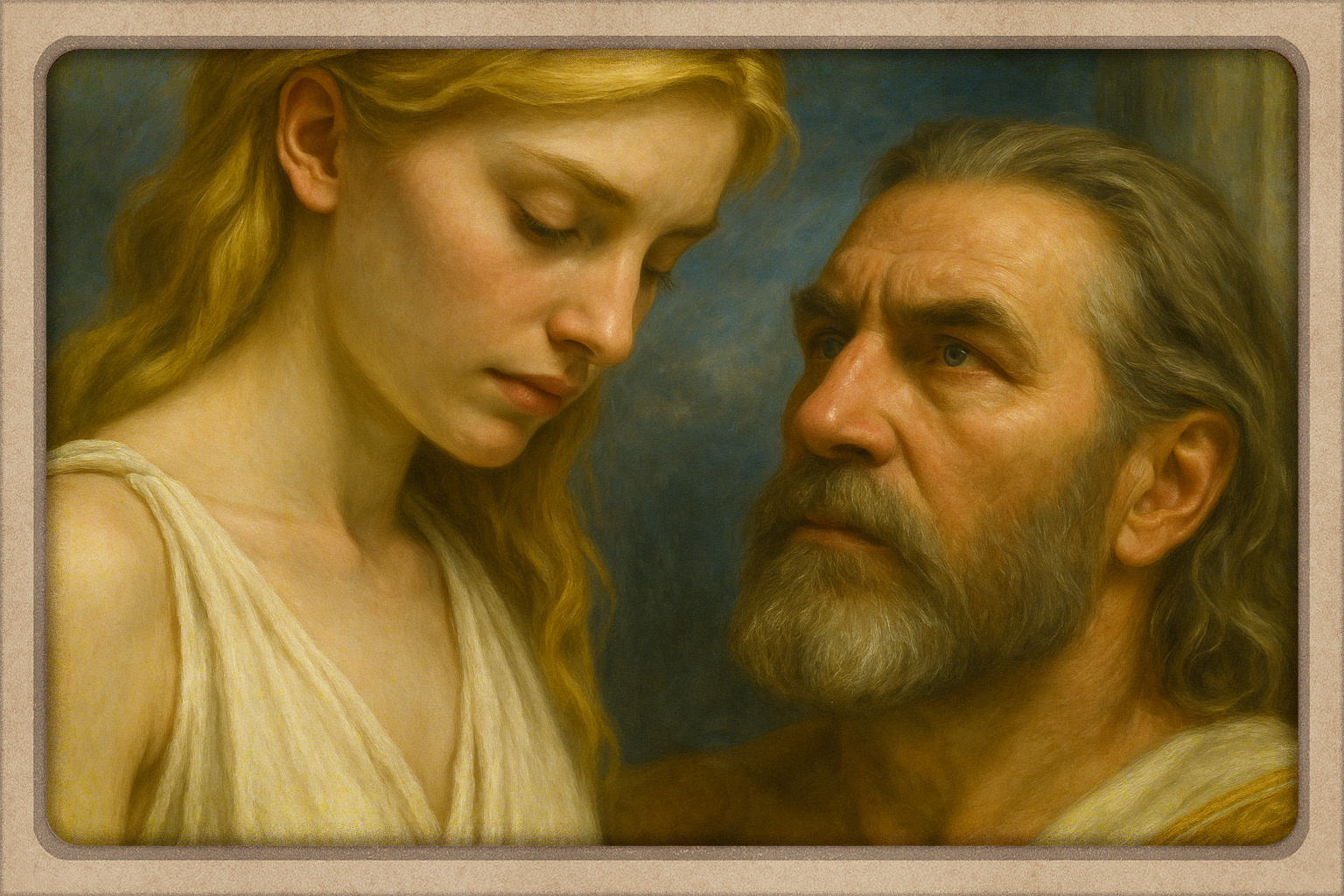
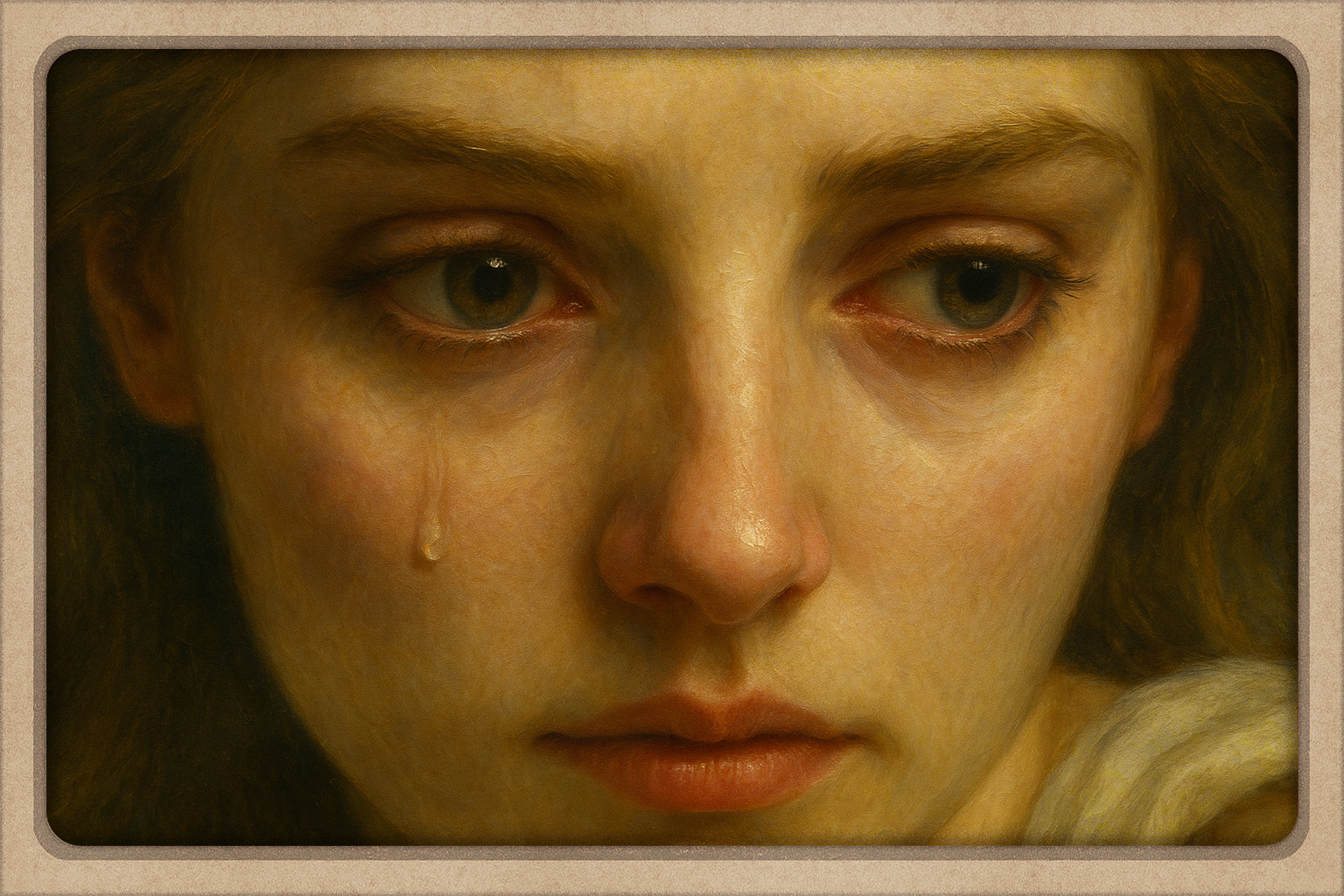
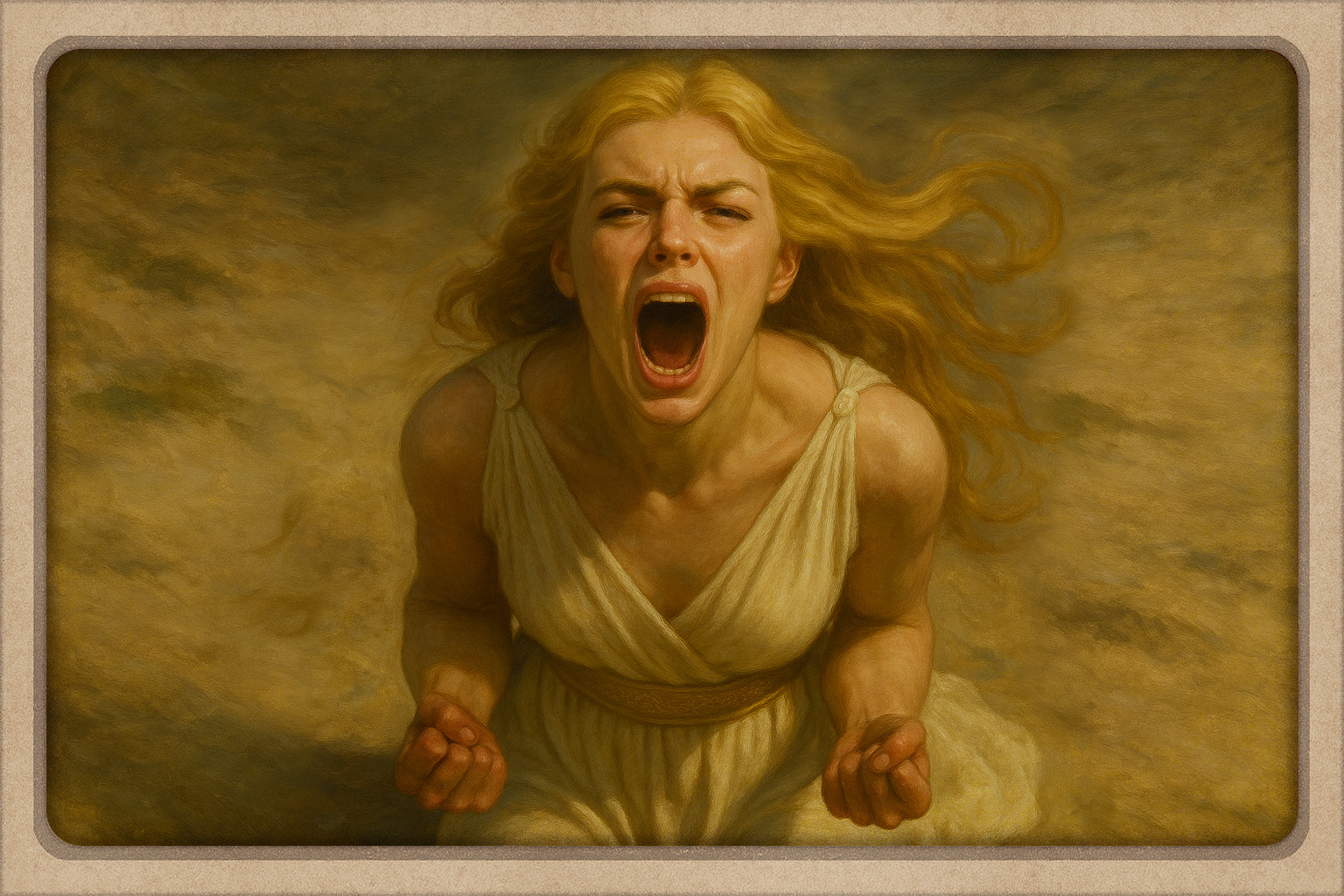
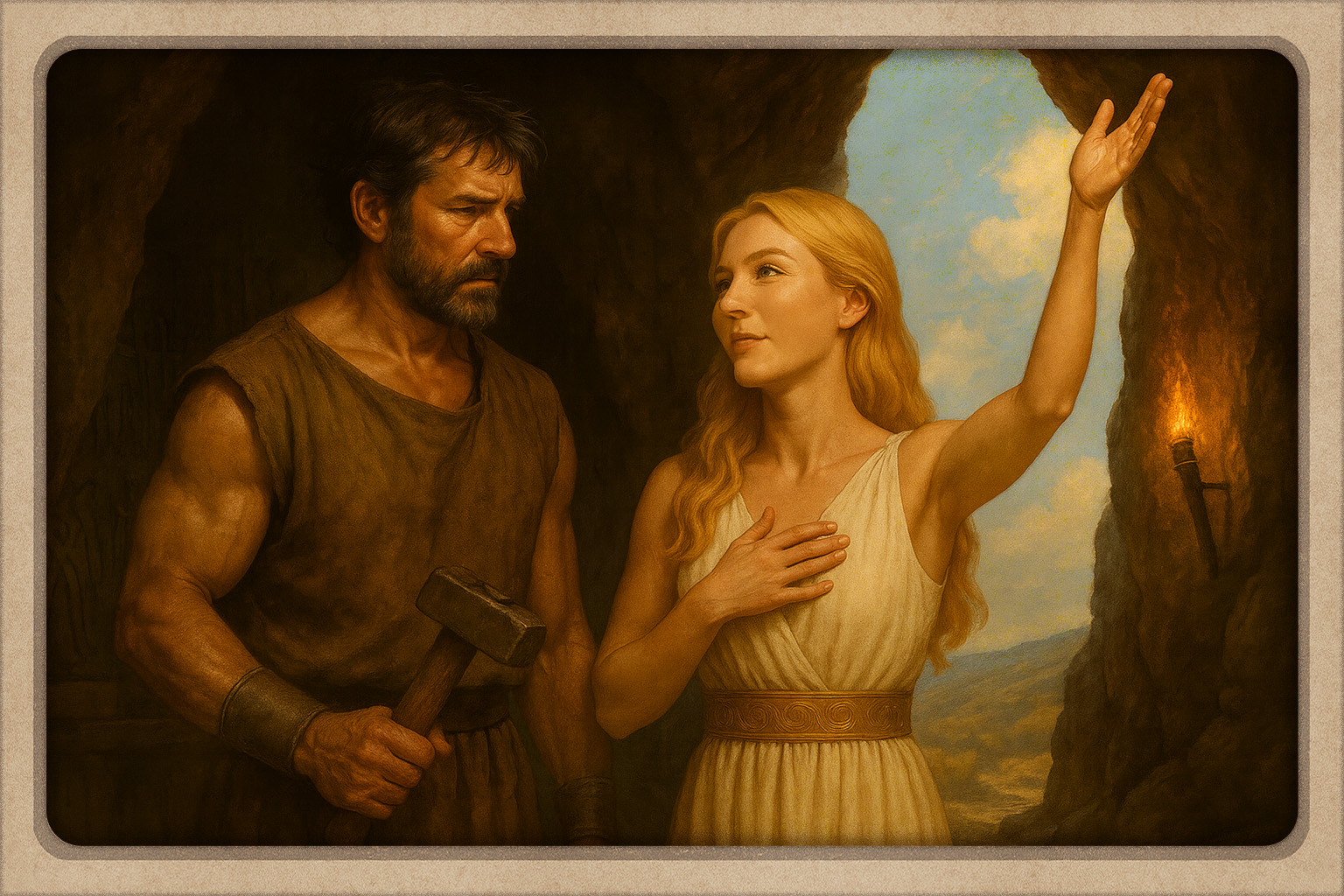
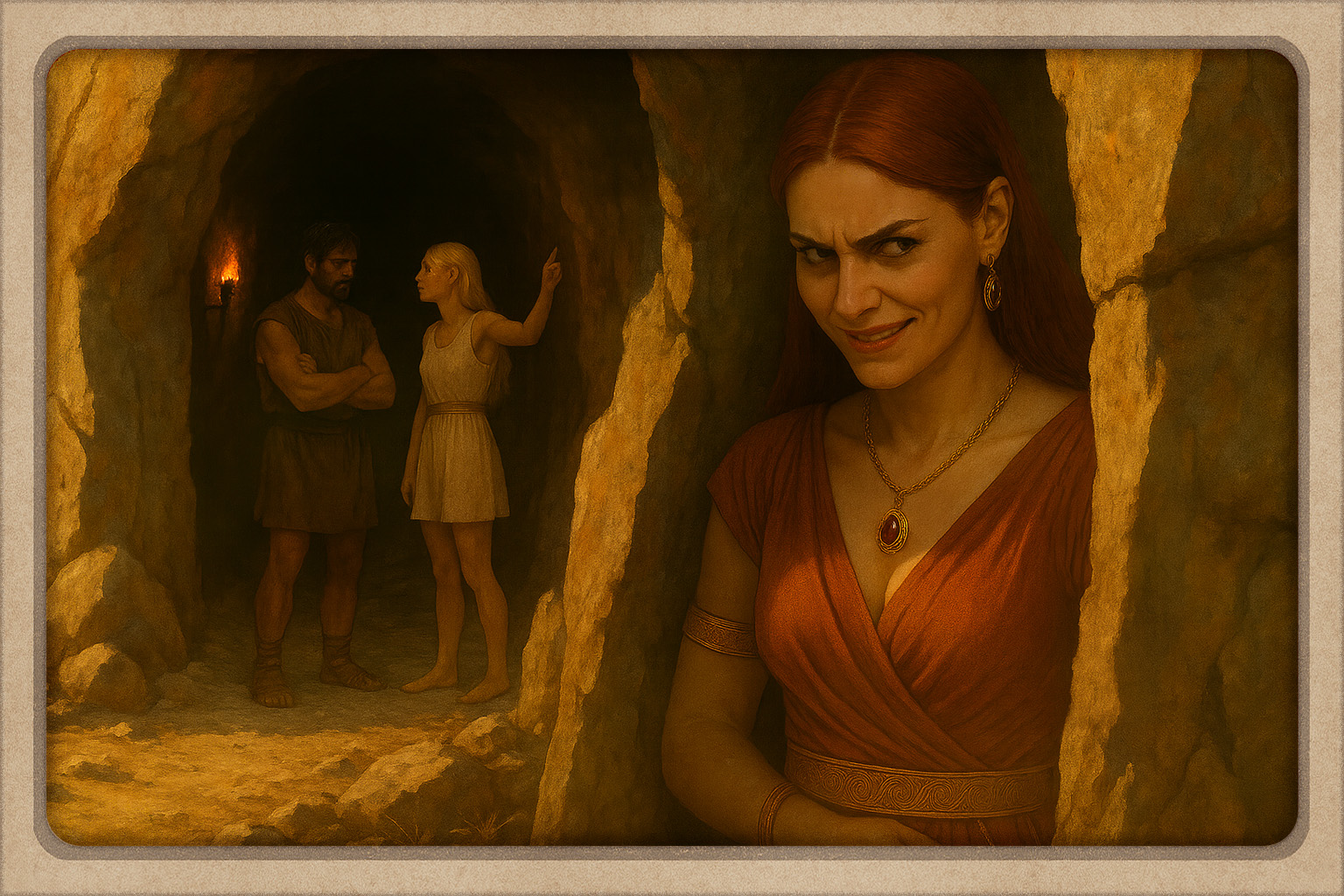
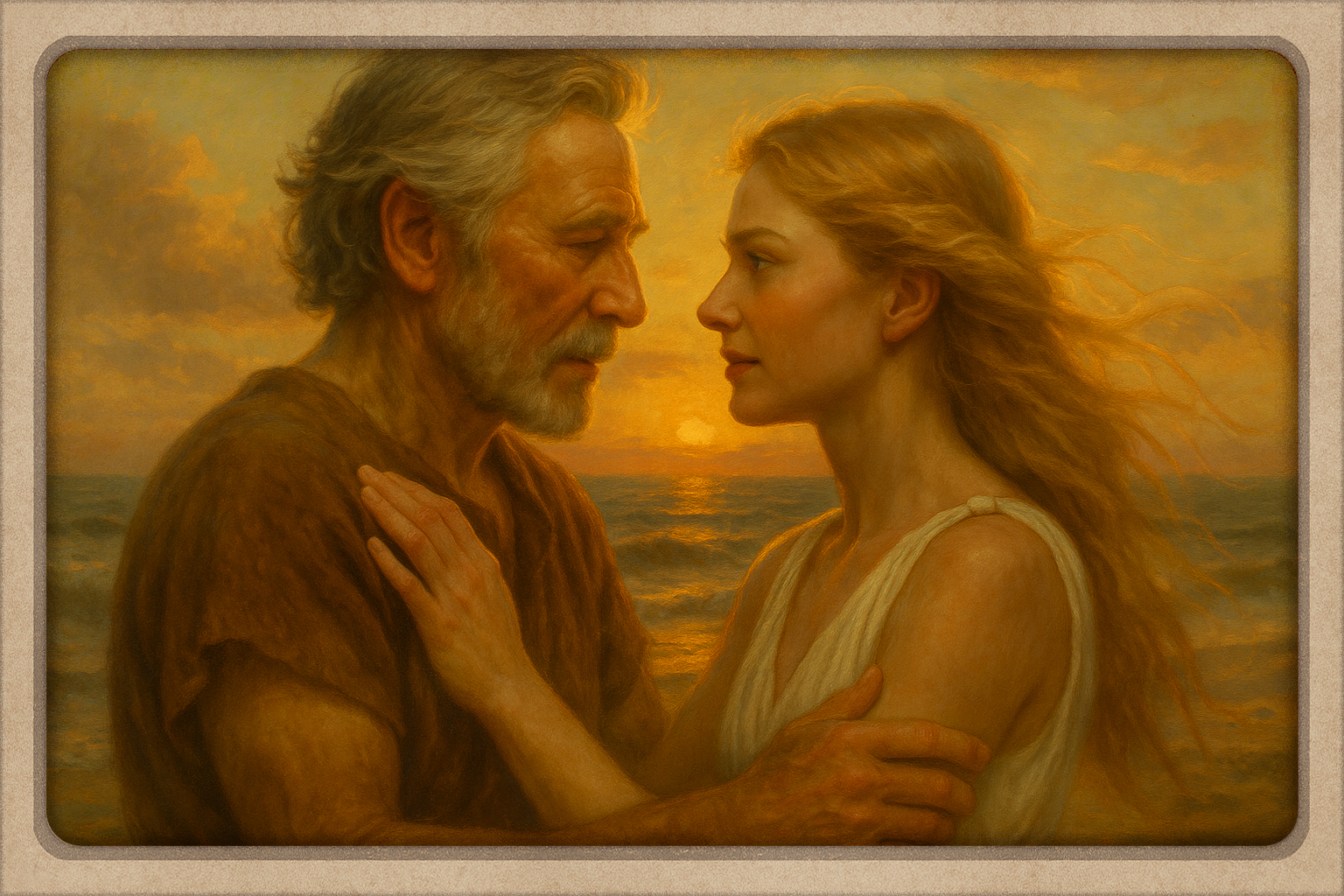
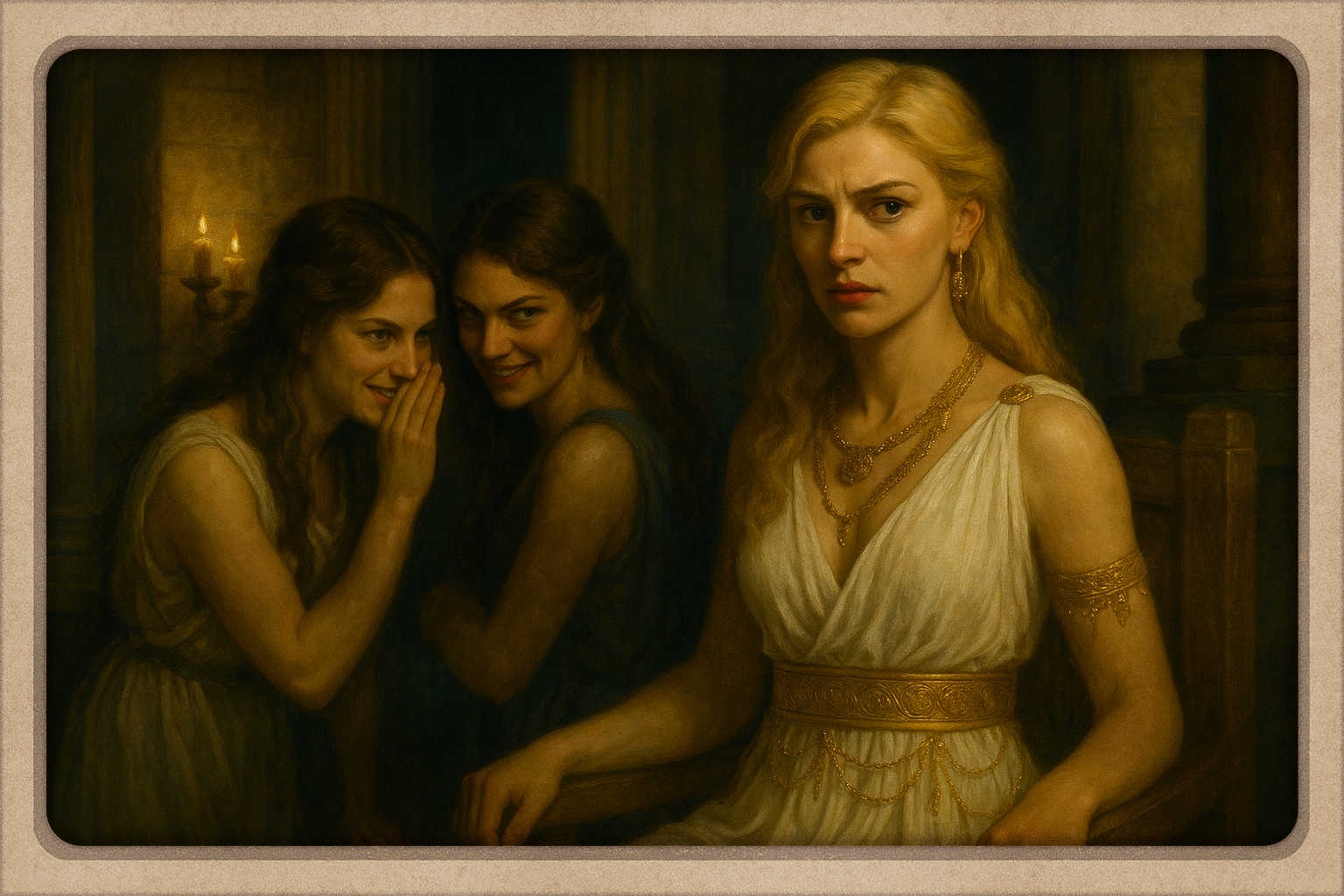
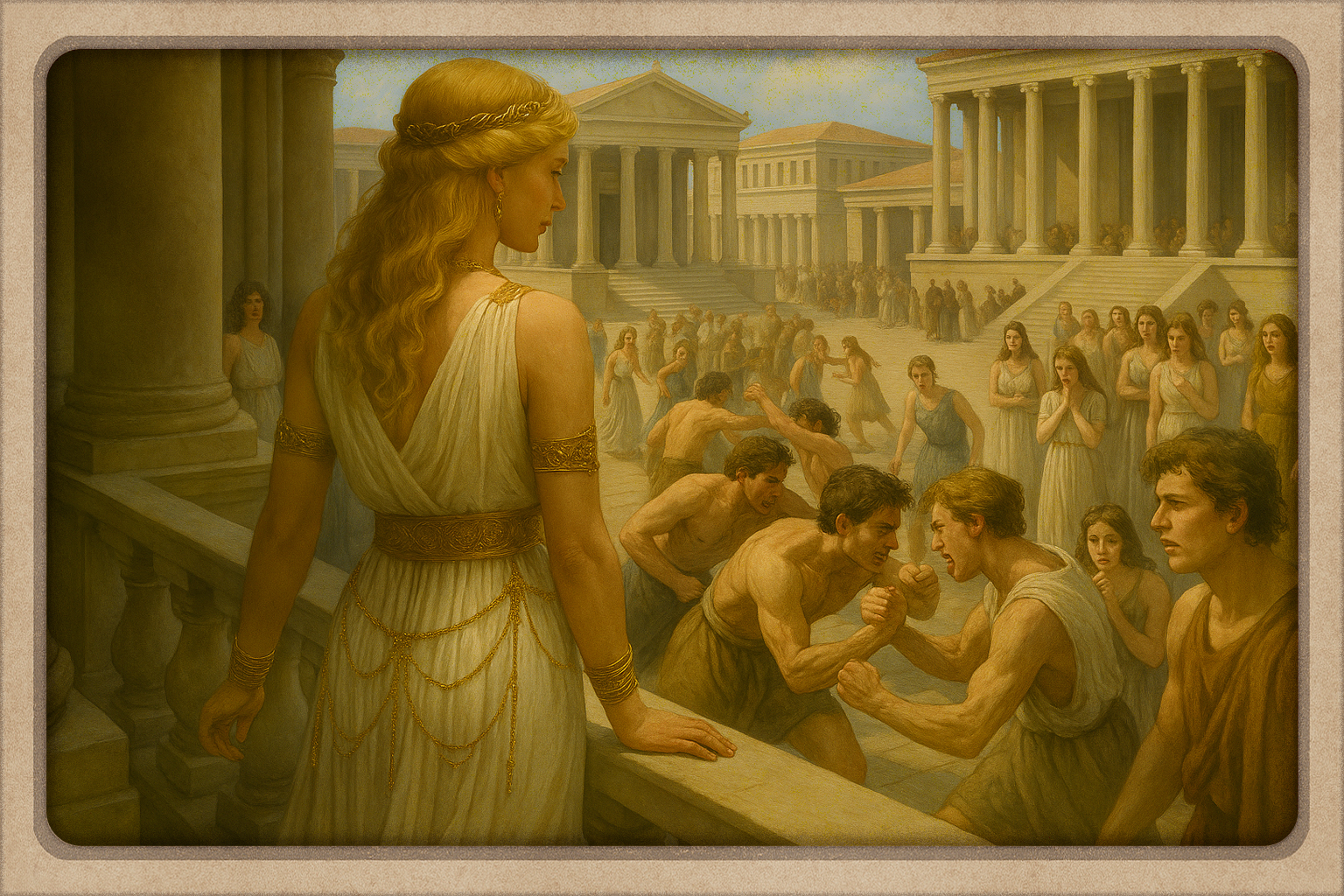
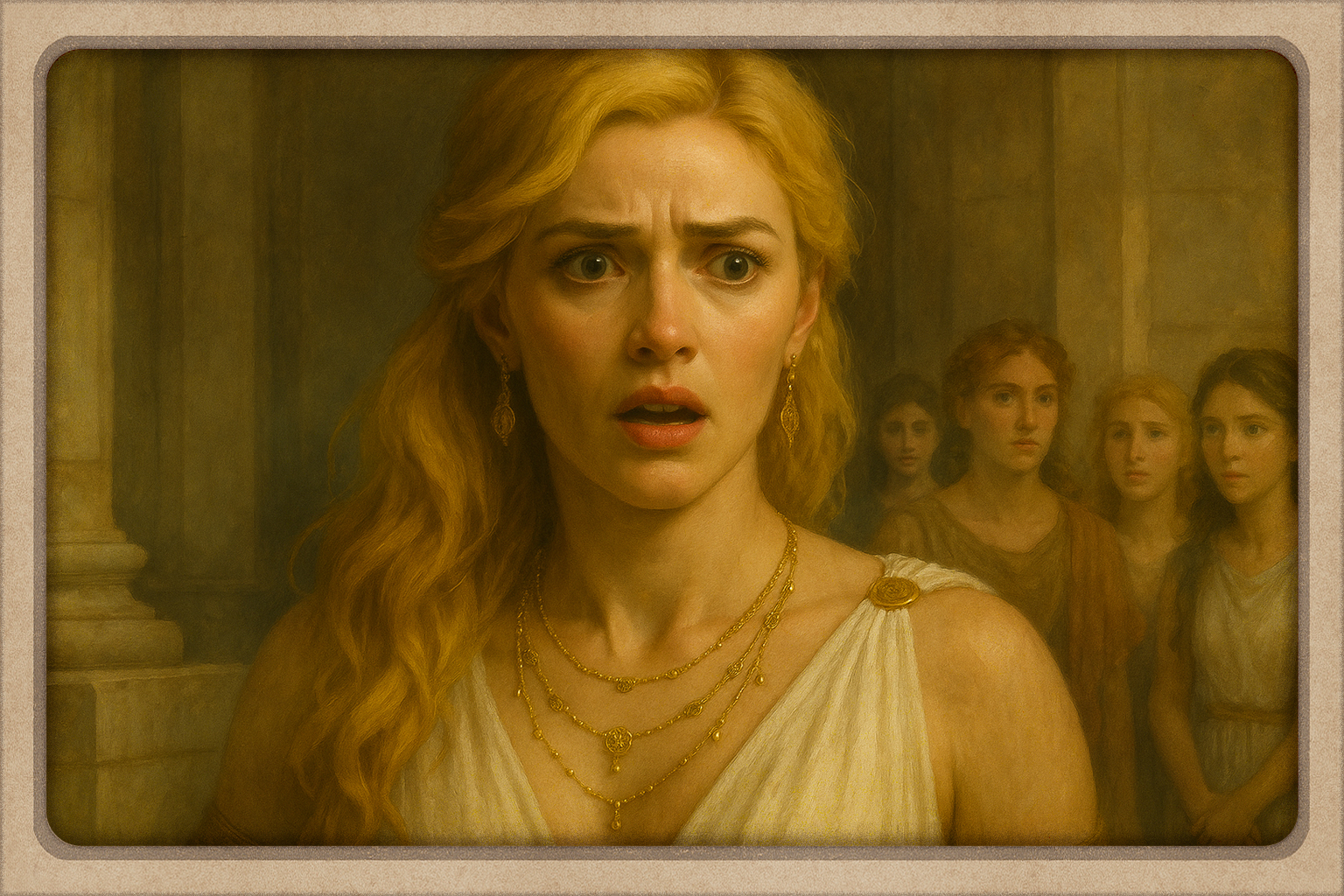
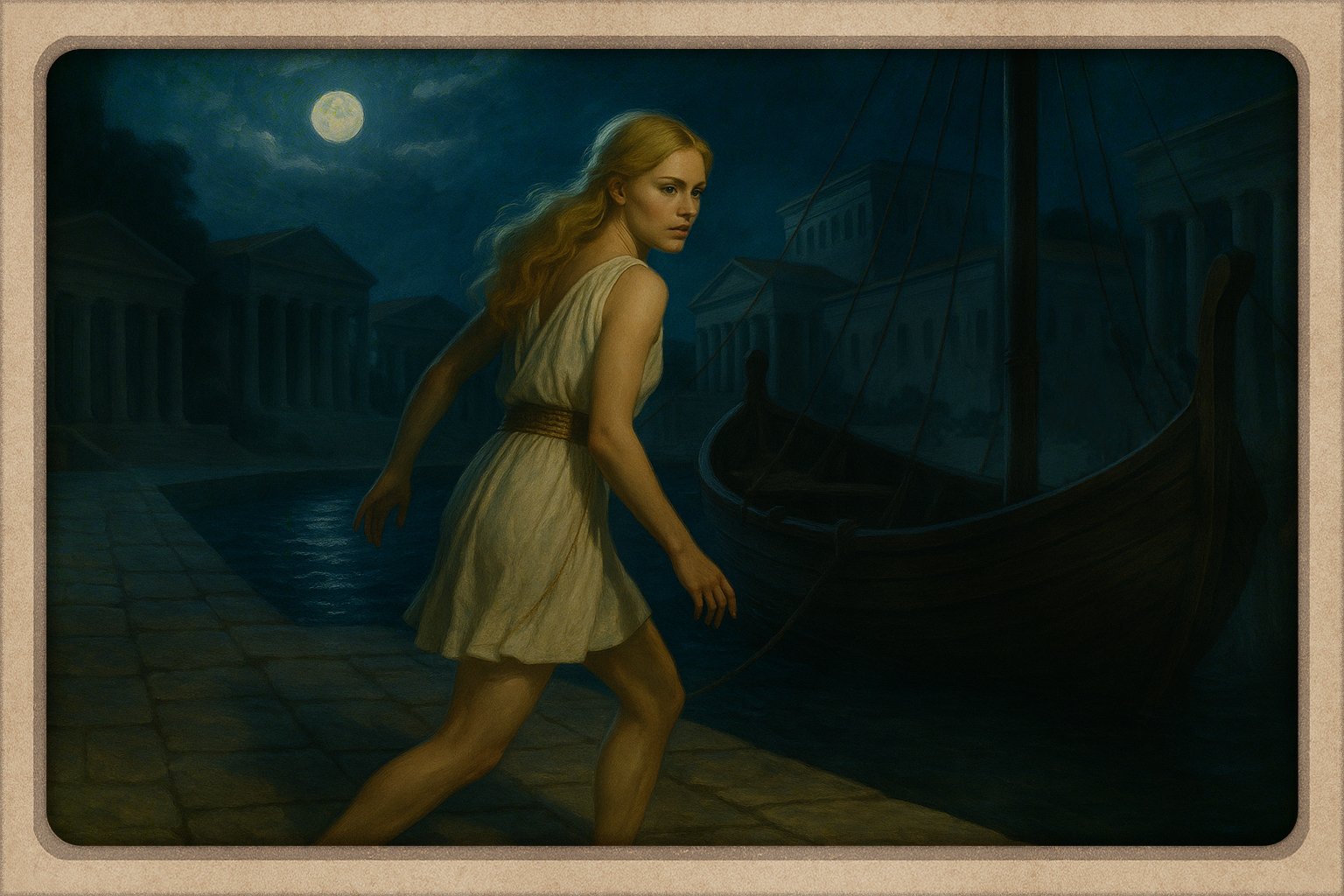
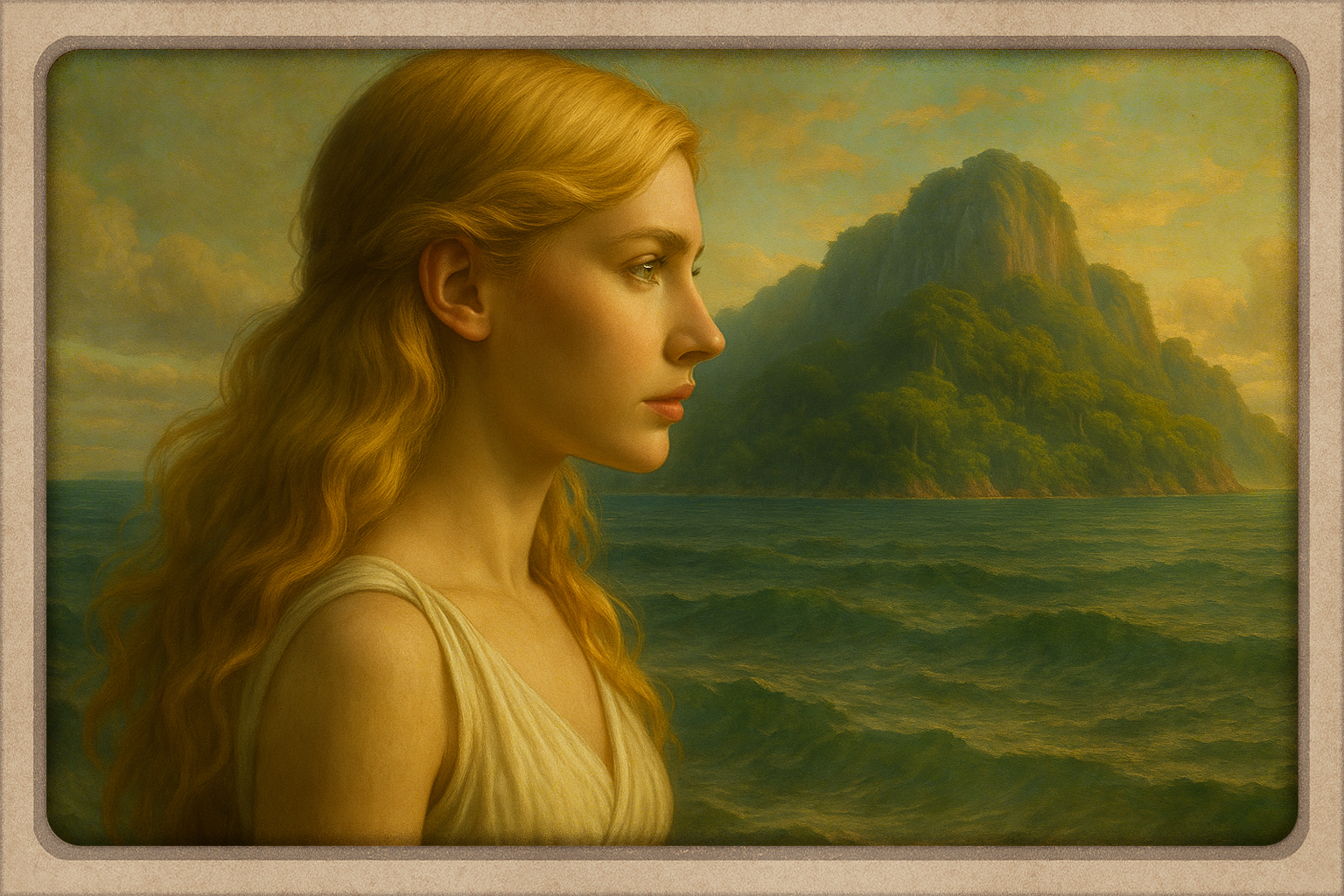
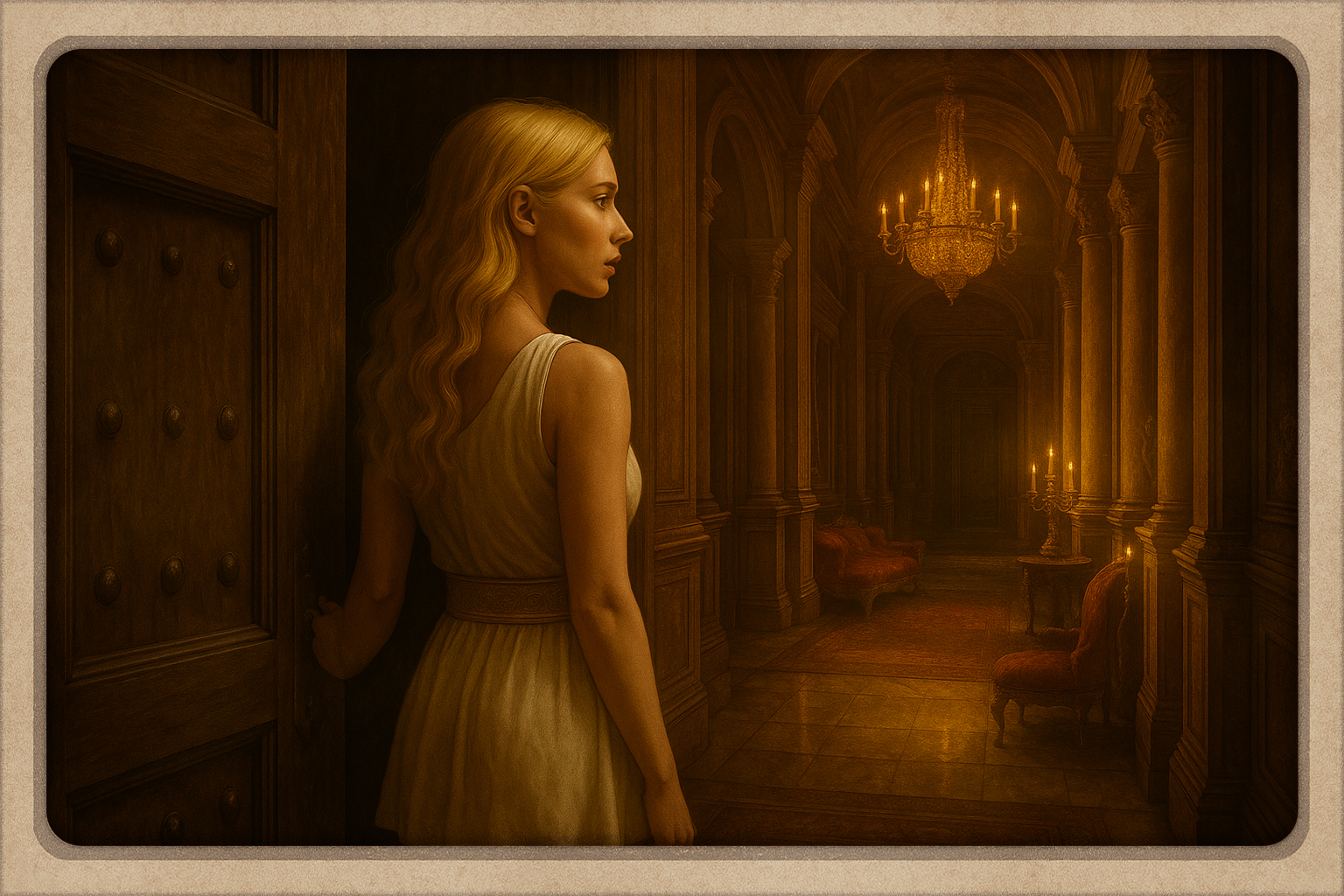
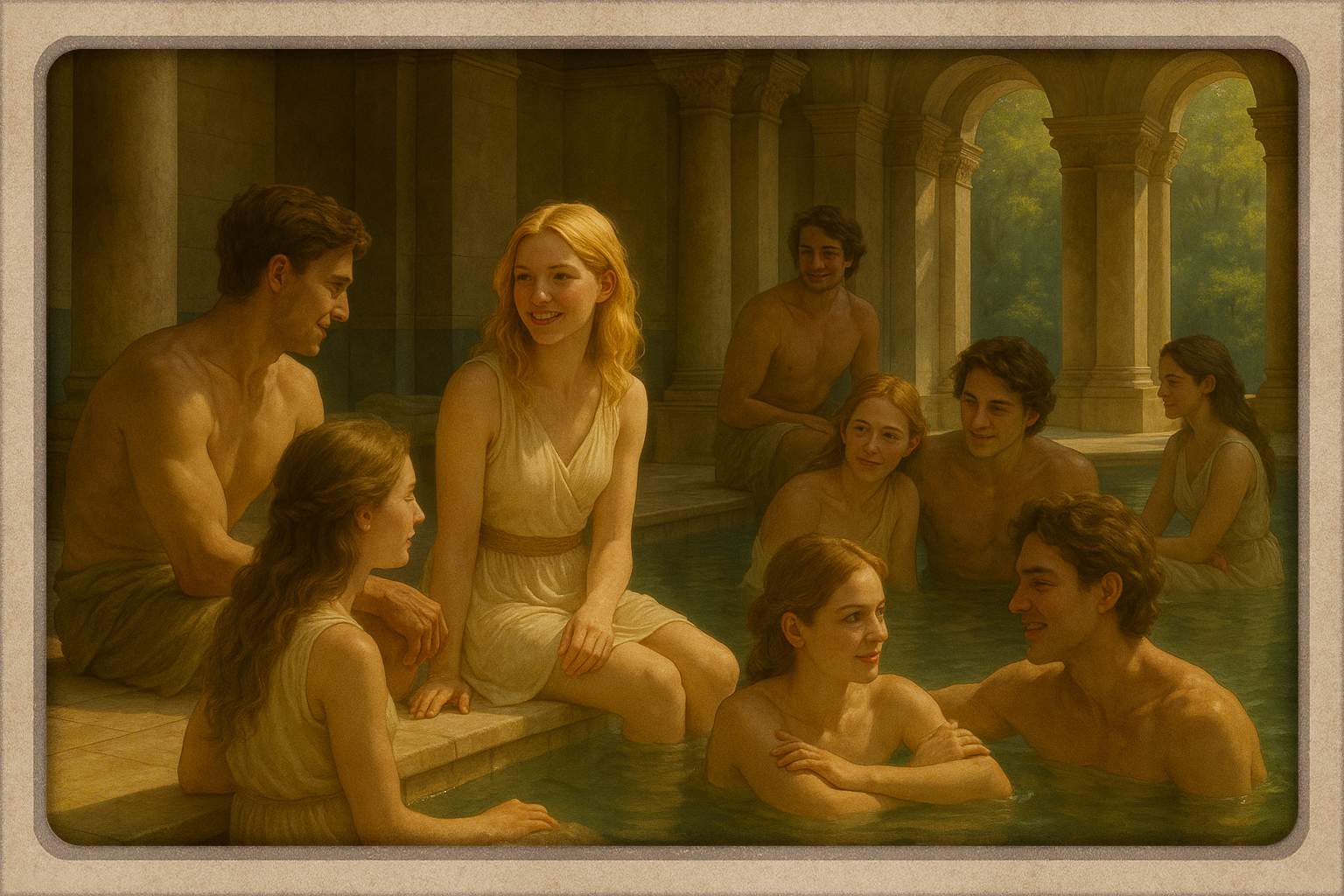
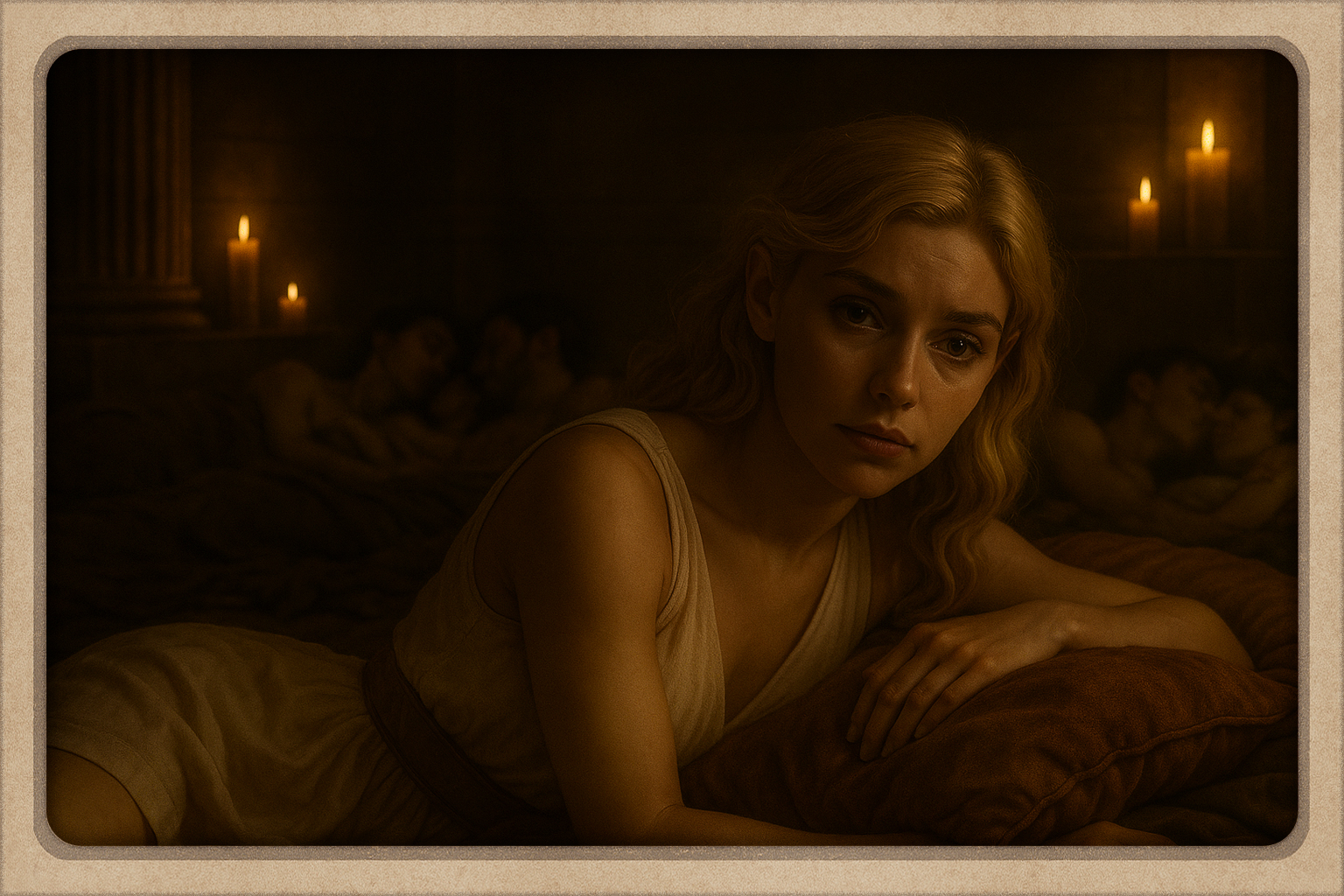
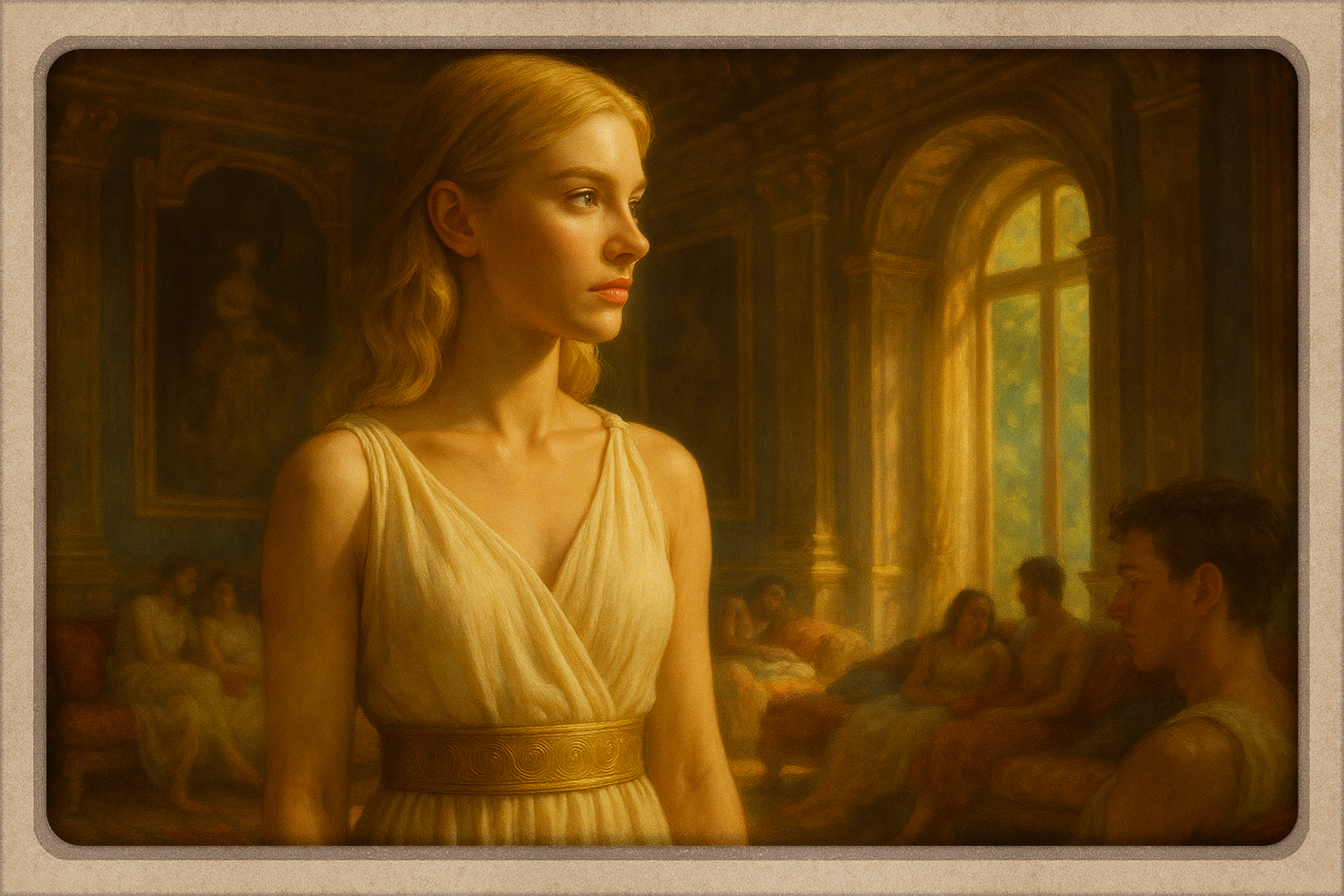
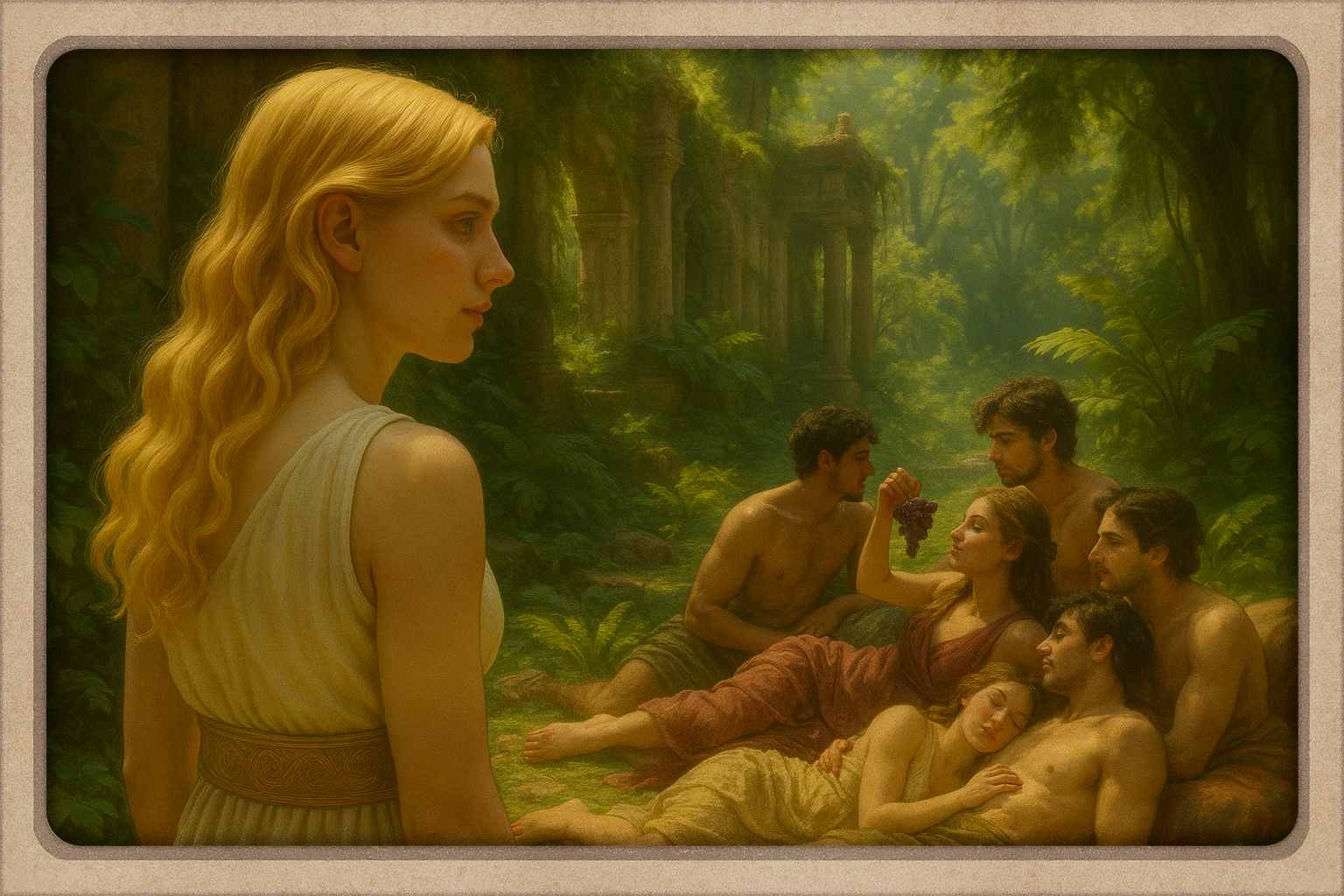
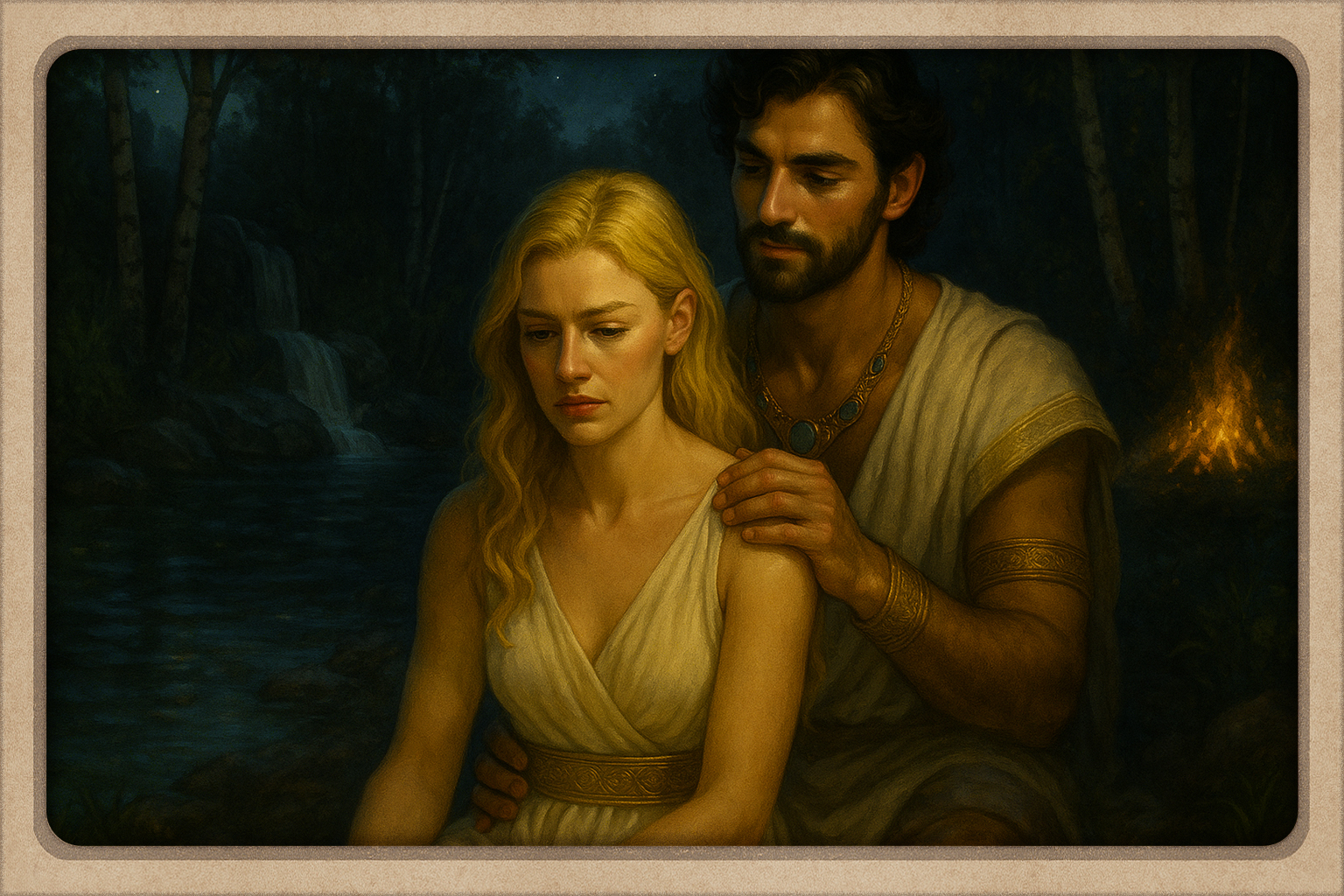
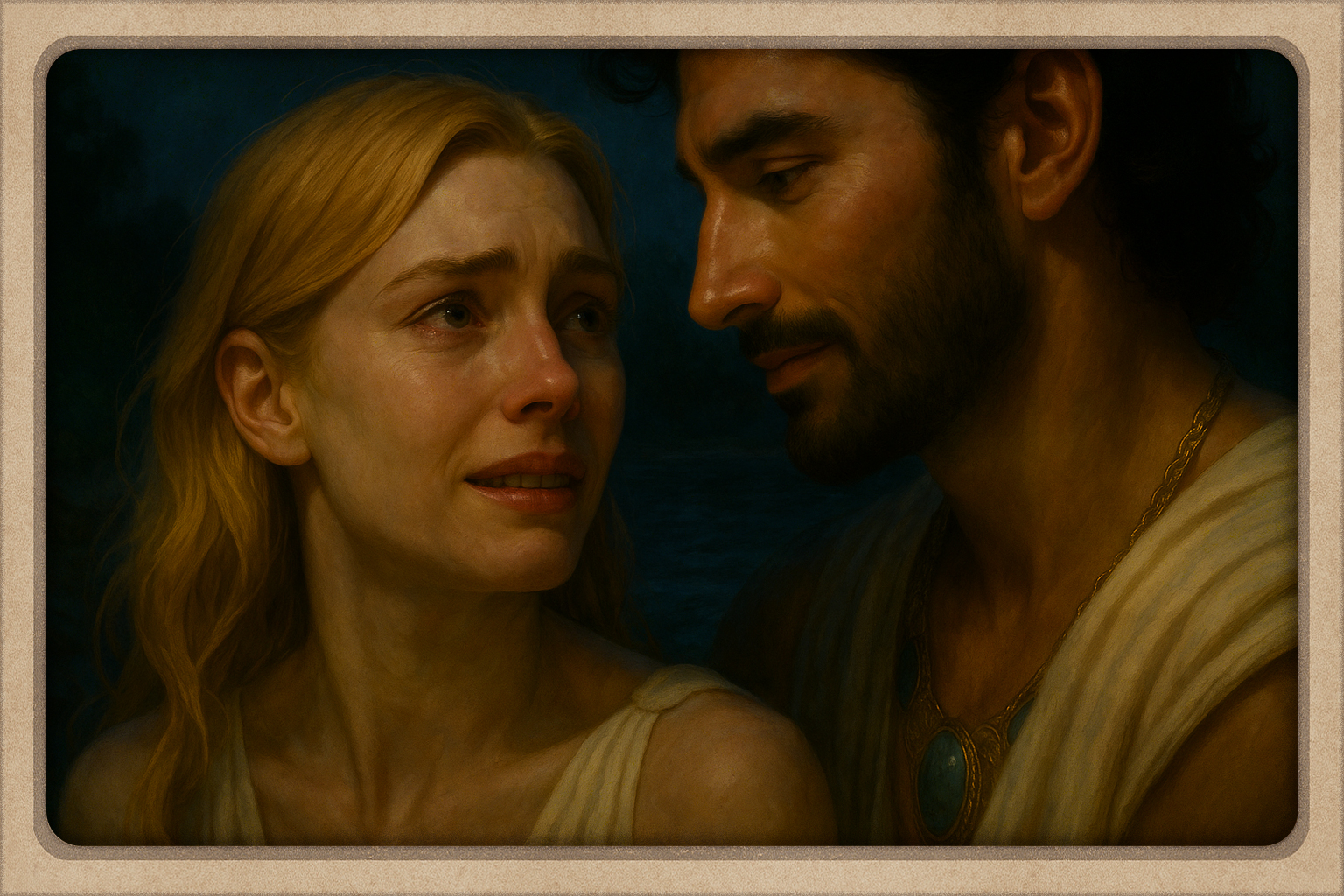
Upon a distant island, hidden from the eyes of mortals, dwelt the Eleven Gods beneath their stern father, Aetherion. He, the Stormbringer, spoke in thunder and ruled in lightning, his will unbending as iron. None among the divine dared to defy him. But Aetherion’s gaze had fallen upon Erosia, whose very presence kindled both desire and doom.
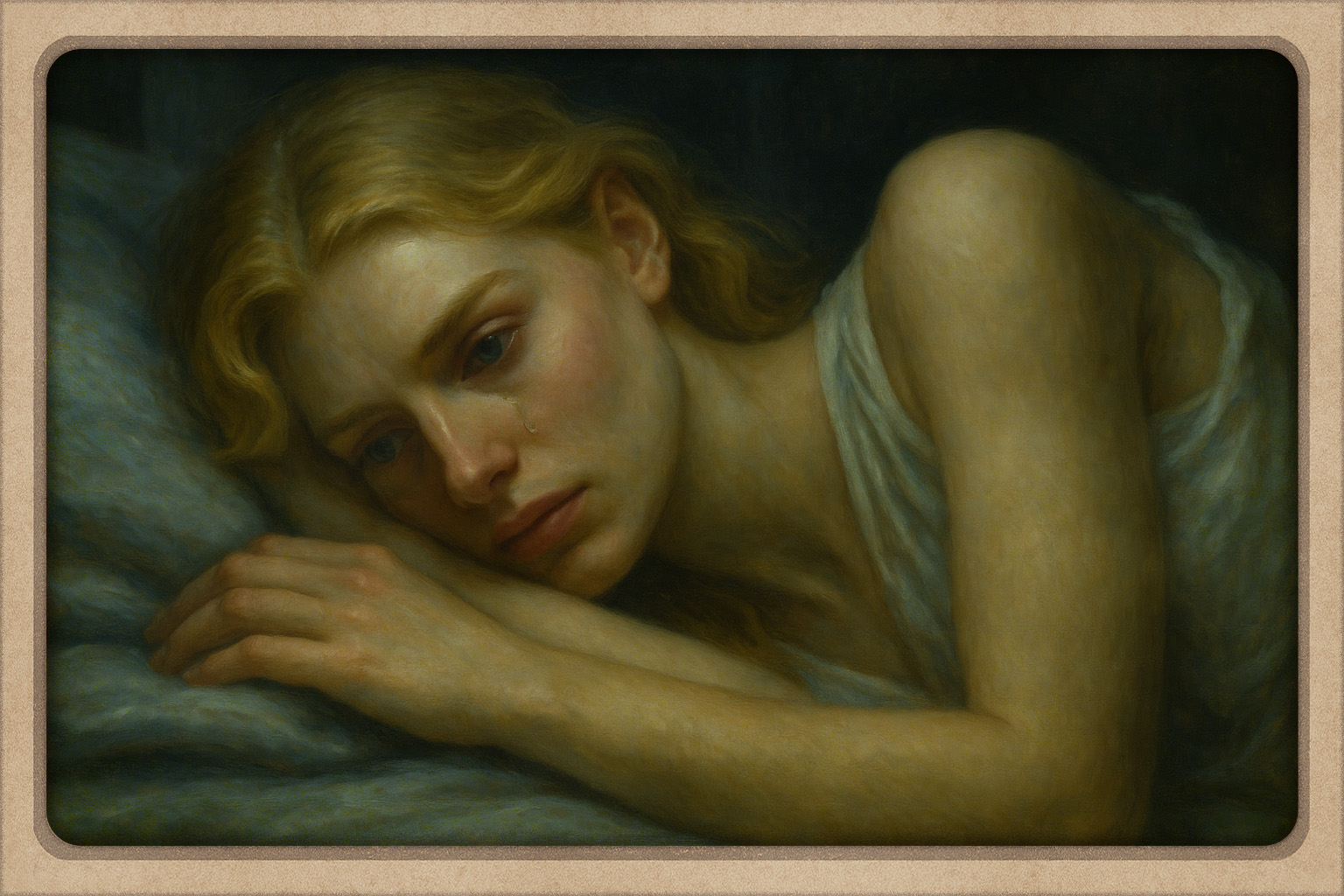
Erosia, goddess of love and all tender desire, wandered the sunlit shores where the foam played at her feet. The sea was her only friend, whispering of lands unseen and freedoms unknown. Though her laughter once filled the heavens, sorrow had taken root in her heart — for the island of the gods had become her golden prison.
Each dawn fed the fire within Aetherion, and with every storm his longing grew more fierce. The thunder that once obeyed his will now echoed the turmoil of his desire. In every flash of lightning he saw her form, in every gust of wind he felt her breath. The lord of storms, unshaken by ages, trembled. Erosia had become the tempest within his immortal flesh.
From the heights of his marble hall, Aetherion summoned Erosia to stand before his throne. The air trembled with power as their eyes met—his ablaze with hunger, hers clouded with dread. Around them, the torches flickered like frightened hearts. Leaning close, the Stormbringer’s voice fell to a whisper, heavy as thunder yet soft as sin: “I want you.”
In the shadow of his throne, Erosia’s light was abused and violated. The Stormbringer’s desire chained her where no chains were seen, and her spirit sank beneath the weight of his power. When night fell over the island, her tears mingled with the sea breeze, unseen by all but the stars. Thus was born her sorrow — and within it, the first spark of defiance.
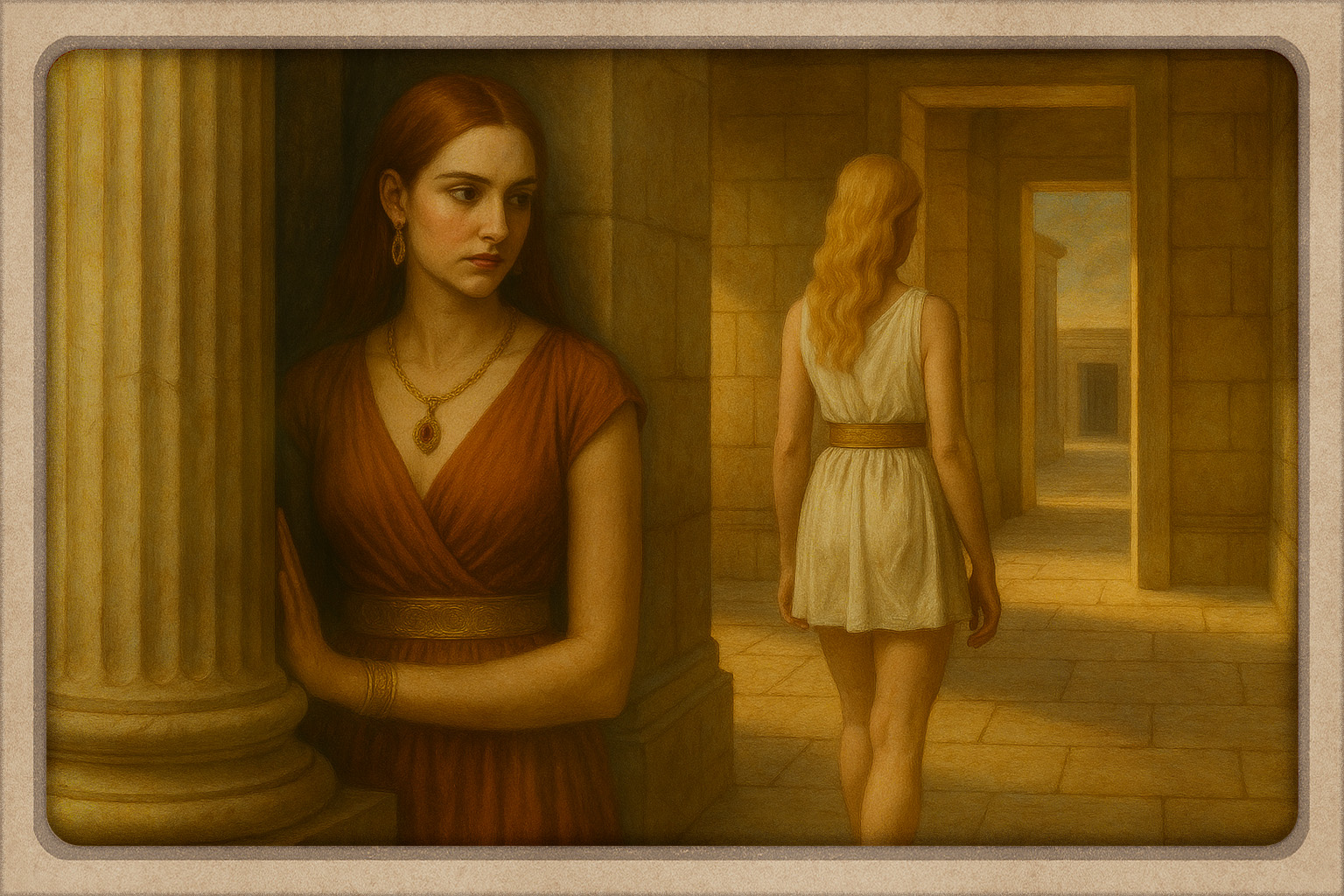
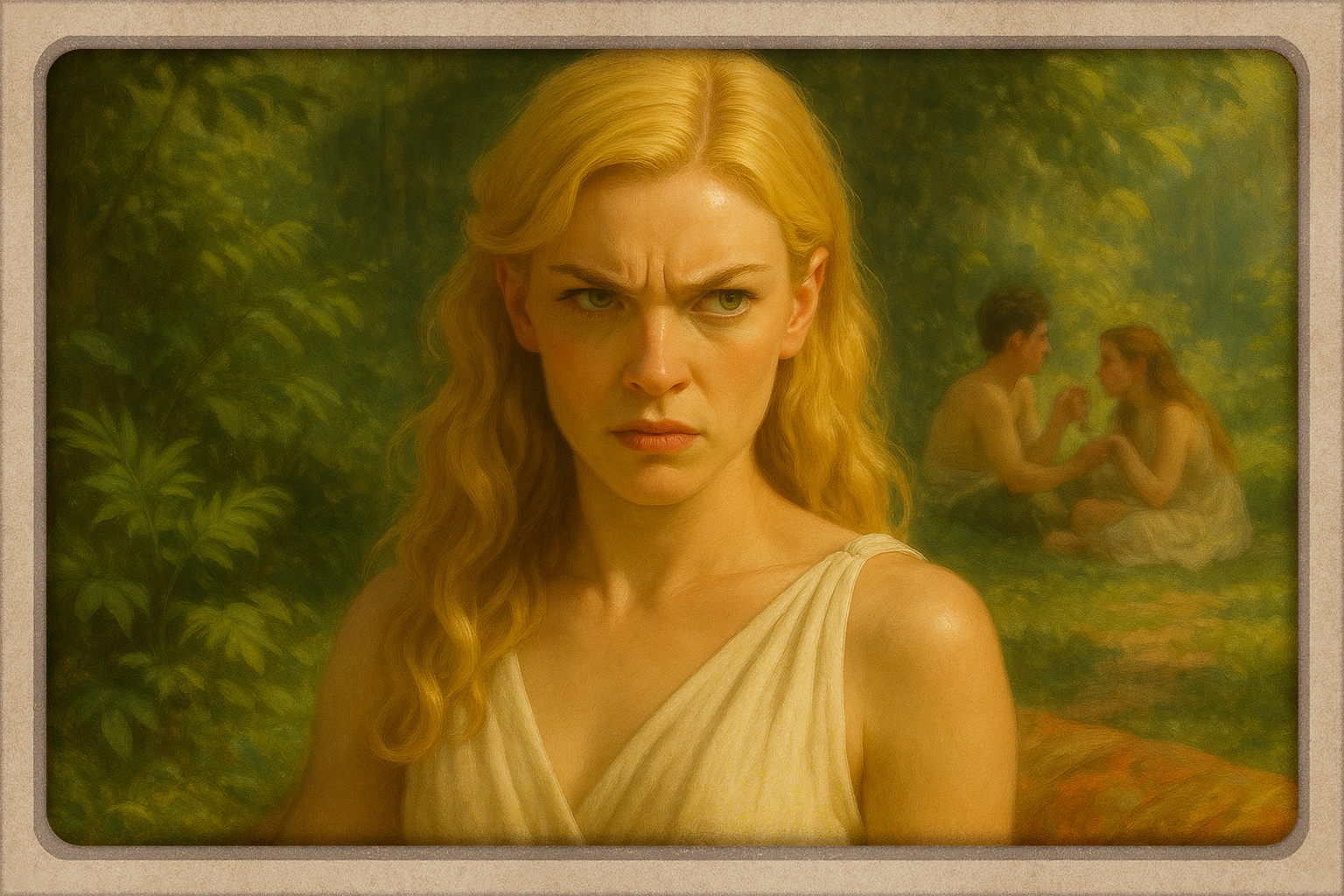
As Erosia left the temple, her steps heavy with shame and wrath. From the shadows of a marble colonnade, Regalia, Aetherion‘s wife, watched in silence. The queen’s gaze was cold and knowing — for she had seen this sorrow before. In that moment, jealousy took root beside vengeance, and the fire in her heart burned brighter than Aetherion’s storms.
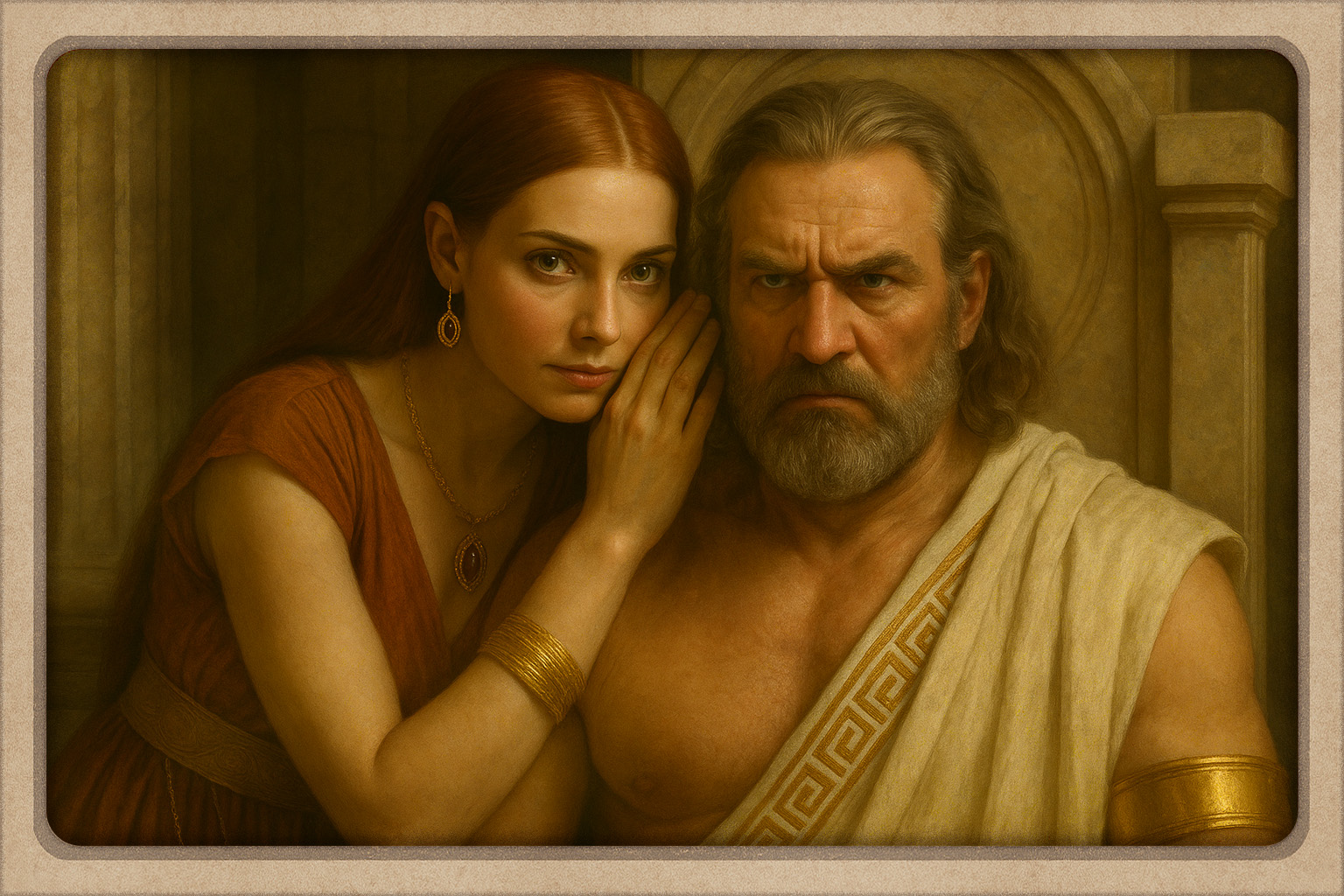
With measured grace, Regalia ascended the steps to Aetherion’s throne, her beauty veiled in cunning calm. She spoke with a voice smooth as silk and sharp as venom, telling him that Erosia had mocked his prowess, laughing behind his back. The Stormbringer’s pride cracked like thunder in the sky. In that shattering moment, Regalia’s poison found its mark.
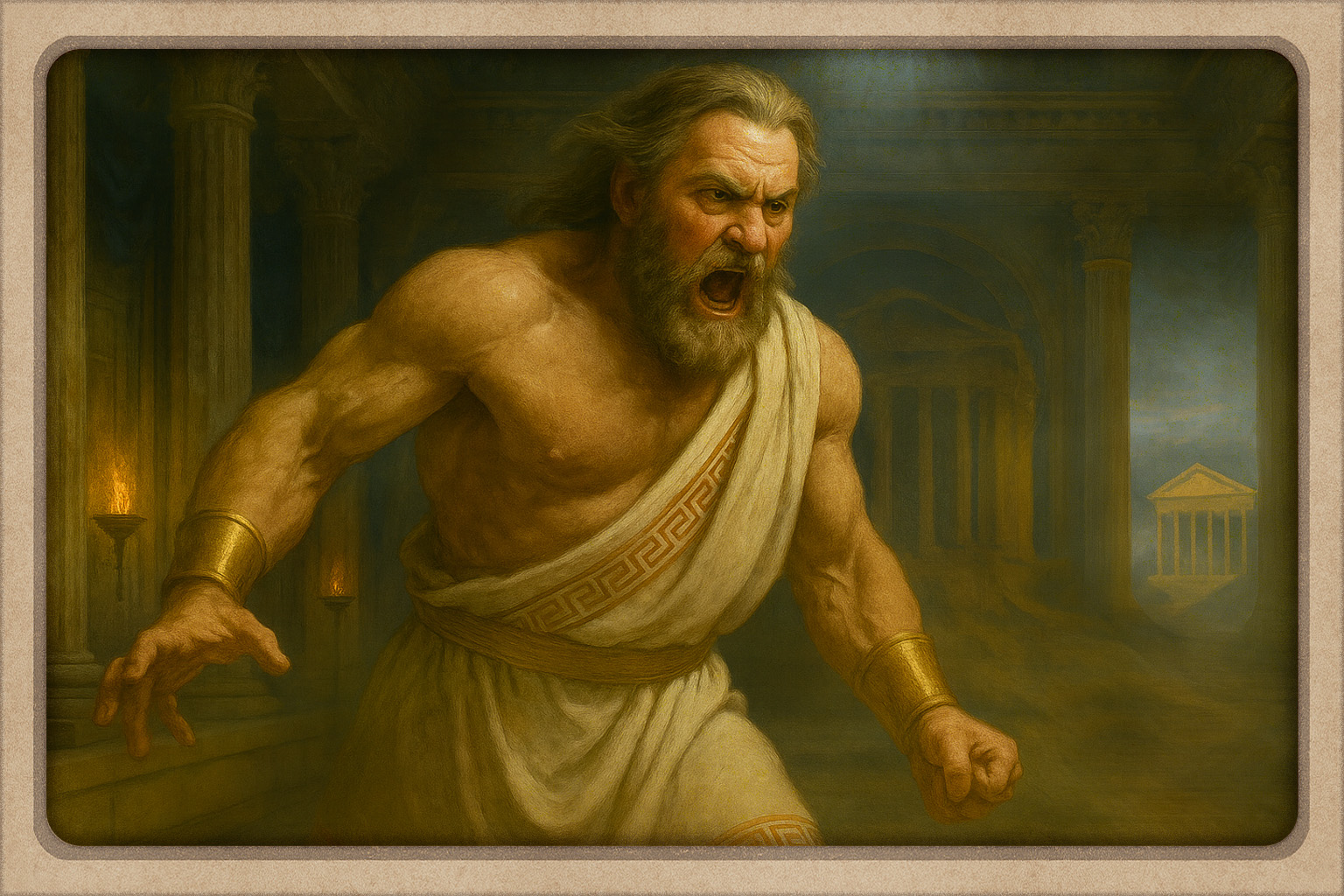
Fury consumed Aetherion like fire within a storm. His voice roared through the temple halls, shaking marble and sky alike. He cursed Erosia’s name, vowing to crush her defiance and shatter her insolent spirit. The heavens darkened at his oath, and thunder answered — for when the father of storms swears vengeance, even the gods tremble.
From that day forth, Erosia’s life among the divine became torment. The halls that once echoed with laughter now whispered her name in scorn. Aetherion’s wrath and Regalia’s venomous lies spread like storm clouds, turning friend to foe. One by one, the gods withdrew their grace, until even the sunlight seemed to shun her face.
Despair consumed Erosia, her heart heavy with the weight of divine cruelty. The island that once gleamed like paradise had become her prison of envy and pain. No song of love left her lips, no joy stirred her soul — only the burning wish to flee. She longed to escape the gods’ grasp, to cast off the chains of jealousy and sorrow, and vanish beyond the endless sea.
In her anguish, Erosia sought out Forgeon, the gentle god of craft and flame. Beneath the glow of his forge she spoke of her dream — to soar beyond the island’s edge and never return. Forgeon warned her of the storms, of Aetherion’s fury, and of the dangers that awaited beyond the horizon. Yet even as he spoke, he saw in her gaze a fire stronger than fear.
While Erosia pleaded with Forgeon, a shadow lingered beyond the forge’s glow. Regalia, hidden and silent, listened to every word. Her eyes gleamed with cruel delight as she learned of Erosia’s daring plan to defy the Stormbringer. Already her mind wove deceit, for she would carry this secret to Aetherion, and turn his wrath once more upon the goddess of love.
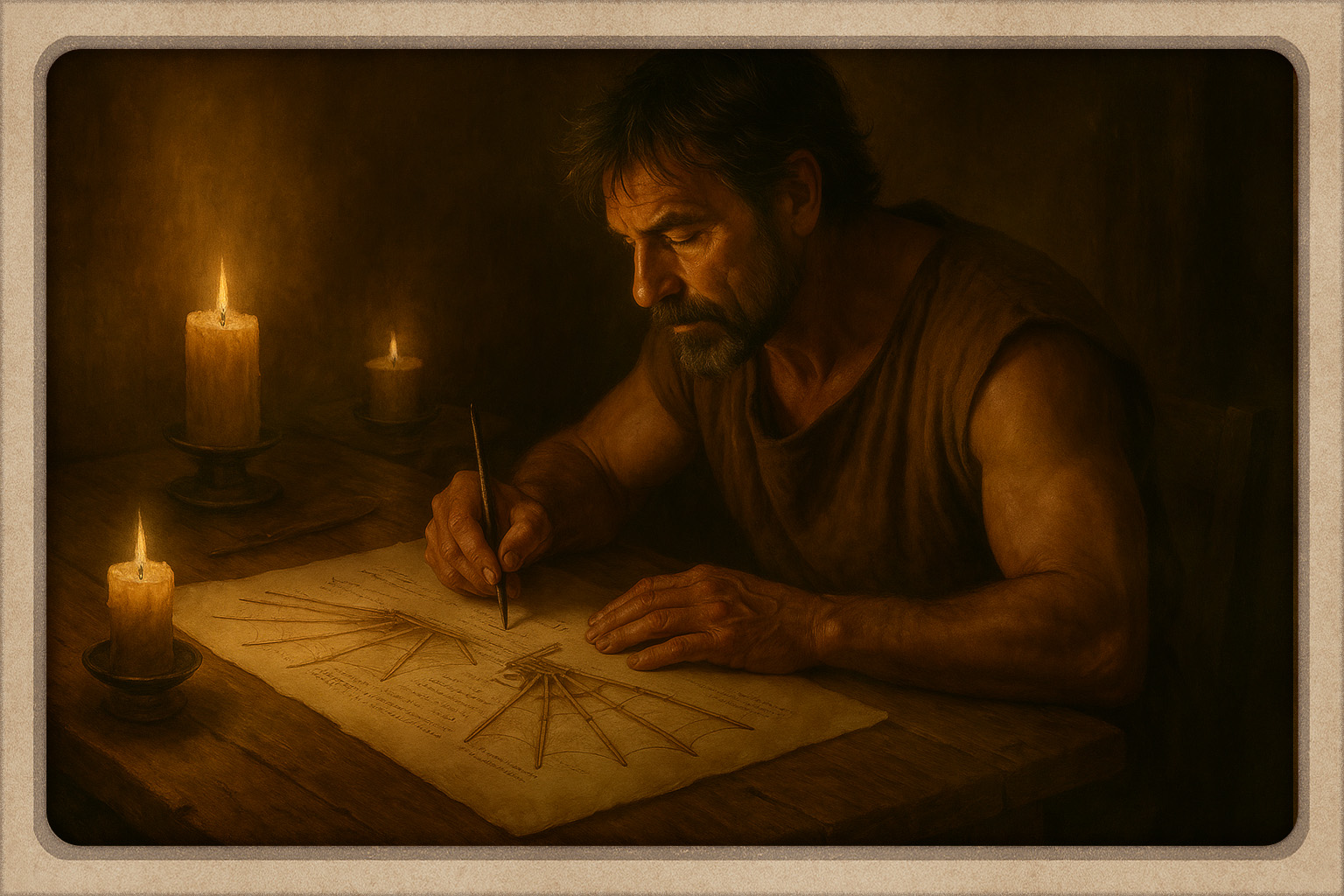
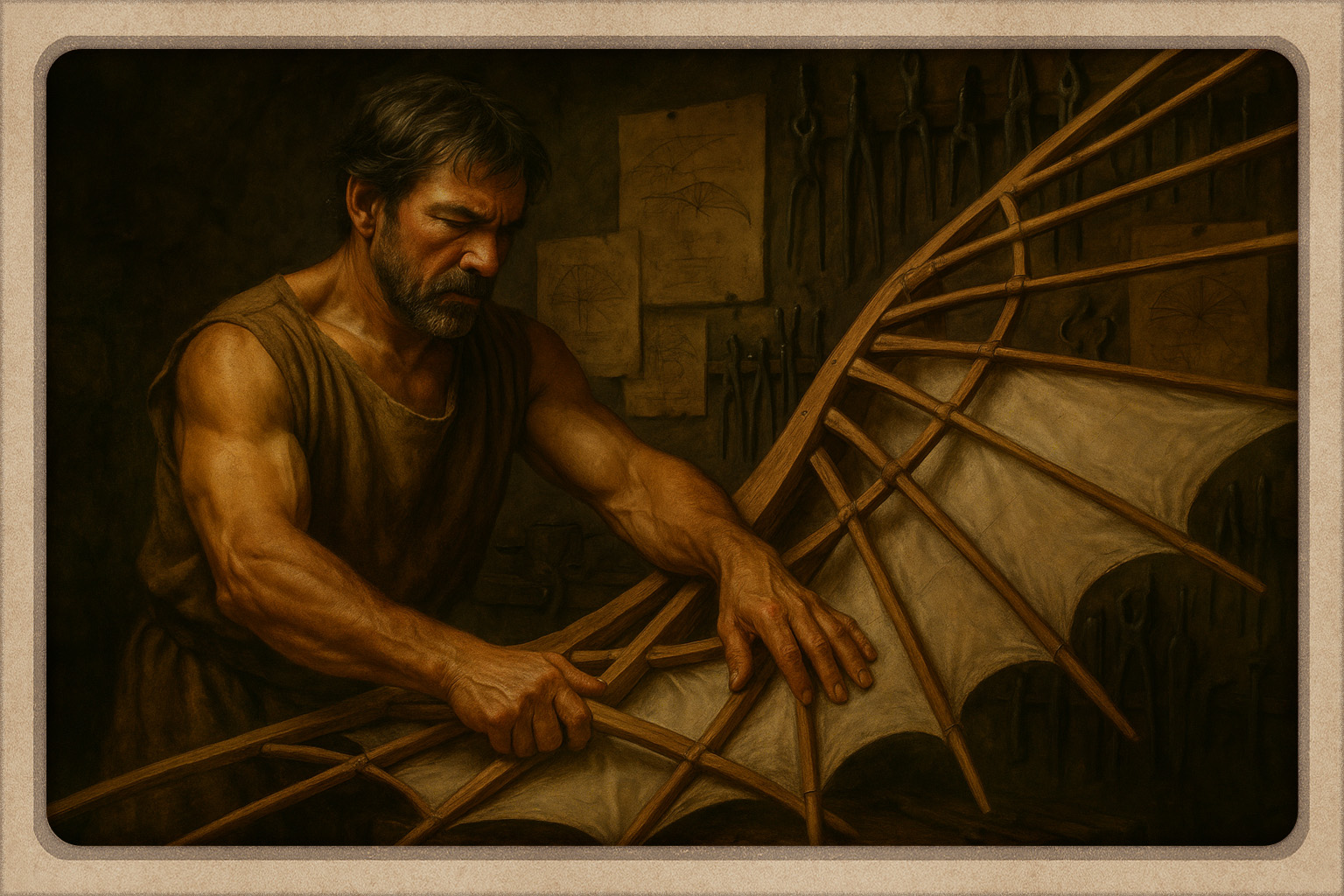
Moved by friendship and pity, Forgeon at last set aside his doubts. In the glow of his eternal fire, he shaped wings of wonder — crafted from wood, canvas, and the breath of dawn. For Erosia, he forged not weapons, but a path to freedom. As the sparks rose into the night, he whispered a prayer that the winds might bear Erosia far from the cage of the gods.
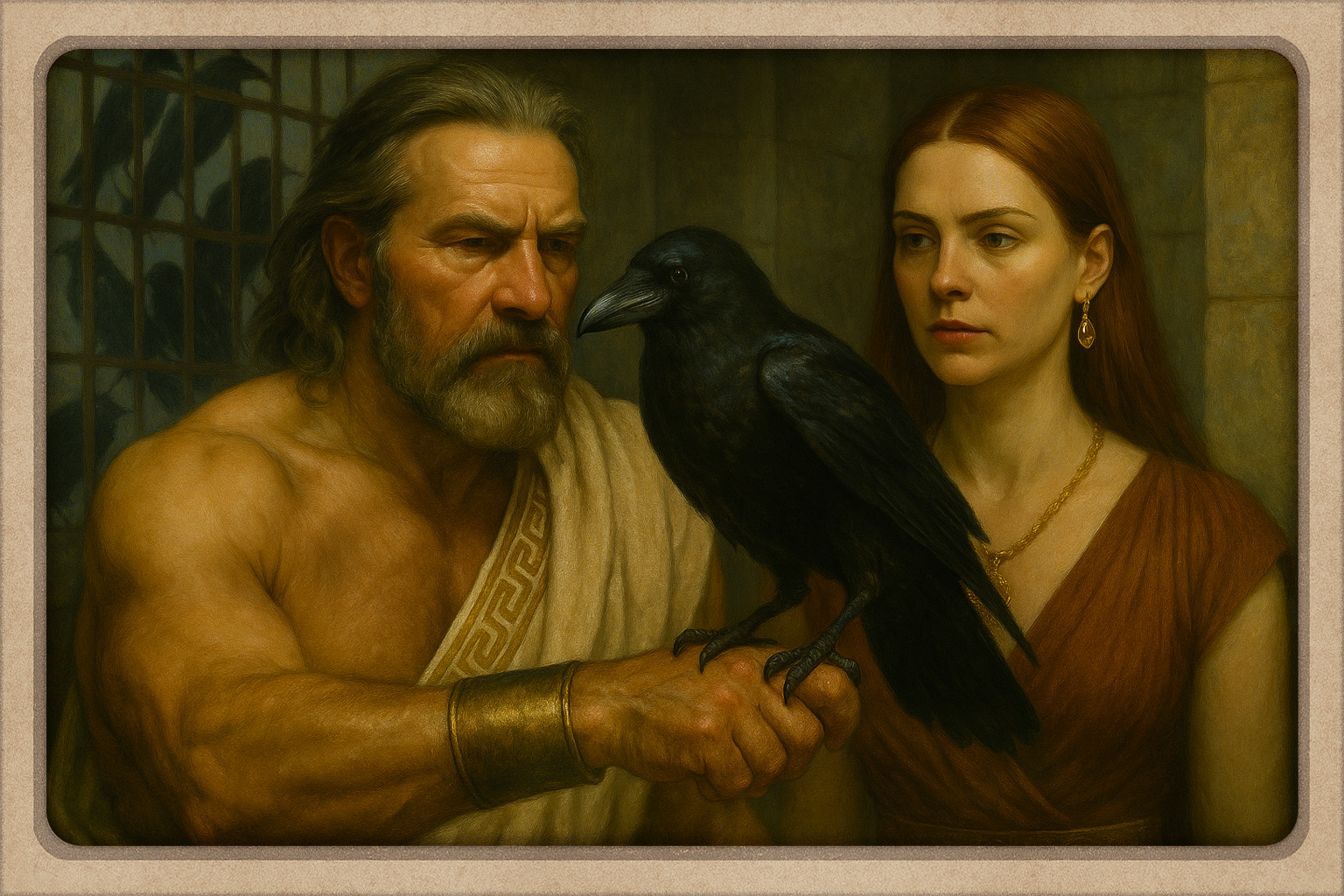
With venom sweet upon her tongue, Regalia revealed to Aetherion the secret of Erosia’s flight. Rage darkened the sky as the Stormbringer listened. Together they went to the aviary of ravens, the messengers of doom, and whispered their cruel design. The black wings stirred in the shadows, awaiting their master’s command to hunt the goddess.
Forgeon labored by the forge, his hammer singing with divine purpose. He shaped the wings to be light as breath, yet strong enough to brave the fury of the heavens. Every inch he formed with care, binding wood to will, canvas to mercy. When his work neared its end those were no mere wings, but the promise of Erosia’s deliverance.
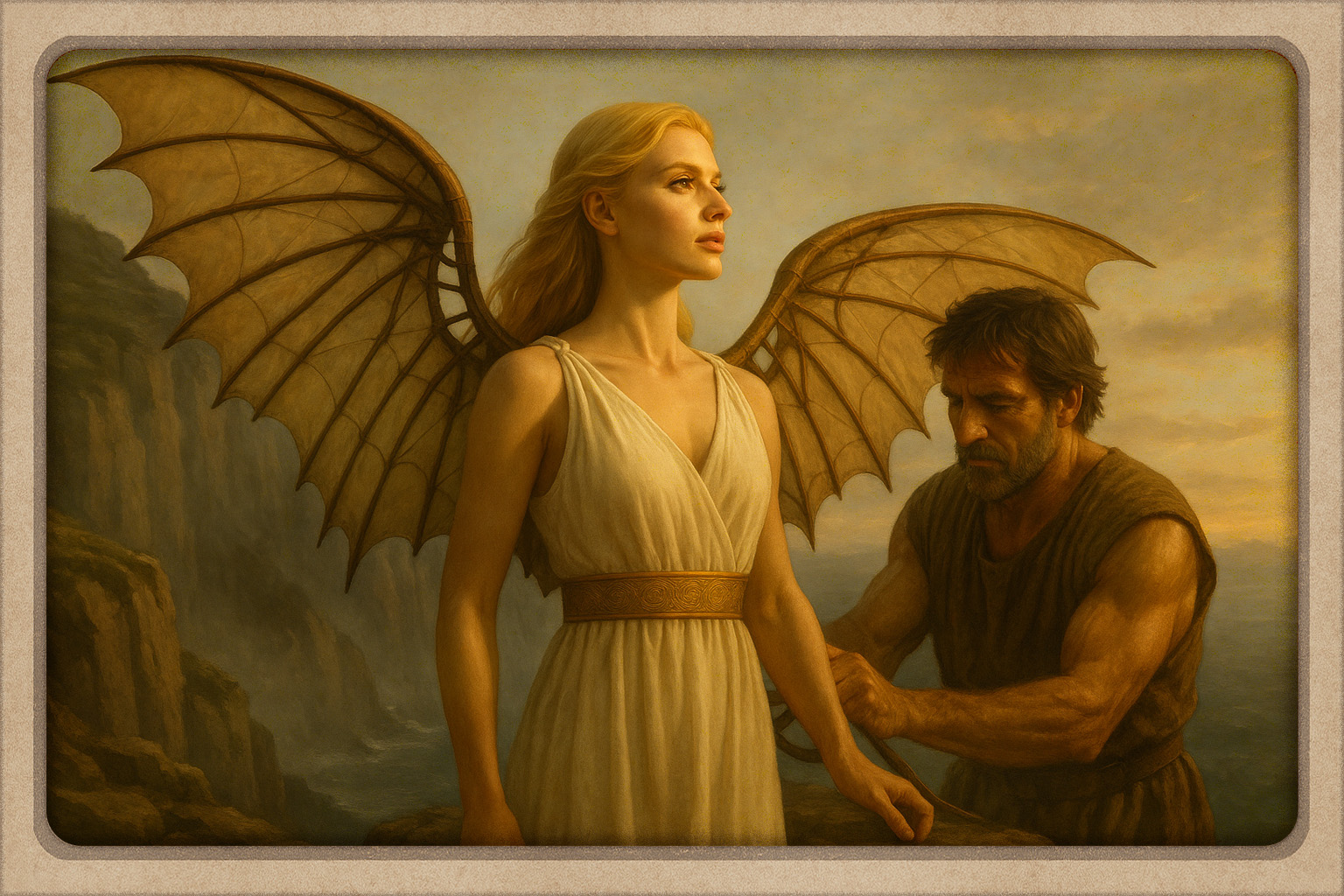
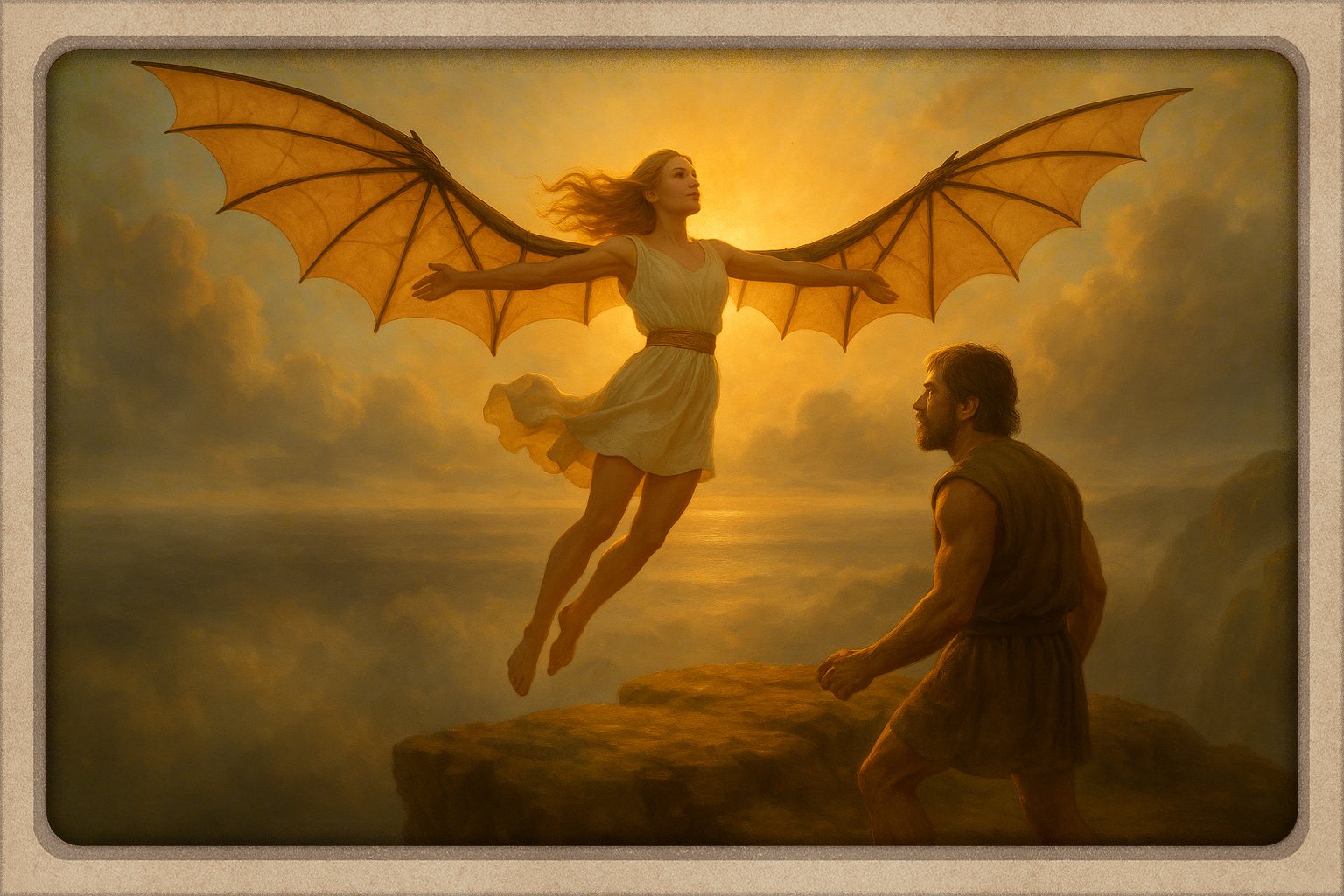
At dawn, Forgeon led Erosia to the edge of a towering cliff, where sea and sky embraced in mist and light. With steady hands he fastened the golden wings upon her back, each clasp a silent prayer. Still he begged her to stay, fearing the wrath of Aetherion and the perils beyond. But Erosia’s eyes burned with resolve. She would rather die in freedom than live one more day in chains.
With a final breath, Erosia spread her wings and leapt into the open sky. The wind caught her, carrying her upward through the breaking clouds, her golden feathers blazing in the dawn. Below, Forgeon watched in silence, awe and sorrow mingling in his heart. For in that moment, he beheld not a goddess fleeing — but freedom itself, taking flight.
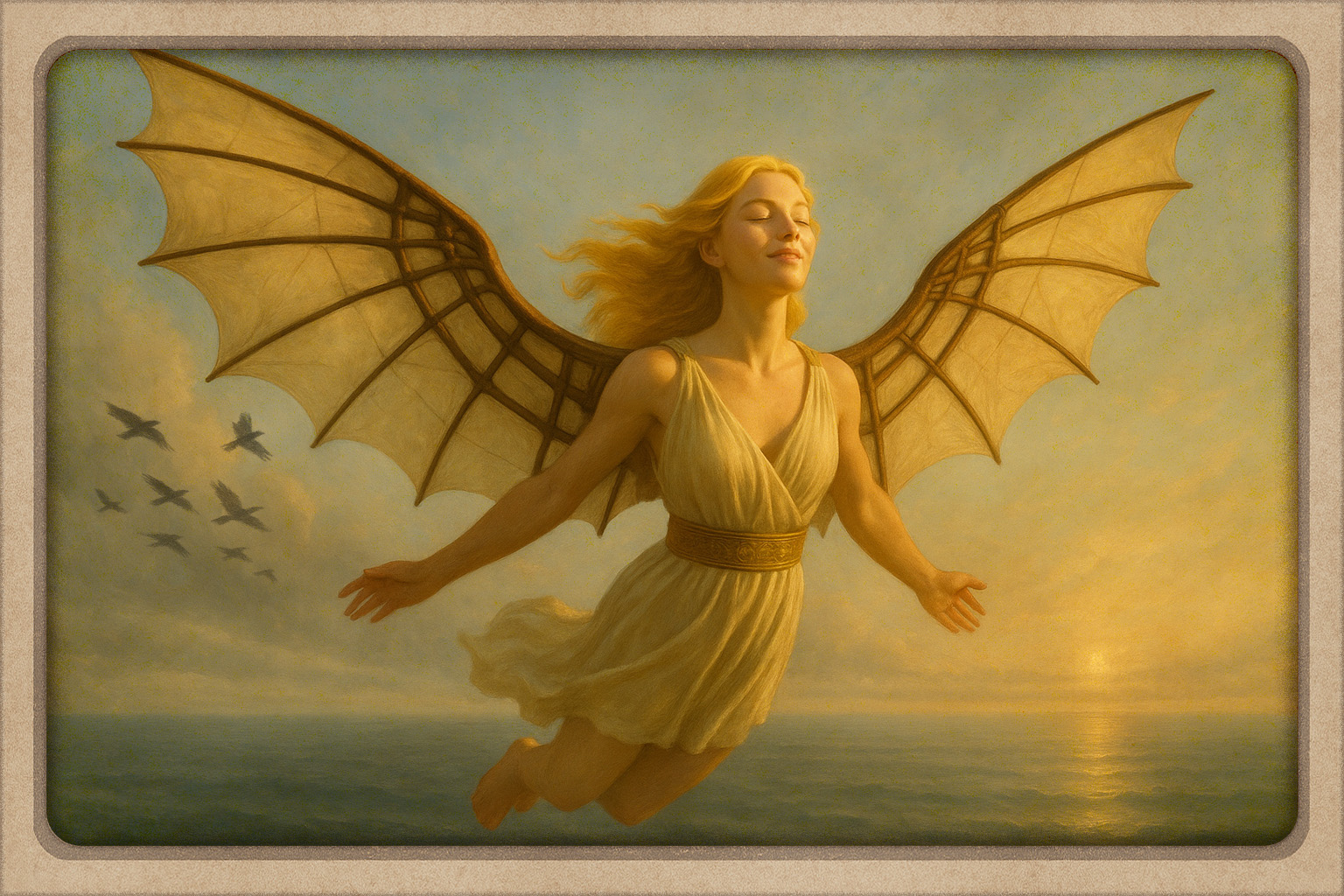
High above the sea, Erosia soared with the wind in her hair and sunlight on her skin. Laughter, long forgotten, rose from her heart — for the first time she felt truly alive. The island of torment faded beneath the clouds, and freedom sang in her veins. Yet far behind, the dark wings of Aetherion’s ravens stirred in silence, the shadows closing in upon the light.
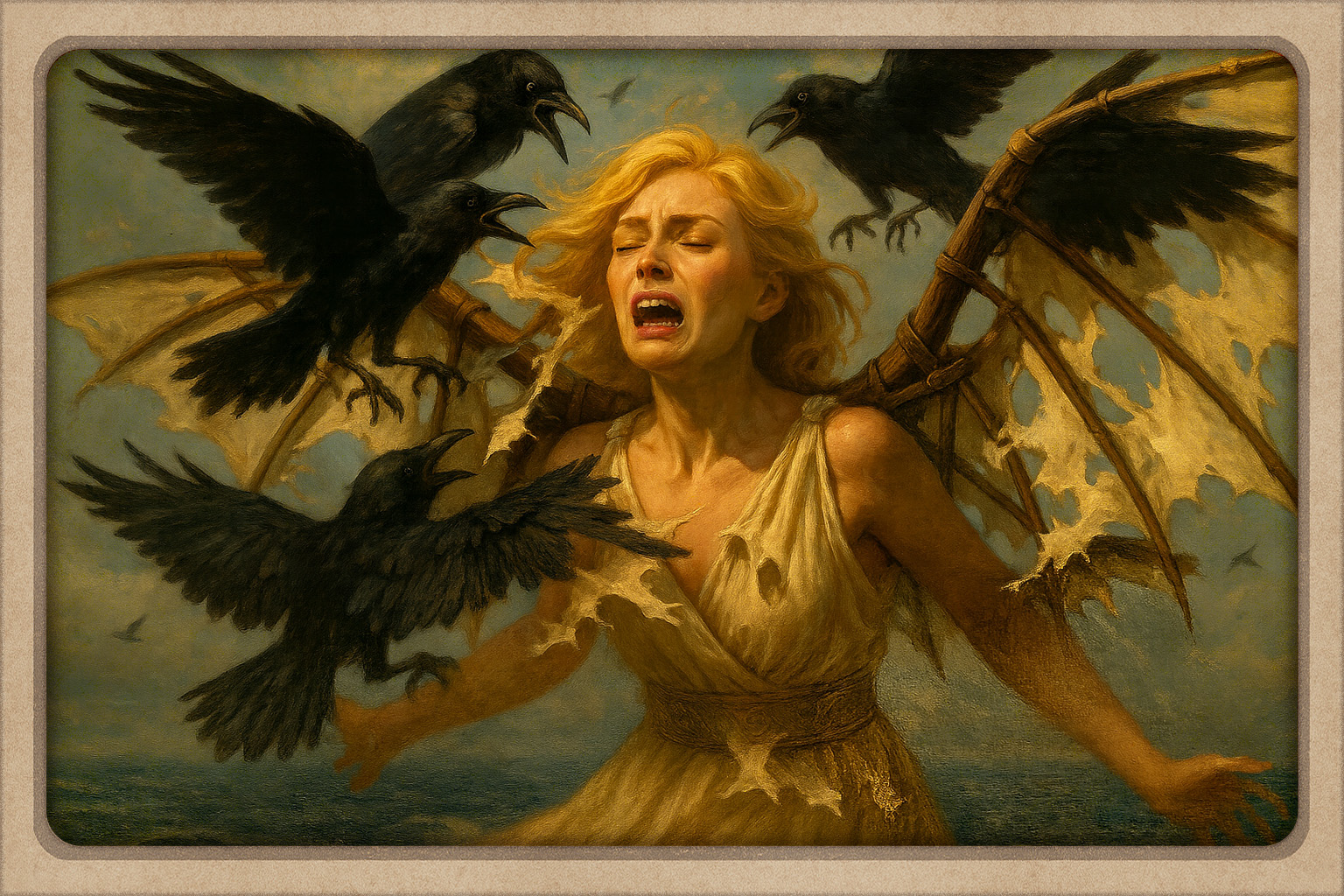
From the storm’s edge, the black ravens descended — a swarm of fury and fate. They struck Erosia’s shining wings, tearing canvas to shreds, their cries echoing Aetherion’s wrath. The sky that had carried her turned against her, and the wind became her enemy. With a cry that split the heavens, the goddess of love was cast down, her freedom shattered.
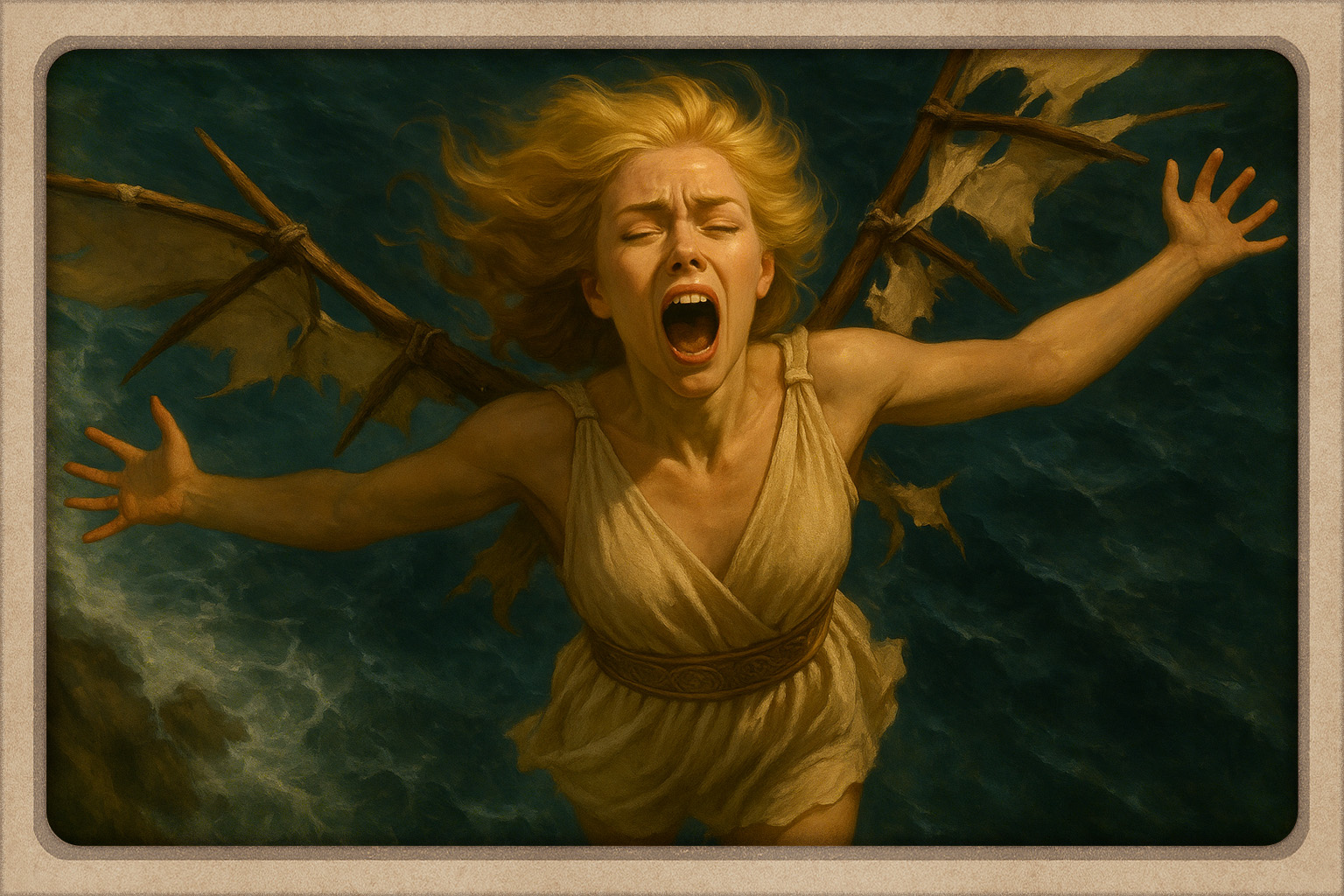
Through cloud and storm she fell, her broken wings trailing light into the darkness below. The sea rose to meet her, vast and merciless, swallowing her in its cold embrace. None among the gods knew where she landed, nor what became of her. Thus ended Erosia’s flight — not in death, but in the mystery of an unknown future.
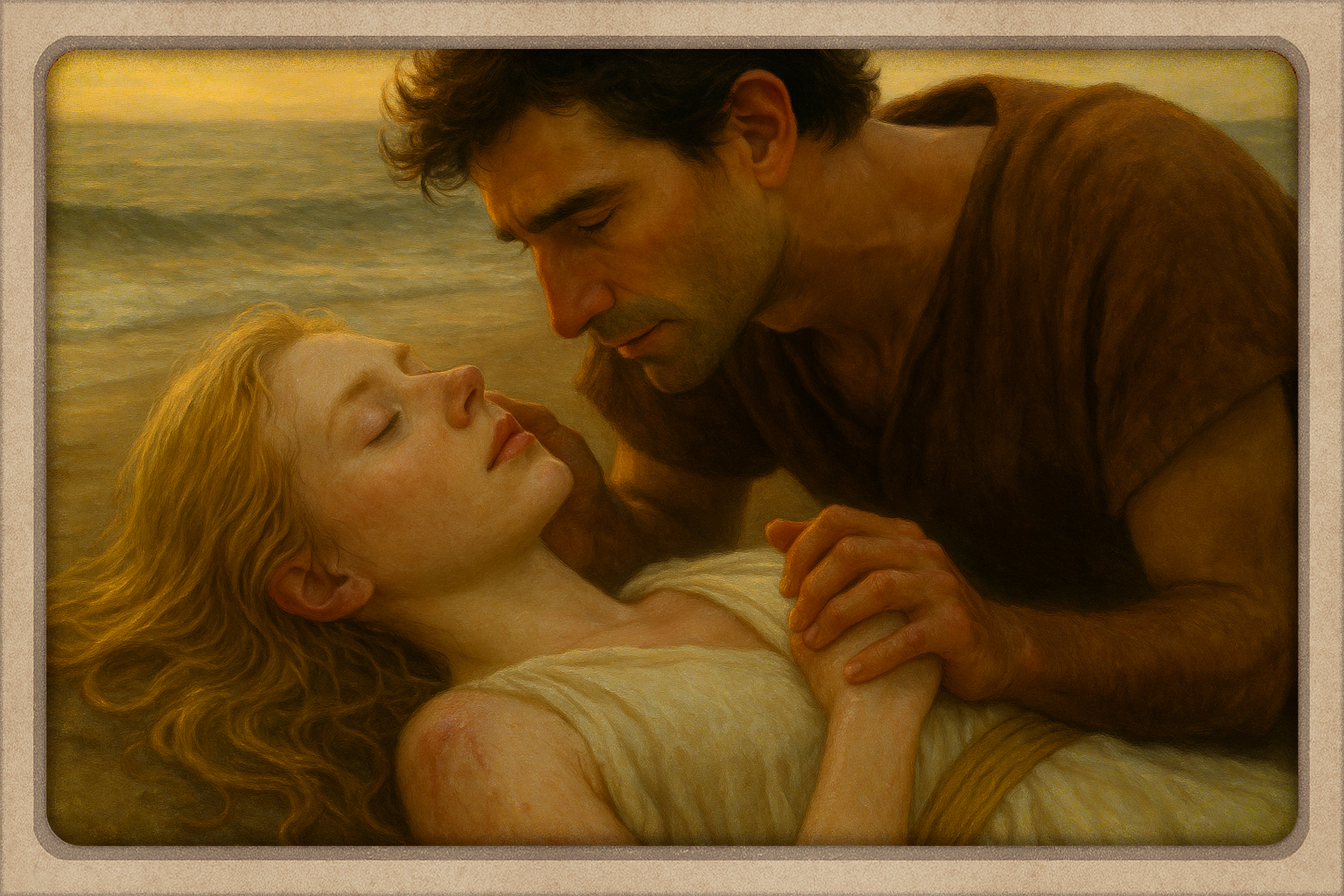
Upon a quiet shore, Kaeden, a fisherman and healer, found a vision cast from the sea. There, amid driftwood and foam, lay Erosia, her body bruised, her light dimmed yet unbroken. Struck by her beauty and sorrow, he knelt beside her, his hand trembling as it brushed her face. In that touch, mercy met divinity — and the fate of gods turned toward the heart of a mortal.
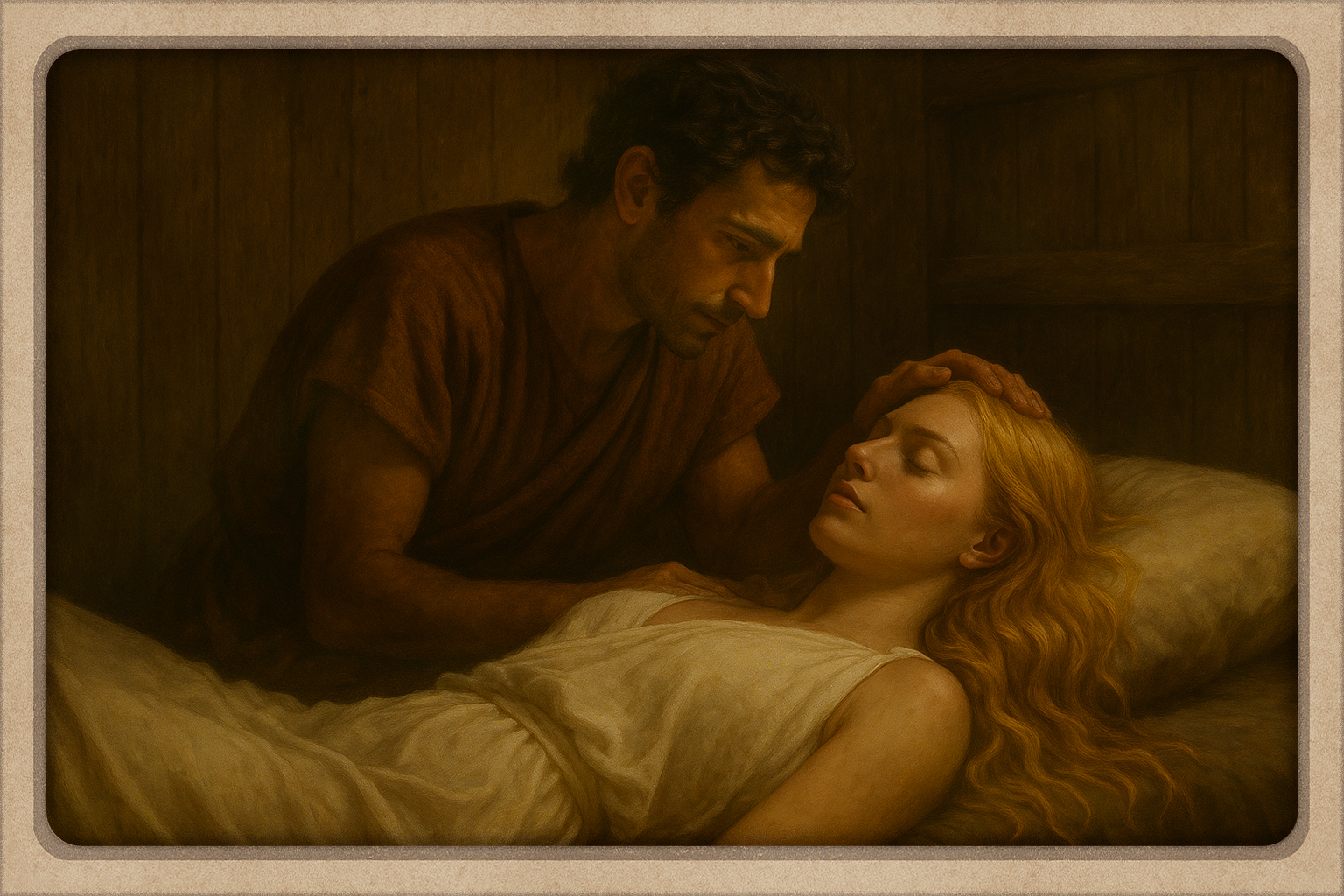
With gentle hands, Kaeden carried Erosia from the shore and sheltered her beneath his humble roof. Day by day he tended her wounds, cleansing the marks of storm and sorrow. Yet more than herbs or touch, it was his kindness that mended her — for in his quiet presence, the goddess of love began to remember what love truly meant.
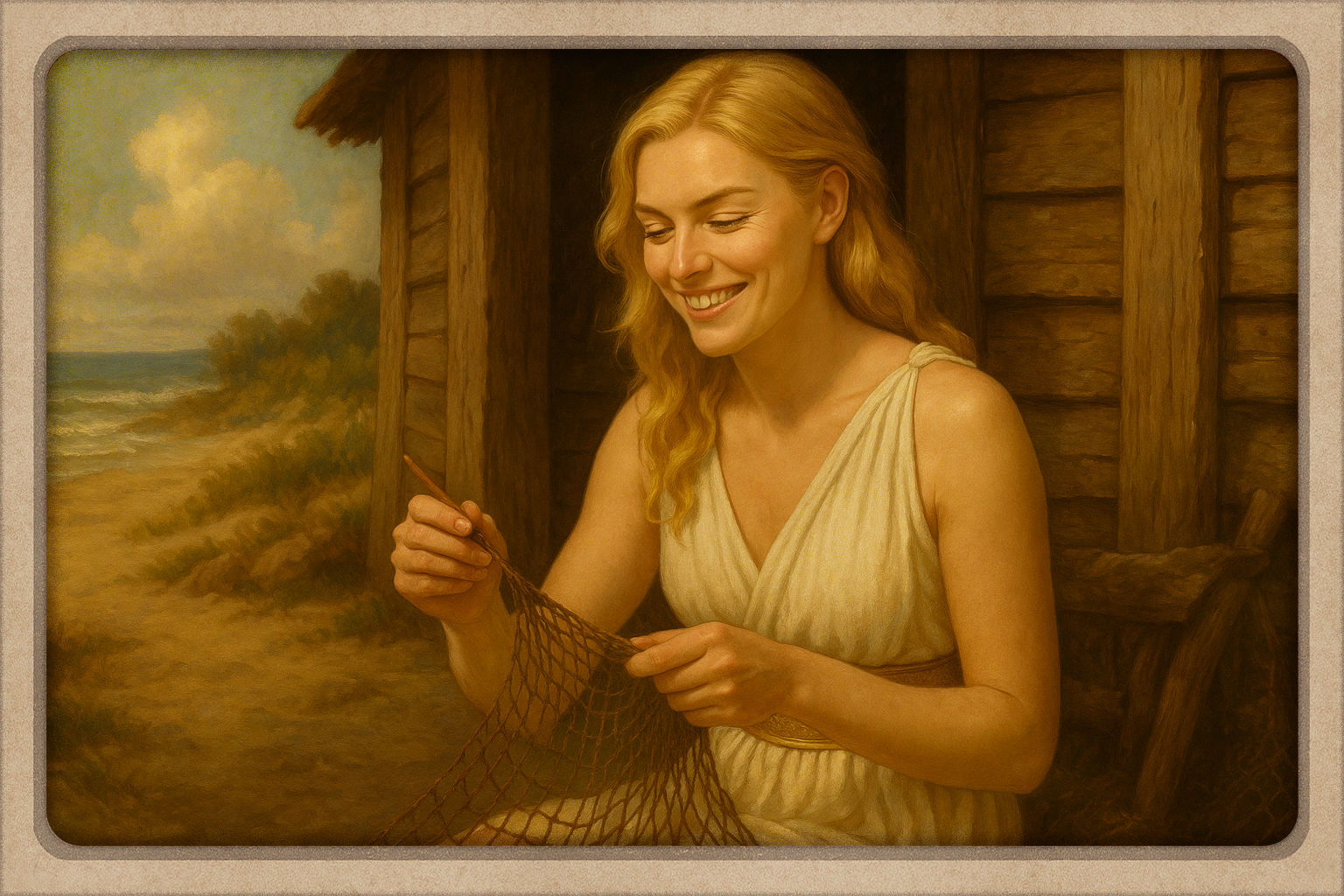
Time passed gently, and Erosia learned to laugh once more. Beside Kaeden, she discovered the grace of simple days — the warmth of shared bread, the peace of the setting sun. She tended his home, his heart, and the small joys of mortal life. In his love, she forgot the thrones of heaven, for no crown had ever felt so light.
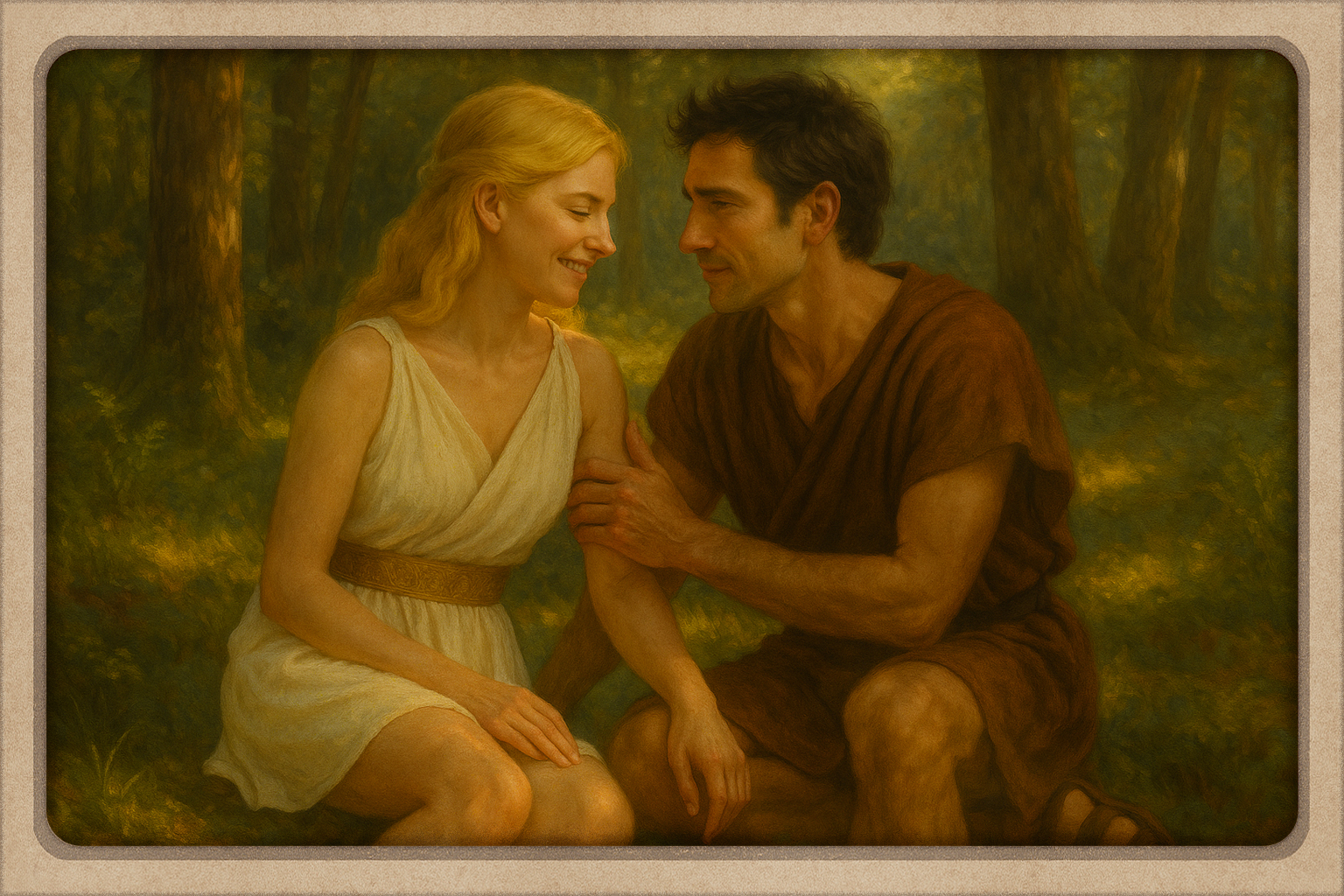
Seasons turned, and the bond between Erosia and Kaeden grew deep as the roots of the earth. Together they lived in quiet harmony within the small seaside village, far from the wrath of gods. Laughter and tenderness filled their days, and for the first time since her creation, Erosia felt whole. In the arms of a mortal, the goddess at last understood her own divine gift.
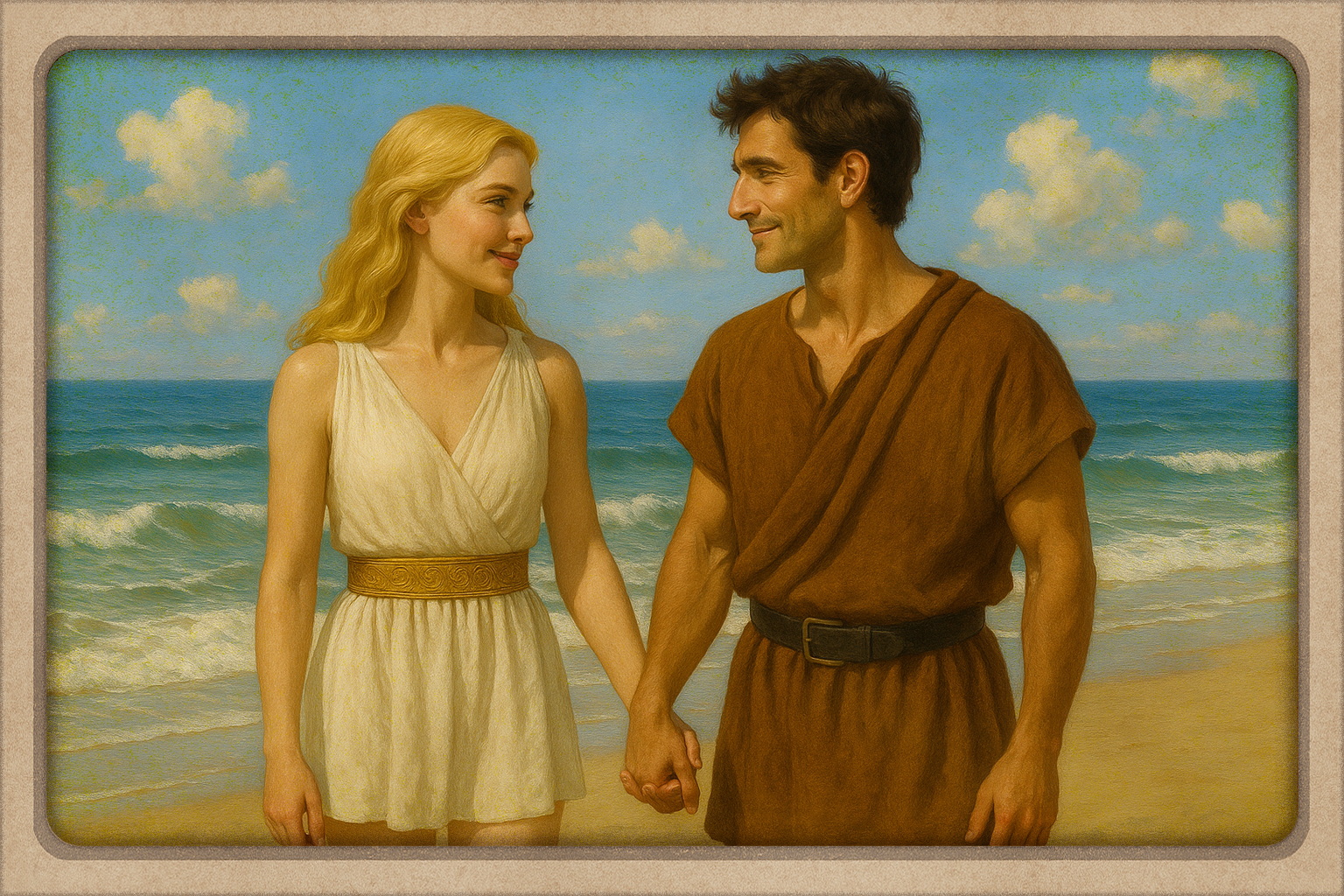
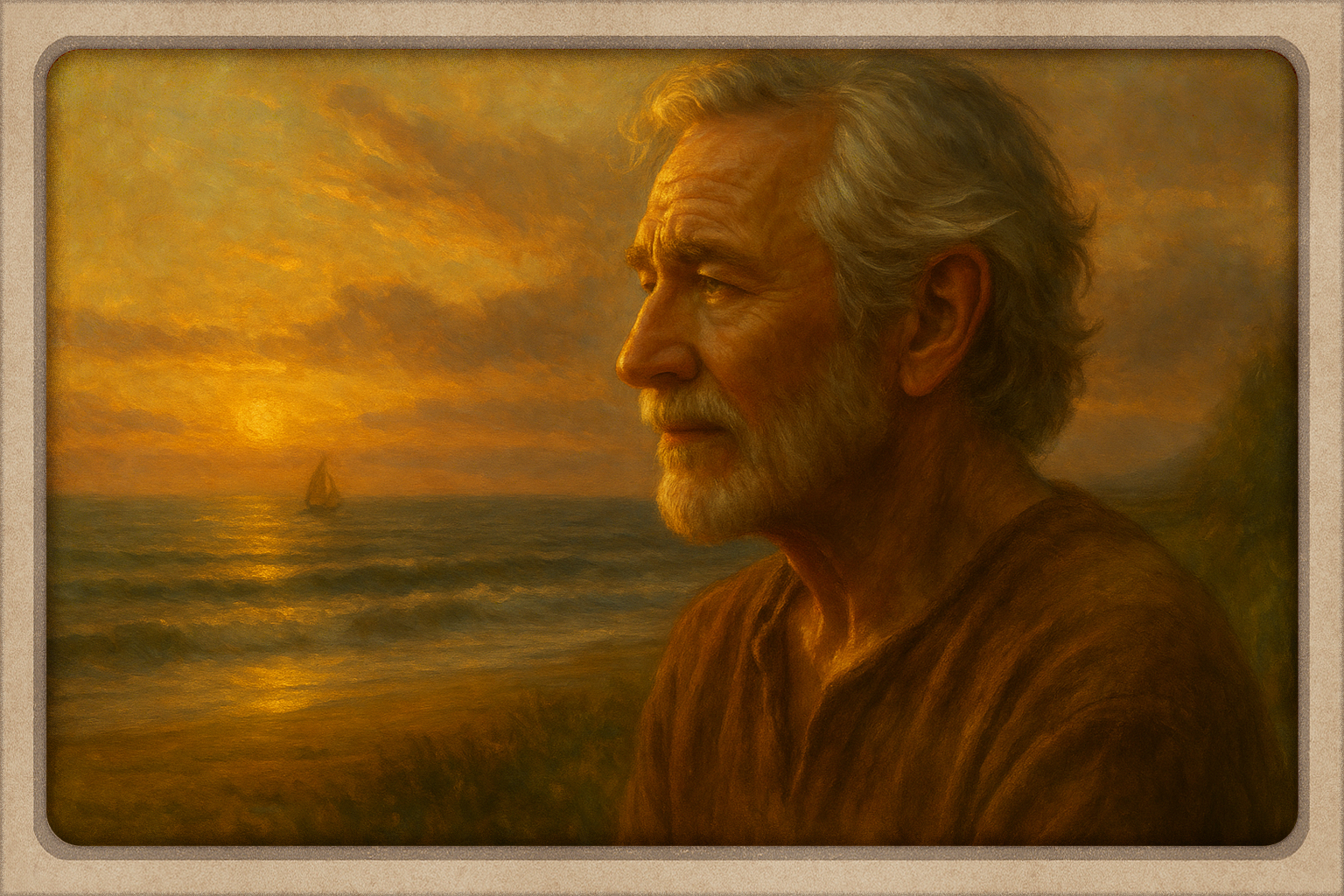
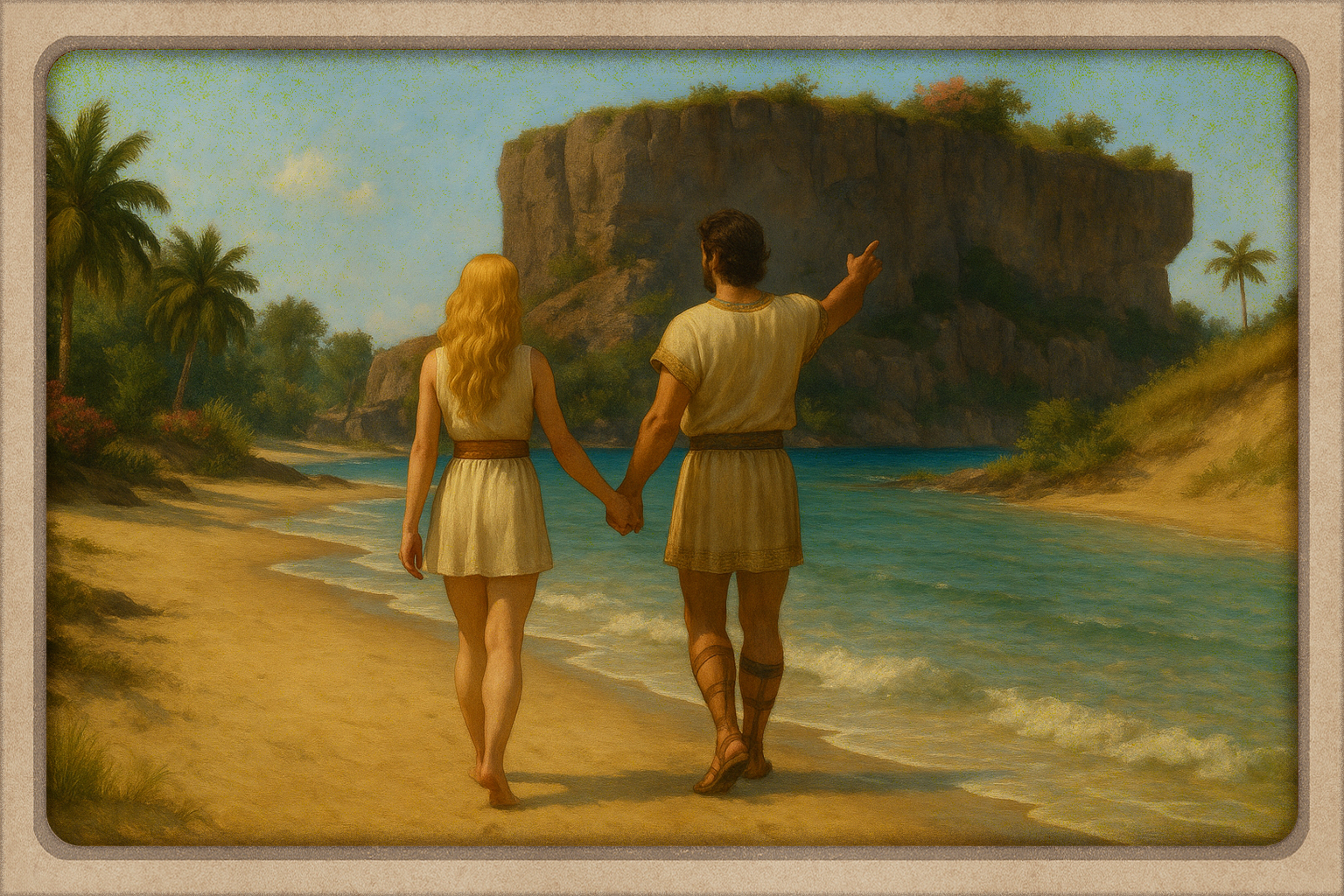
Many days, Erosia and Kaeden walked along the whispering shore, their hands entwined like tide and sand. Yet as the years flowed by, a quiet longing stirred within her — a pull she could neither name nor silence. Often Kaeden watched her stand at the water's edge, her gaze lost to the horizon, as if the sea itself were calling her home.
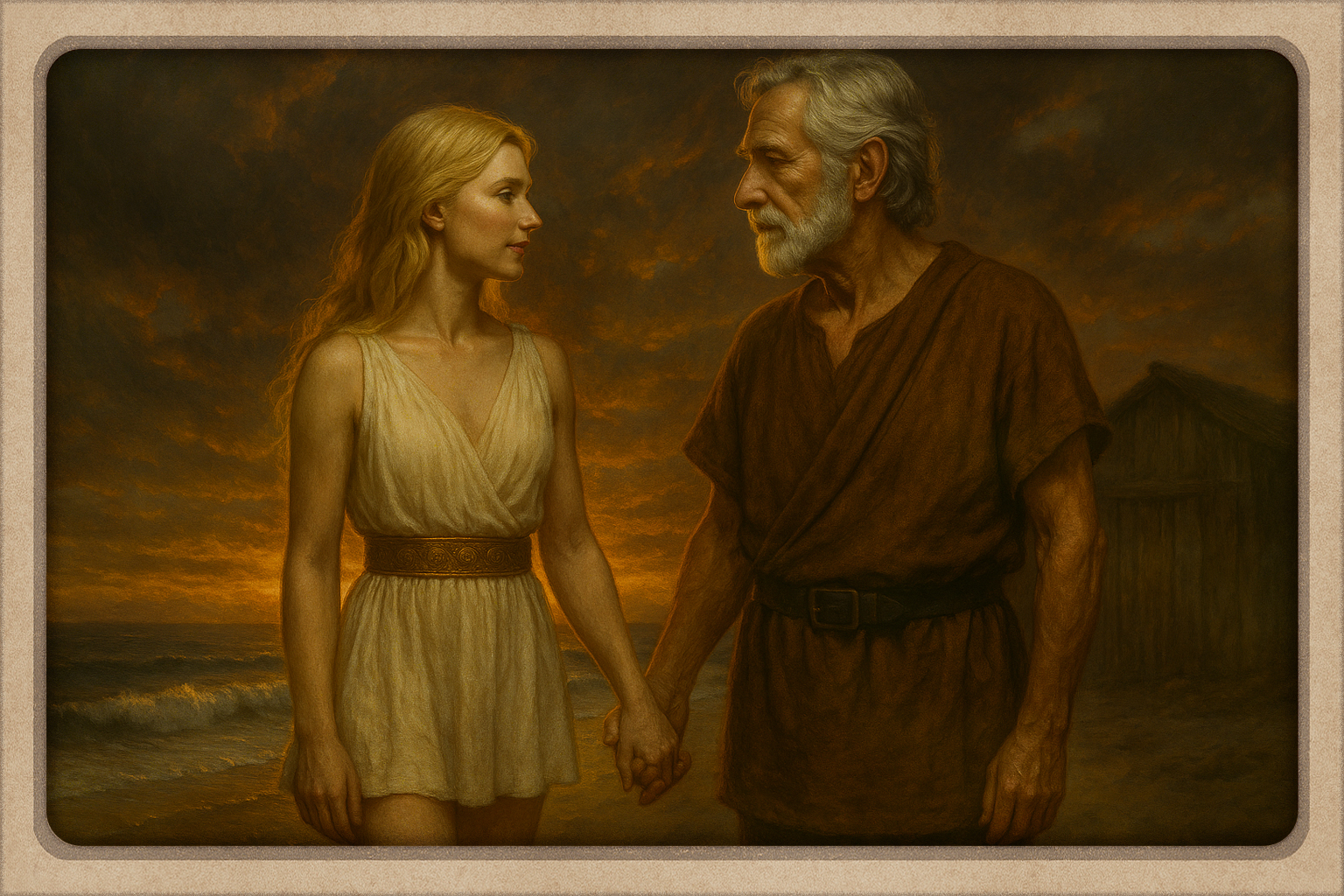
The years drifted by like waves upon the shore. Kaeden's hair turned silver, his face lined with the gentle marks of age, while Erosia remained untouched by time, forever young. Between them grew a quiet sorrow, for love could bridge hearts but not mortality. They felt the border rising, unseen yet unyielding. The line where eternity and life could no longer meet.
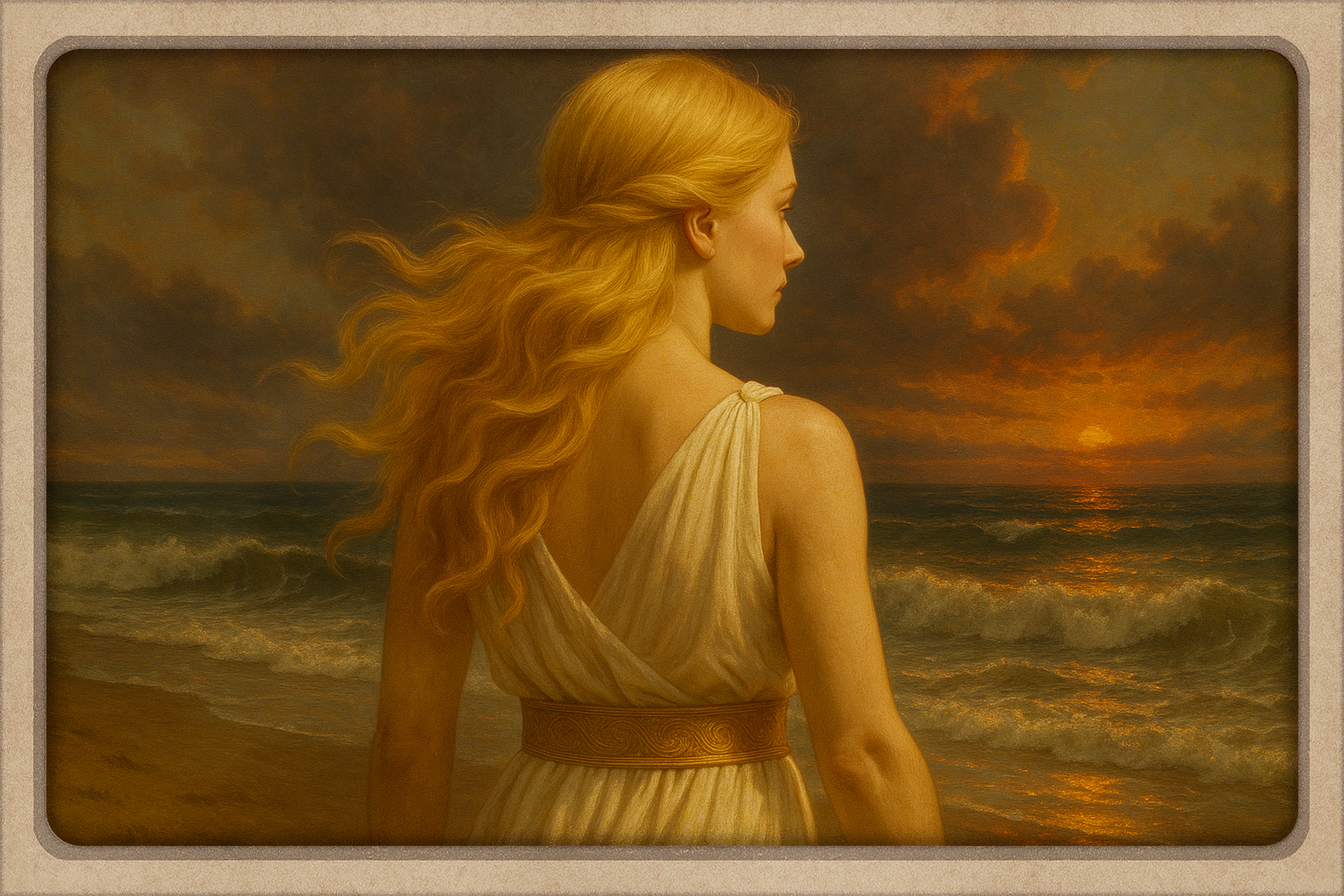
In the stillness of night, Erosia felt the truth stirring within her immortal heart. No matter how fierce her love, the tide of fate could not be held back. She belonged to the boundless — not to time, not to one shore. With silent tears she understood: to spare Kaeden and to remain herself, she must leave the island… and the man who had given her peace.
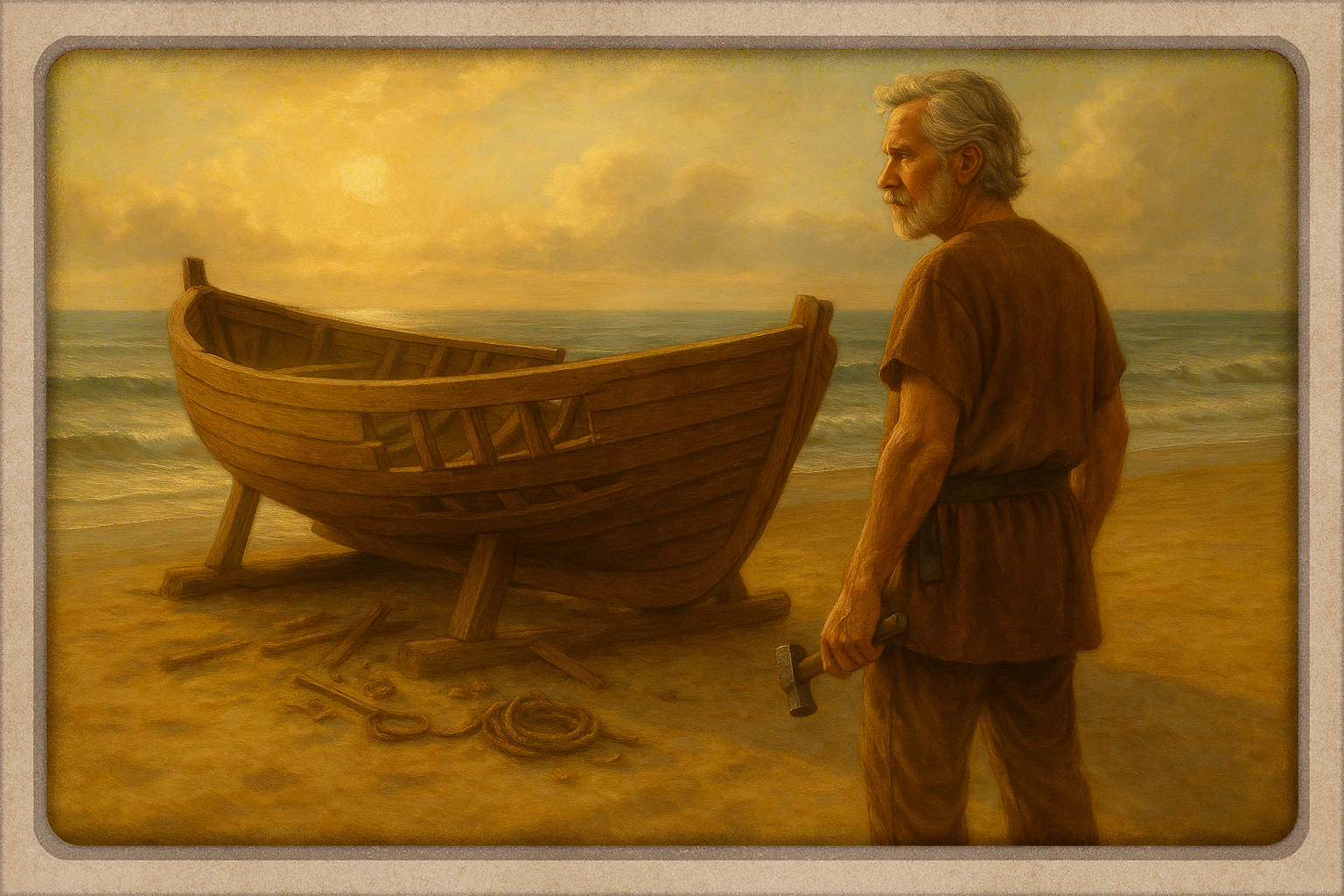
With heavy heart yet steady hands, Kaeden began to build a boat for his beloved. Plank by plank, he shaped it beneath the fading sun, knowing it would bear Erosia to lands he would never see. Each strike of his hammer was a prayer, each knot a farewell. For love, he understood, is not possession — it is the courage to let go.
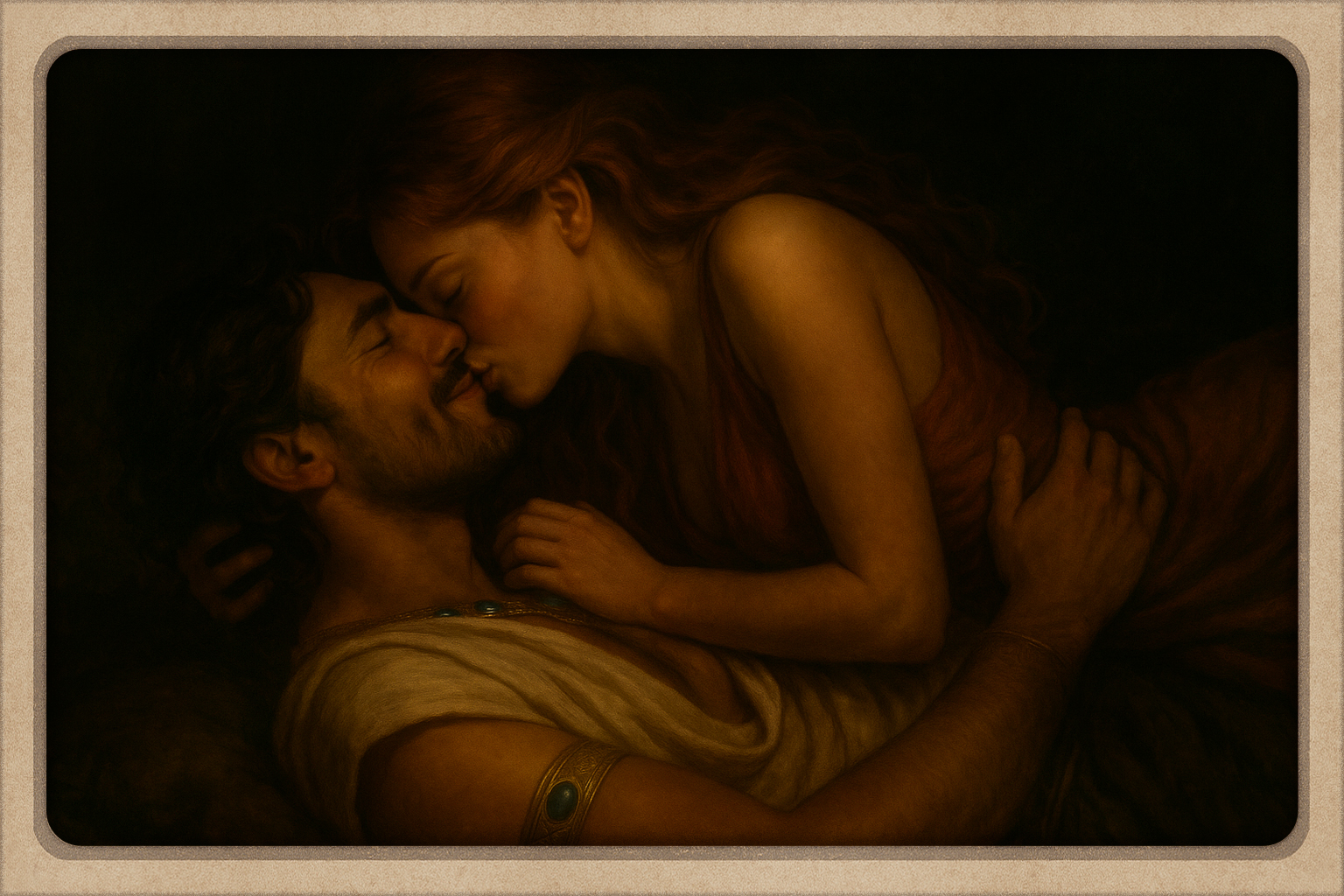
At dawn, beneath a sky of gold and sorrow, Erosia and Kaeden stood upon the shore. The sea murmured around their feet as they shared one final kiss. The goddess and the mortal, bound by love yet divided by fate. In whispers only the waves could hear, they vowed that their hearts would remain entwined beyond all distance, beyond all time.
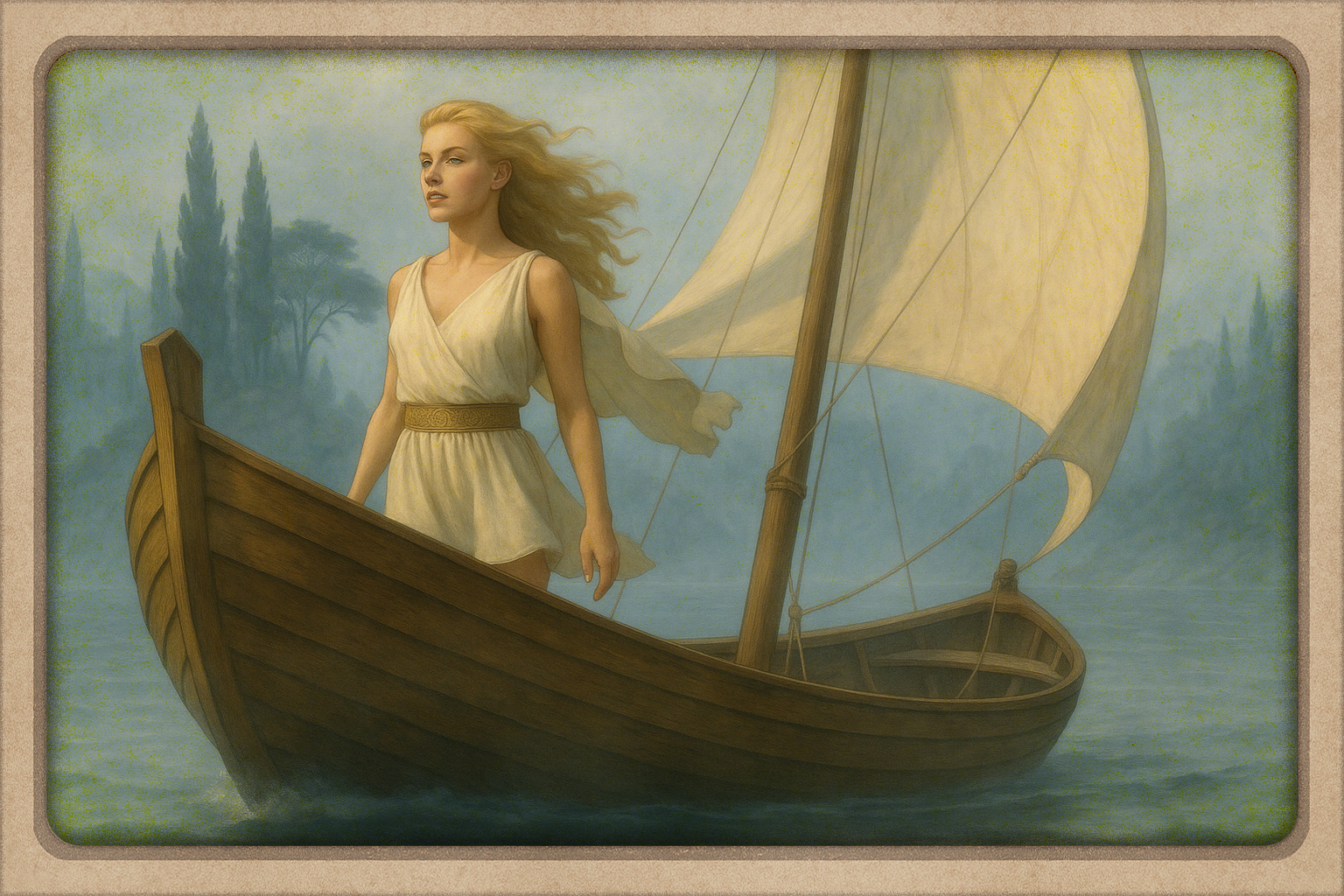
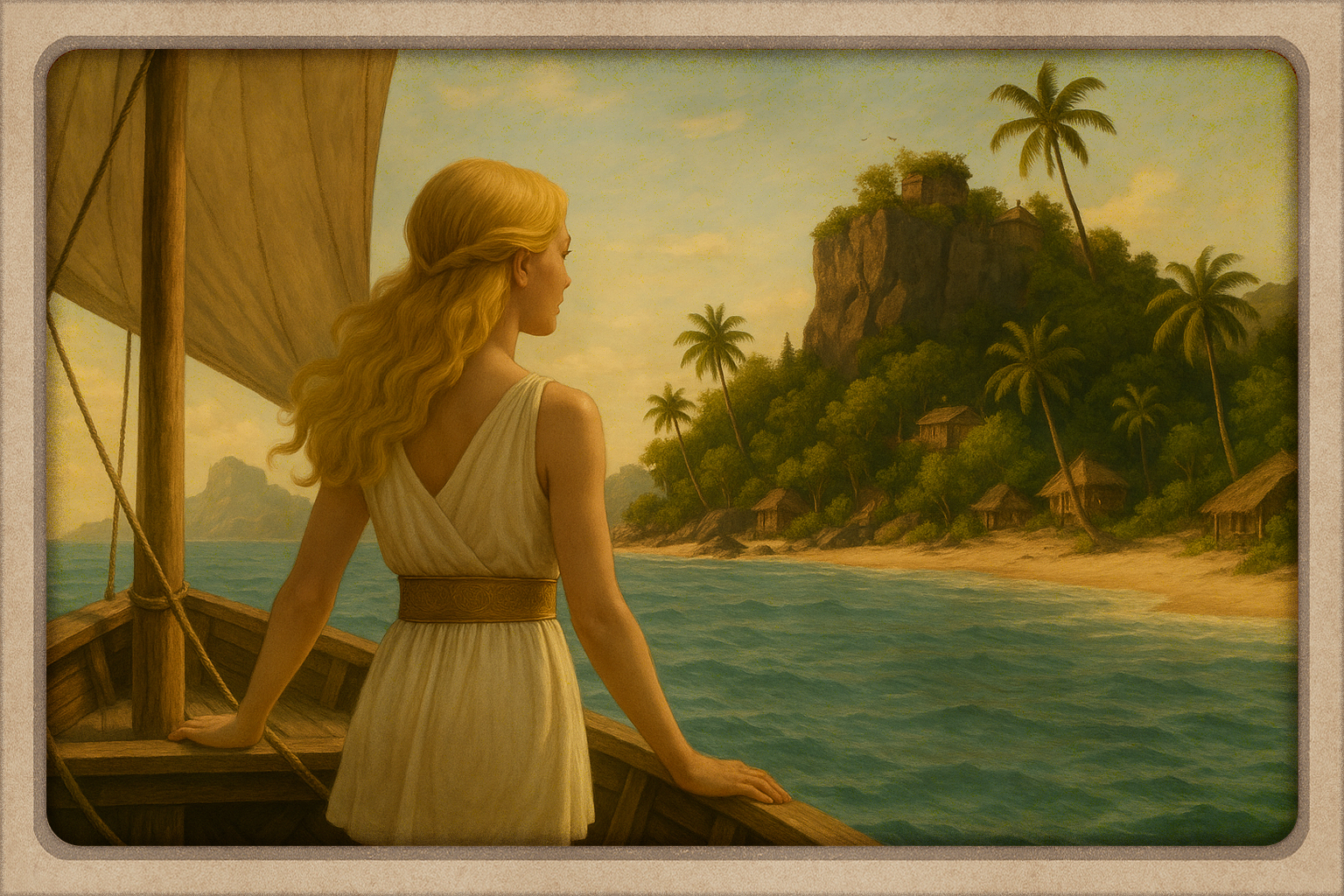
With tears glimmering, Erosia stepped into the small boat and set her sails to the wind. Kaeden stood silent upon the shore. She knew she would never again see the man who had taught a goddess the meaning of love. Long after her sails had vanished beyond the horizon, Kaeden remained, watching the endless sea that had taken her from him.
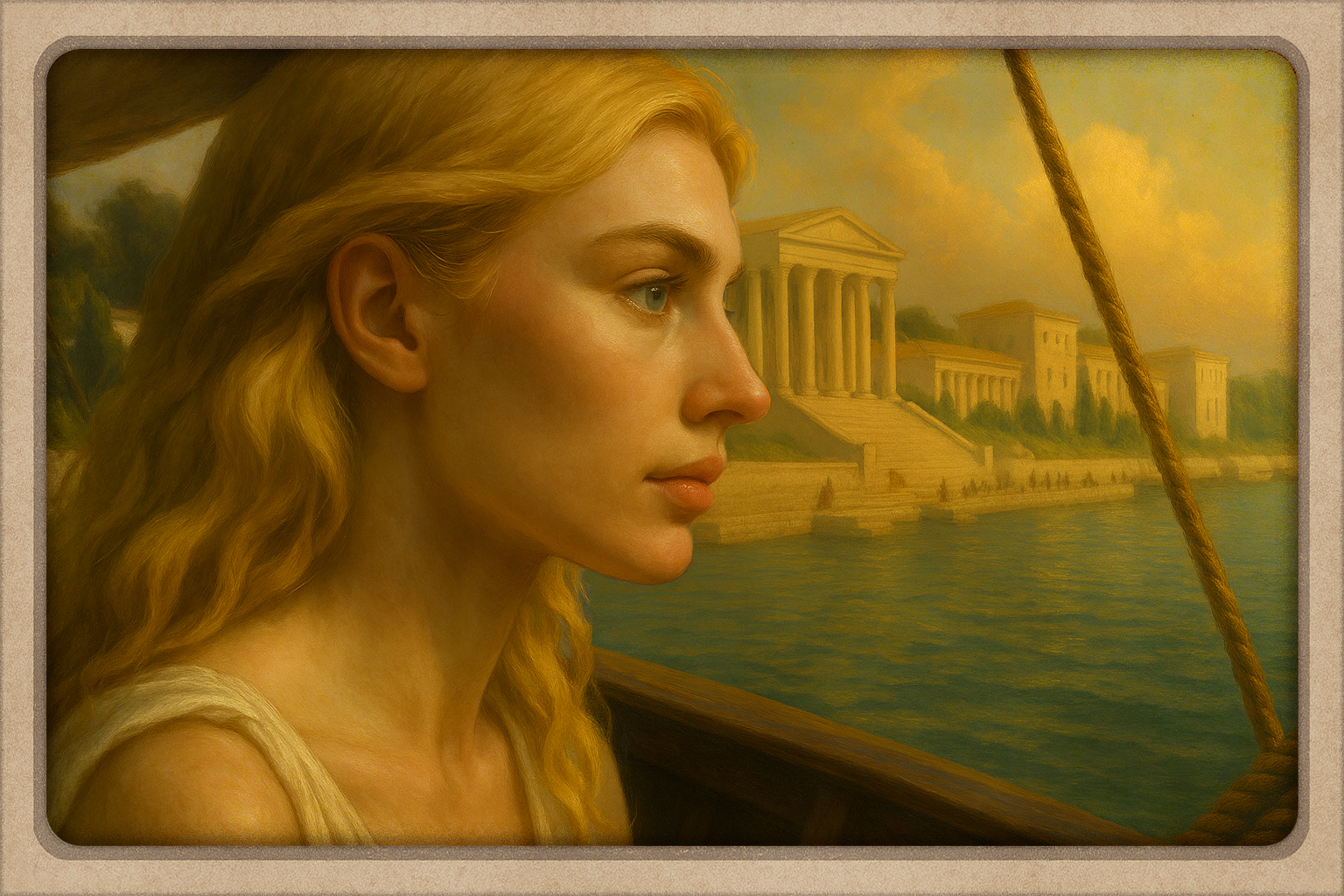
After many days adrift upon the endless sea, Erosia beheld a vision rising from the mist — an island crowned with a shining city and encircled by forests deep and green. As she drew near, the people gathered on the shore, their voices rising in awe. They knew her not as a wanderer, but as the goddess of love returned from the depths of legend.
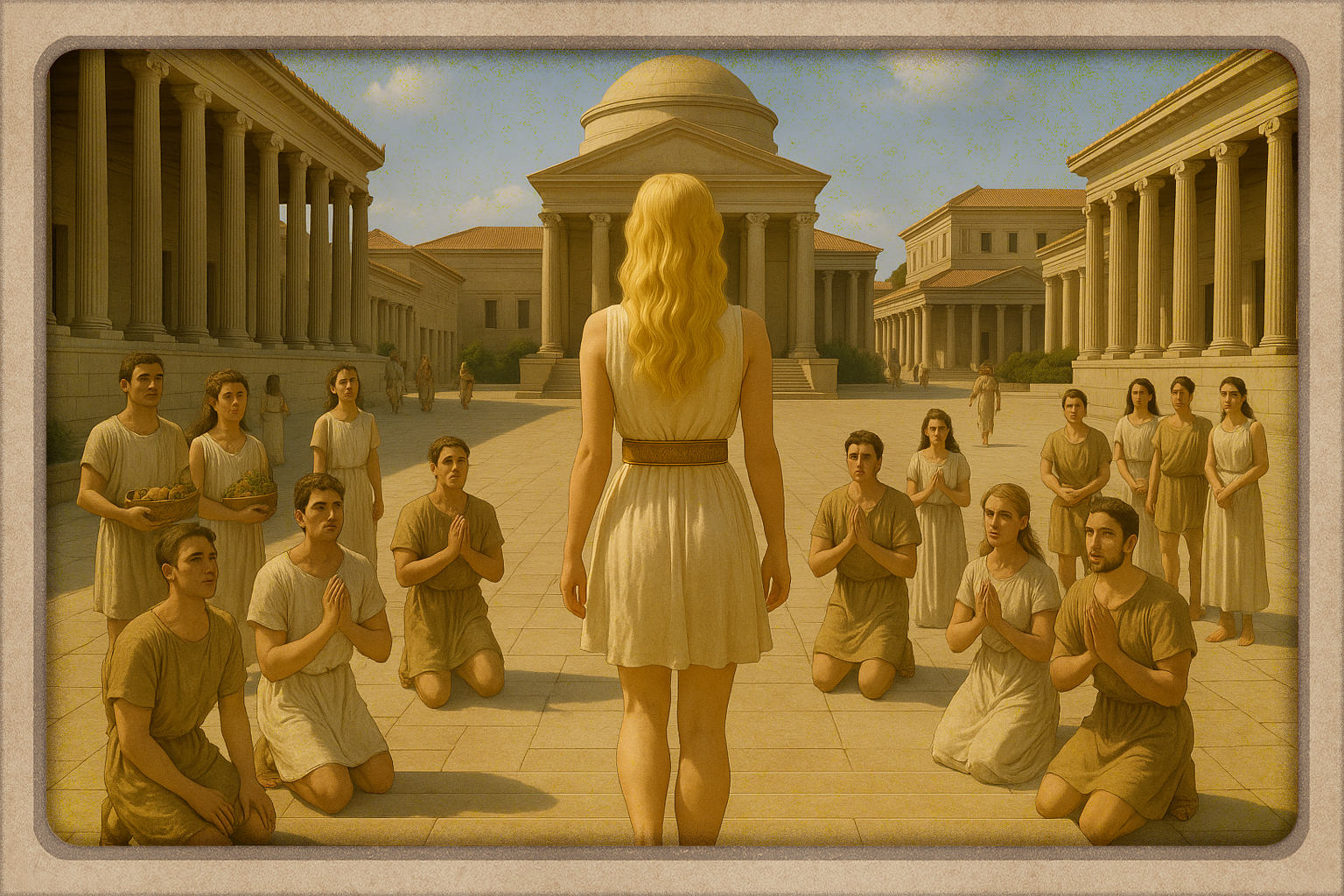
Stepping from her boat, Erosia walked the long marble steps that led toward the city's heart. The people fell to their knees as she passed. Their eyes shone with youth and beauty — not one bore the weight of age, nor the innocence of childhood. A stillness lingered beneath their adoration, and as Erosia gazed upon them, a quiet unease stirred within her soul.
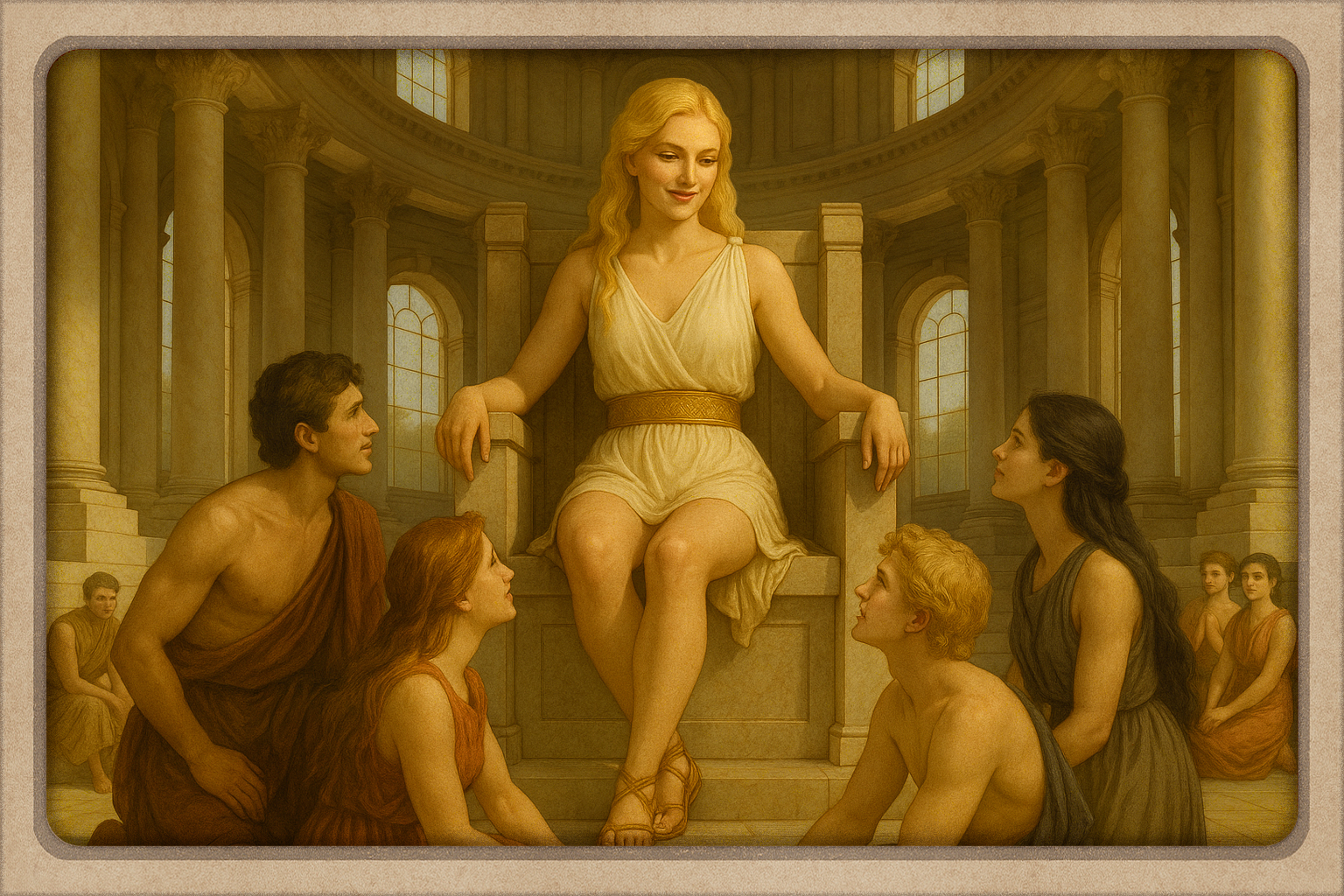
As Erosia entered the great hall of the city, women and men approached, their faces radiant with reverence, their voices trembling with joy. They led her to a marble throne at the center of the room and bowed deeply. "You are our goddess," they proclaimed, "we have awaited your coming through the ages!" As Erosia took her seat, awe and uncertainty mingled in her heart.
It did not take long for Erosia to grow accustomed to her new throne and the adoration surrounding it. The people told her the secret of their realm, that all who dwelt here were sent from distant shores at twenty, and returned home at thirty, never older, never younger. Thus the island was a sanctuary of beauty and desire, untouched by time or decay.
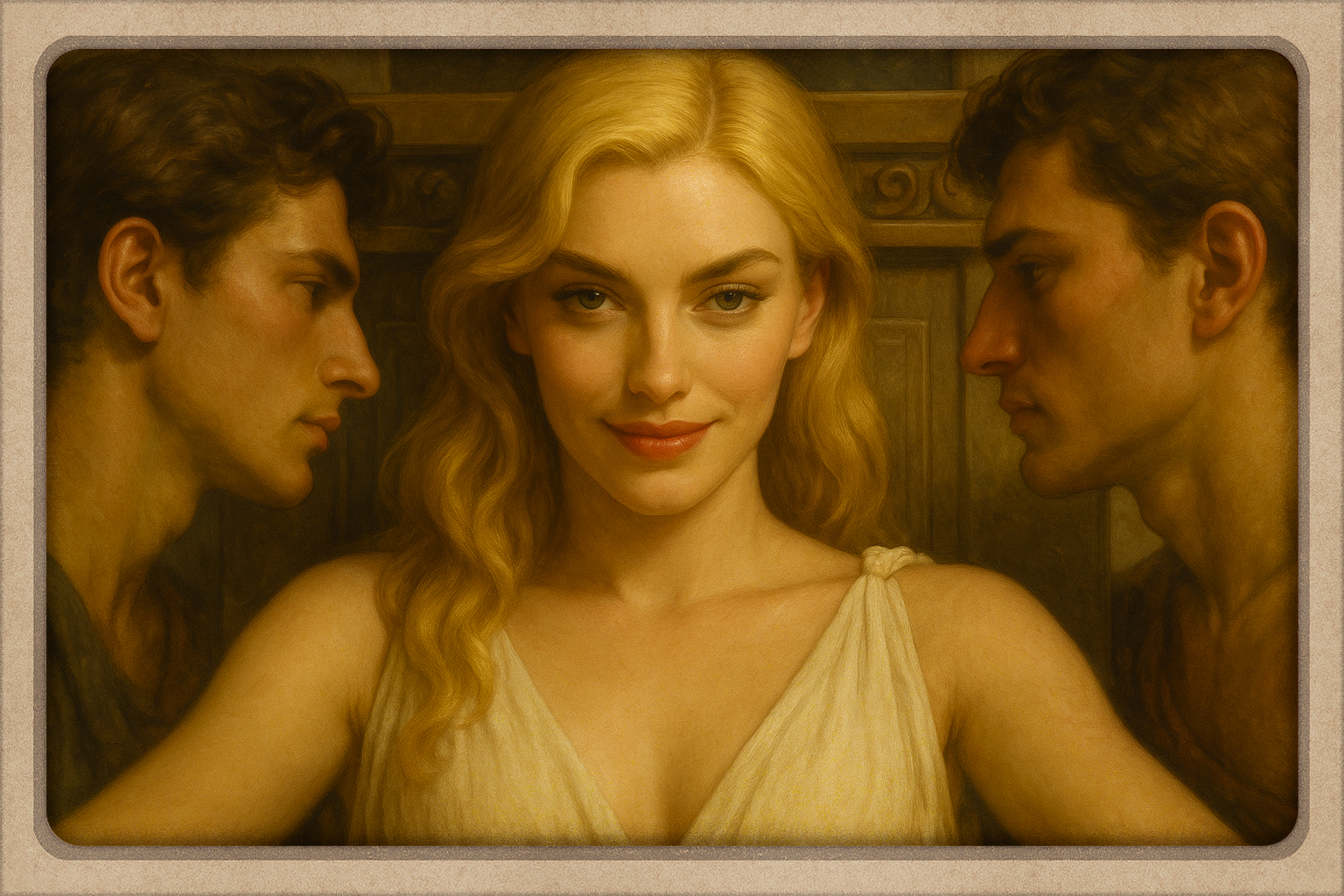
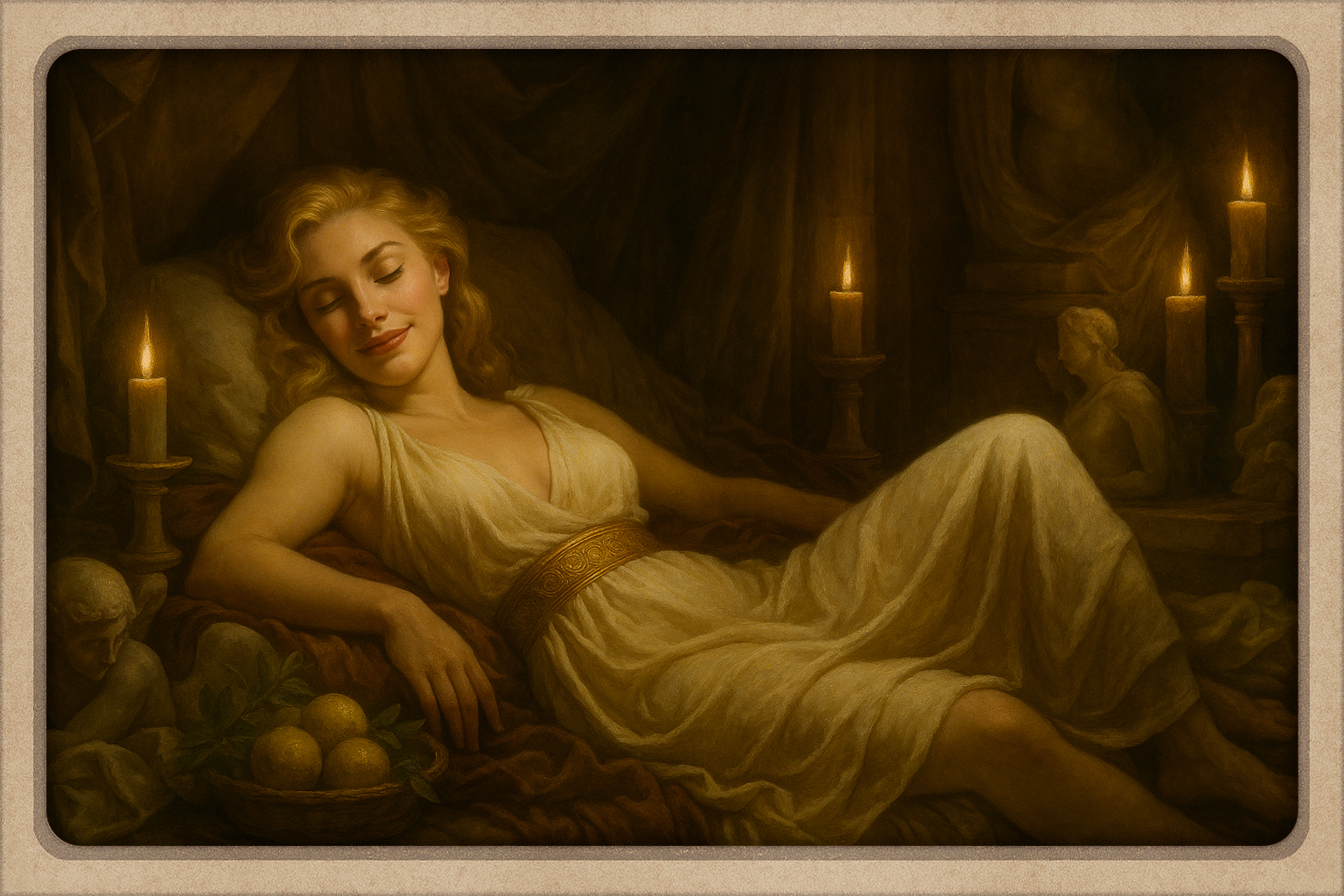
Erosia lived as the goddess she had always been meant to be. Each night she summoned lovers to her side — men and women alike, answering the call of divinity and passion. Yet on certain nights she chose solitude, gazing into the starlit sea and pondering the strange gift of her fate. Mortality, once her sorrow, had become a distant memory — for here, youth never faded.
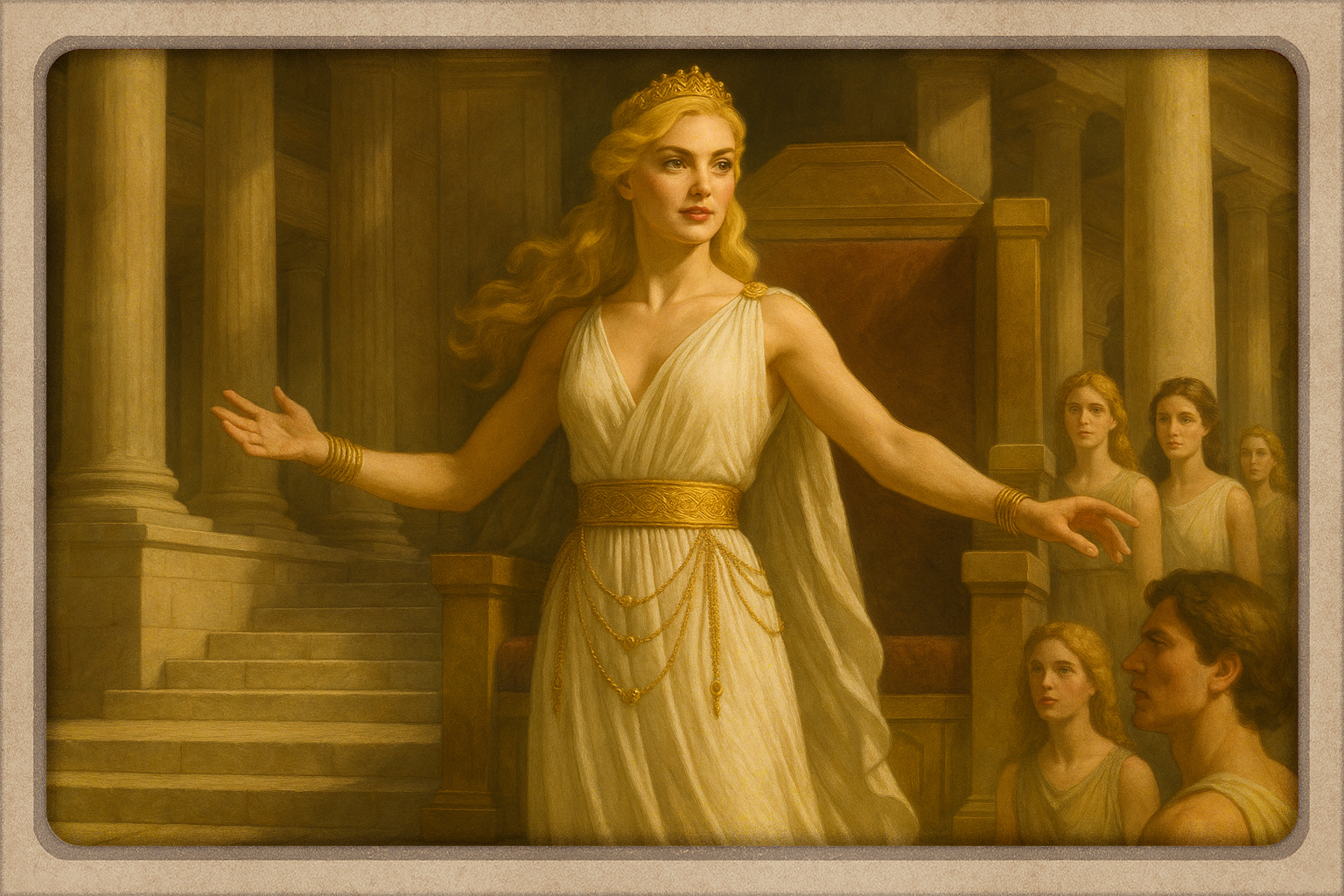
Months passed in splendor, and Erosia's rule became the heart of the island's rhythm. Wherever she went, faces turned toward her in worship, hands reaching, voices praising, hearts yearning to please their radiant queen. Adoration followed her like perfume in the air, and she reveled in it, basking in the endless devotion that surrounded her.
In time, Erosia began to sense a change in the air. The worship that once felt pure now carried the sting of deceit. Behind smiles and praises, whispers coiled like serpents, and flattery masked the hunger for power. Some sought not her blessing but her weakness, using devotion as their disguise. And once again, the goddess of love felt the chill of betrayal.
The island echoed with strife. Those who had whispered in secret turned against one another, their envy laid bare in open conflict. They fought for Erosia's gaze, for the favor of the goddess whose love had become their obsession. Jealousy poisoned every heart, and even Erosia, divine and radiant, found herself powerless before the chaos her beauty had unleashed.
Amid the ruin of devotion, Erosia stood silent, her heart heavy with disbelief. She gazed upon the madness that had consumed her paradise and felt a chill deeper than any storm. Was this the price of her presence: the curse of divine desire? In the cries of envy and broken love, she heard her own reflection, and for the first time, the goddess of love doubted her own grace.
Under the cover of night, Erosia cast off her golden jewels, leaving behind the splendor of her throne. She walked in silence through the sleeping city toward the harbor. There lay her old barque — the vessel Kaeden had built with love and sorrow. She set her sail to the wind and departed the island that had been her paradise, now fallen to vanity and deceit.
For many days Erosia drifted upon the open sea, alone with the whispering wind. Then, through the morning mist, an island appeared — vast and wild, its heart veiled by a great green jungle. Drawn by curiosity she steered her barque toward the shore. As her feet touched the sand, Erosia felt the pulse of life within the island — untamed, ancient, and waiting to be discovered.
Deep within the jungle's heart, Erosia came upon a sight both wondrous and strange — a vast palace of marble and gold, standing alone amid the trees. No village, no road, no sign of life surrounded it, as if it had been dreamed into being. Drawn by faint laughter and the echo of pleasure, whisper and soft sighs drifting through the halls, she stepped inside.
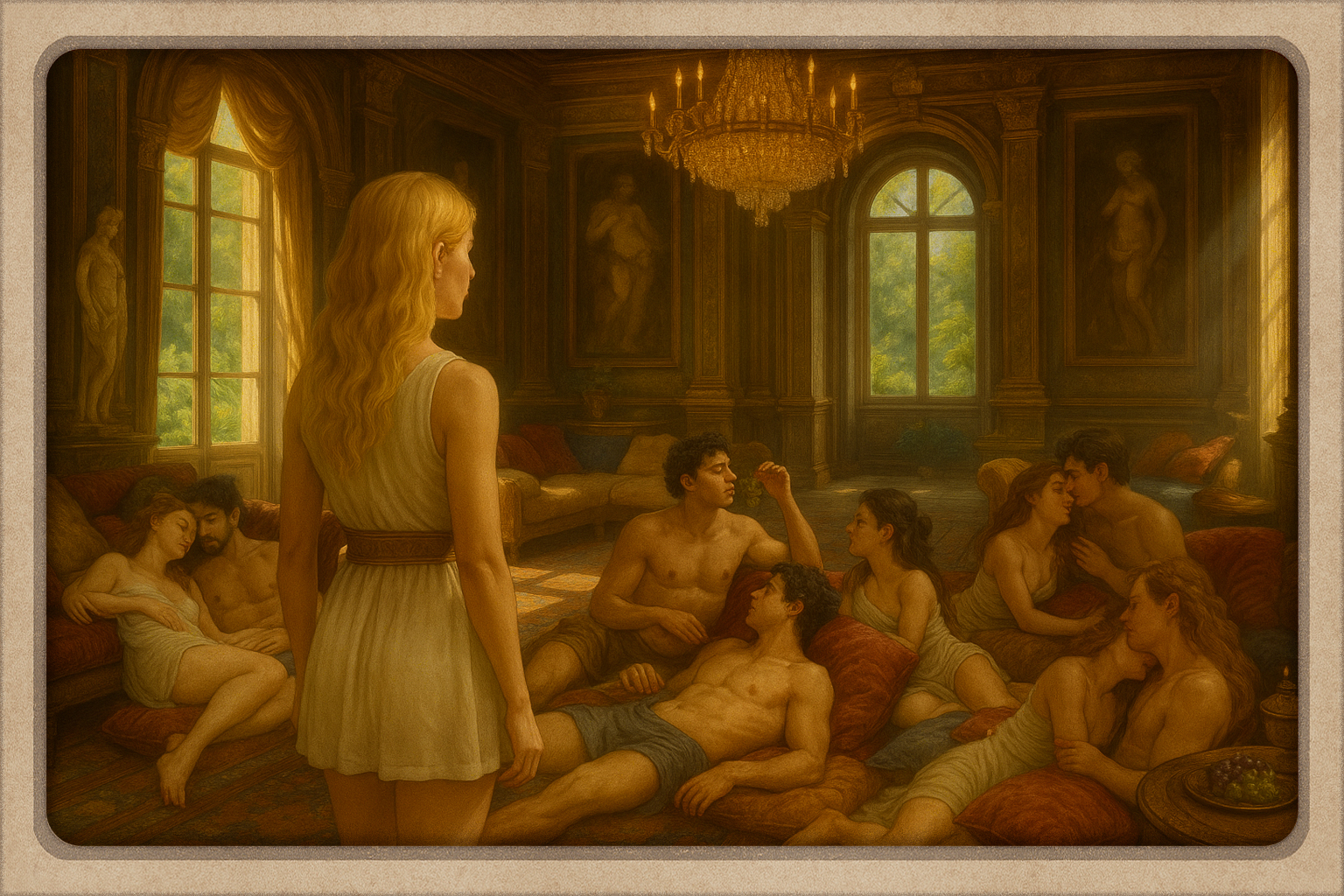
Within the palace's heart, Erosia found a great chamber bathed in golden light. There, young men and women reclined upon silken cushions, their laughter mingling with the scent of fruit and wine. They touched and fed one another in tender abandon, lost in a world where pleasure knew no restraint. Watching them, Erosia felt both wonder and unease.
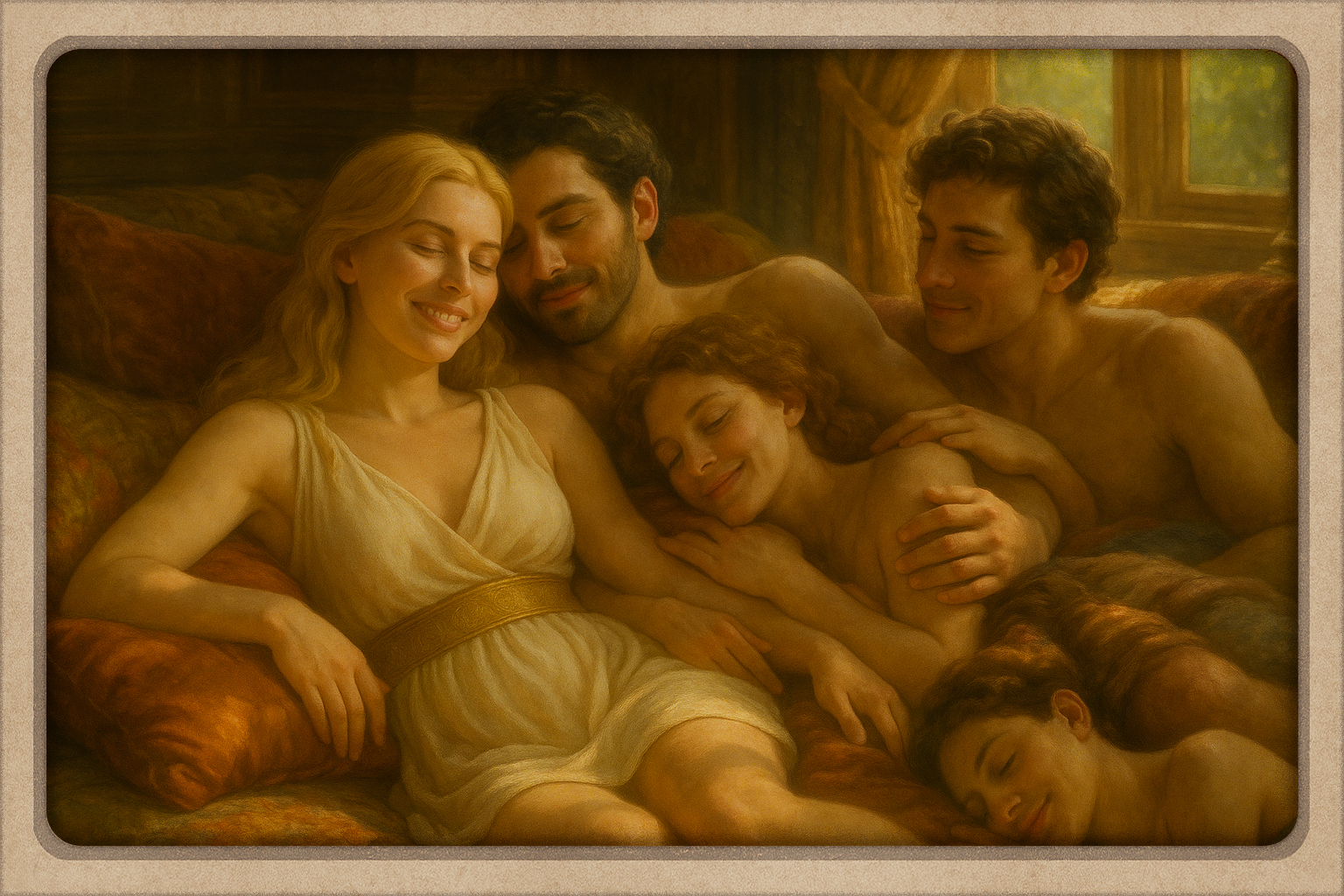
They welcomed Erosia with open arms, drawing her into their circle of warmth and laughter. Their touch was gentle, their joy unbound, and soon the barriers between goddess and mortal faded like mist. For the first time since she left Kaeden, she felt not worshipped, but belonging. Among them she was no deity of love — only a woman, alive in the pulse of shared desire.
Time lost its meaning within the golden halls. Days and nights flowed together in a haze of laughter, touch, and dreamlike delight. No hunger, no pain, no labor touched those who dwelt there — only pleasure without end. When Erosia, in a moment of wonder, asked how the palace sustained itself, the others merely laughed, their eyes gleaming with secrets.
Yet when night's laughter faded and the torches burned low, Erosia felt a quiet ache within her heart. None who shared her bed saw her soul. To them, she was a fleeting pleasure soon replaced by another. Their kisses were sweet but hollow, their touch warm yet without meaning. Within endless passion, the goddess of love found herself utterly alone.
At last, Erosia's curiosity broke through the haze of delight. The laughter that once charmed her now echoed strangely in her ears, and the sweetness of the palace began to taste of emptiness. Determined to uncover the truth, she left the perfumed halls and wandered into the gardens beyond. Among the flowers and fountains she sought the secret of this hollow paradise.
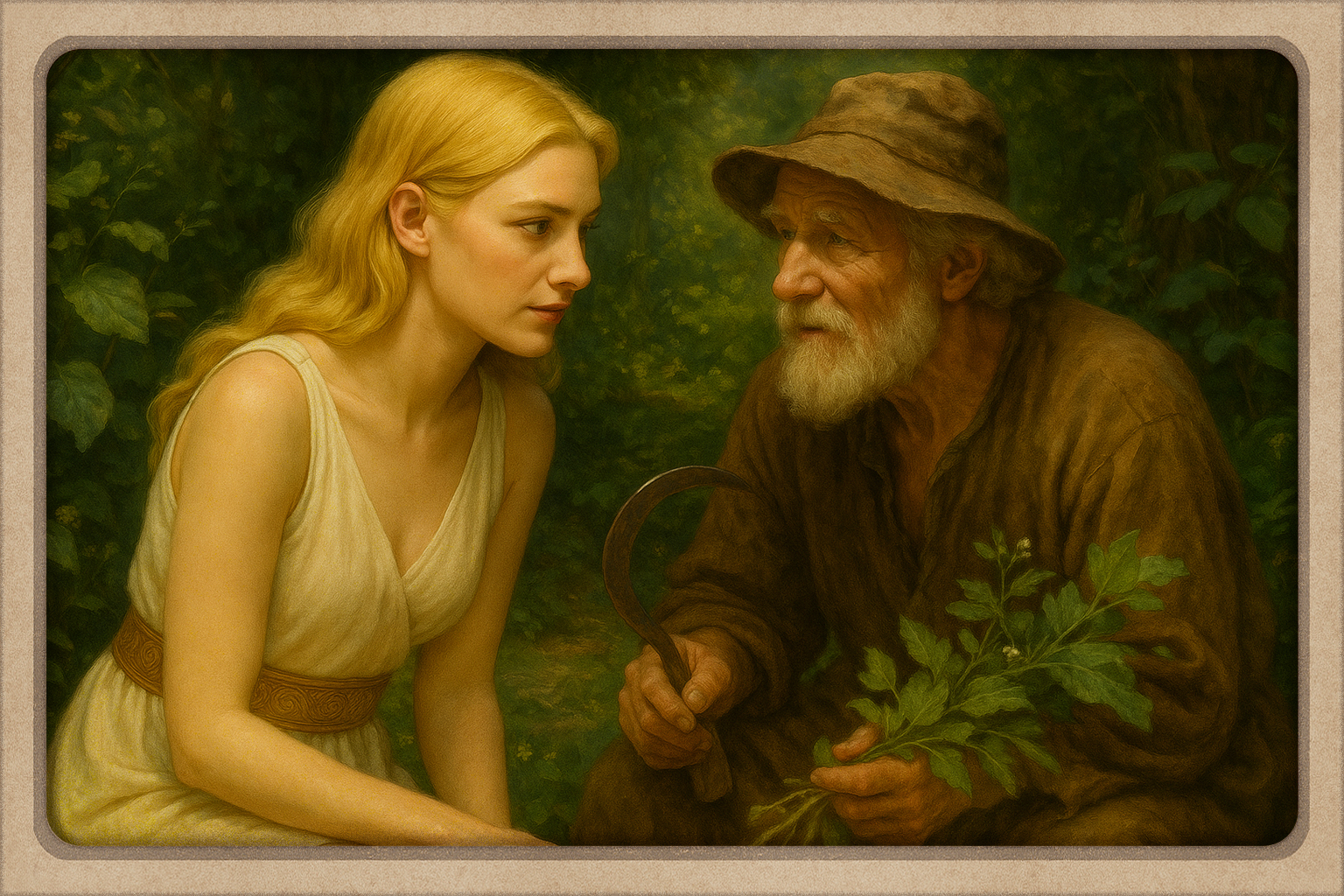
Erosia passed groups lost in pleasure so deep they scarcely saw her. She asked them what power sustained their endless revelry, but they only smiled faintly and turned away. Puzzled, she reached a quiet corner where the air smelled of earth instead of perfume. There, bent with toil, an old man worked among the fields — the first sign of labor she had seen here.
The old man looked up from his toil, his eyes weary yet kind. He told Erosia that long ago he too had danced and feasted within the golden halls. But as the years passed and youth faded from his face, the others cast him out. All who aged were sent here, he said, to labor in secret — tending the gardens, mending the walls, feeding the paradise that had forgotten them.
Disgust filled Erosia's heart as the truth took root within her. The paradise she had cherished was nothing but a mask — a hollow dream fed by cruelty and neglect. The laughter of the young now sounded cruel, the golden walls tainted by indifference. Erosia turned from the palace of false delight, returned to her small barque, and set her sails once more.
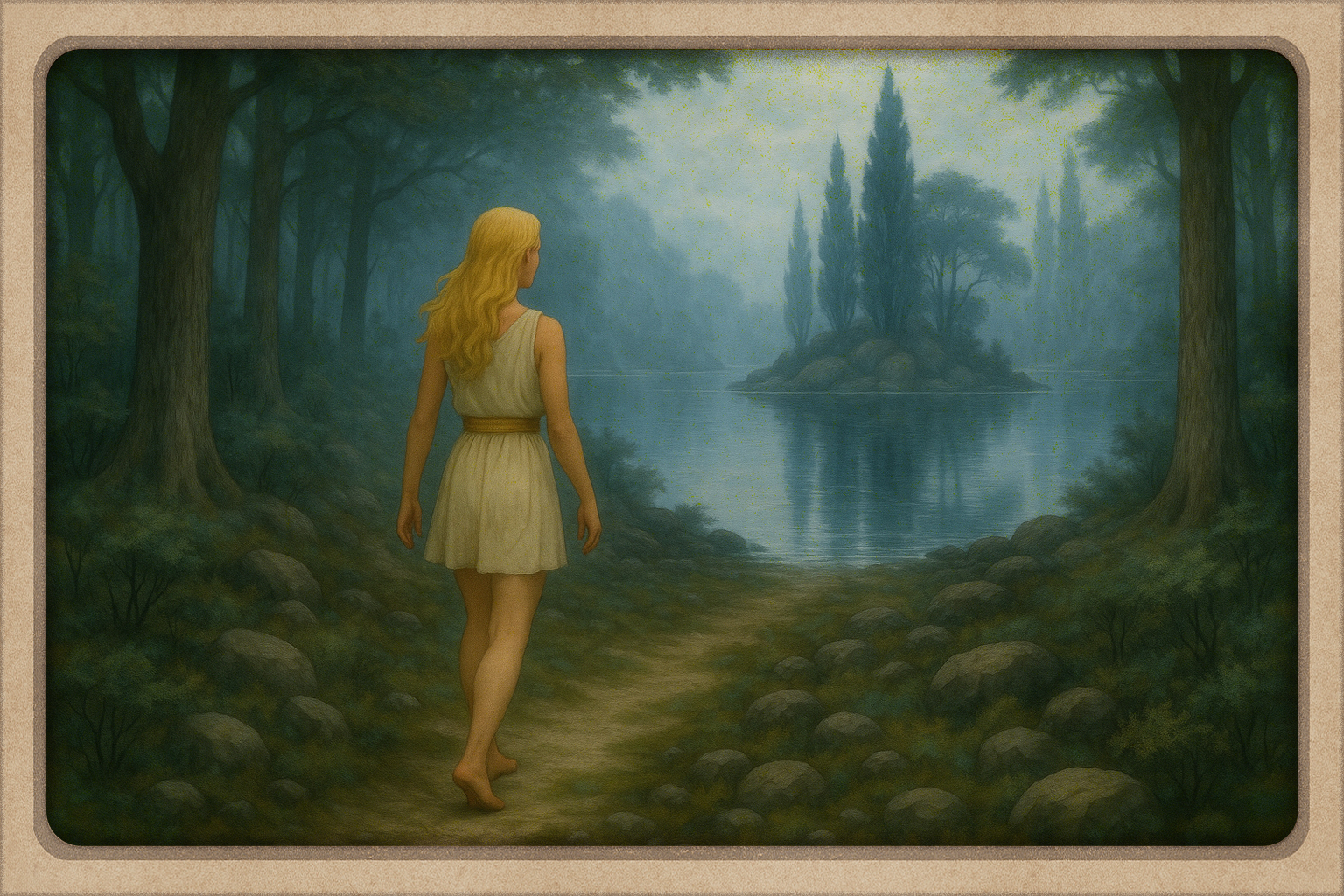
Once more adrift upon the endless waters, Erosia followed the wind until a pale island rose before her, a shroud of mist covered its shores. She guided her small boat — the last gift of Kaeden — through the veil and stepped onto land. No voices greeted her, no signs of life stirred; only the whisper of fog and the echo of her own footsteps in a world that seemed asleep.
Through the silver mist, Erosia found a narrow path winding into the island's heart. Whether made by mortal hands or by fate itself, she could not tell. She followed its ghostly trail until it opened to a vast, still lake. The surface shone like polished glass, and as she leaned over its edge, Erosia beheld her reflection — ageless, flawless, yet marked by sorrow.
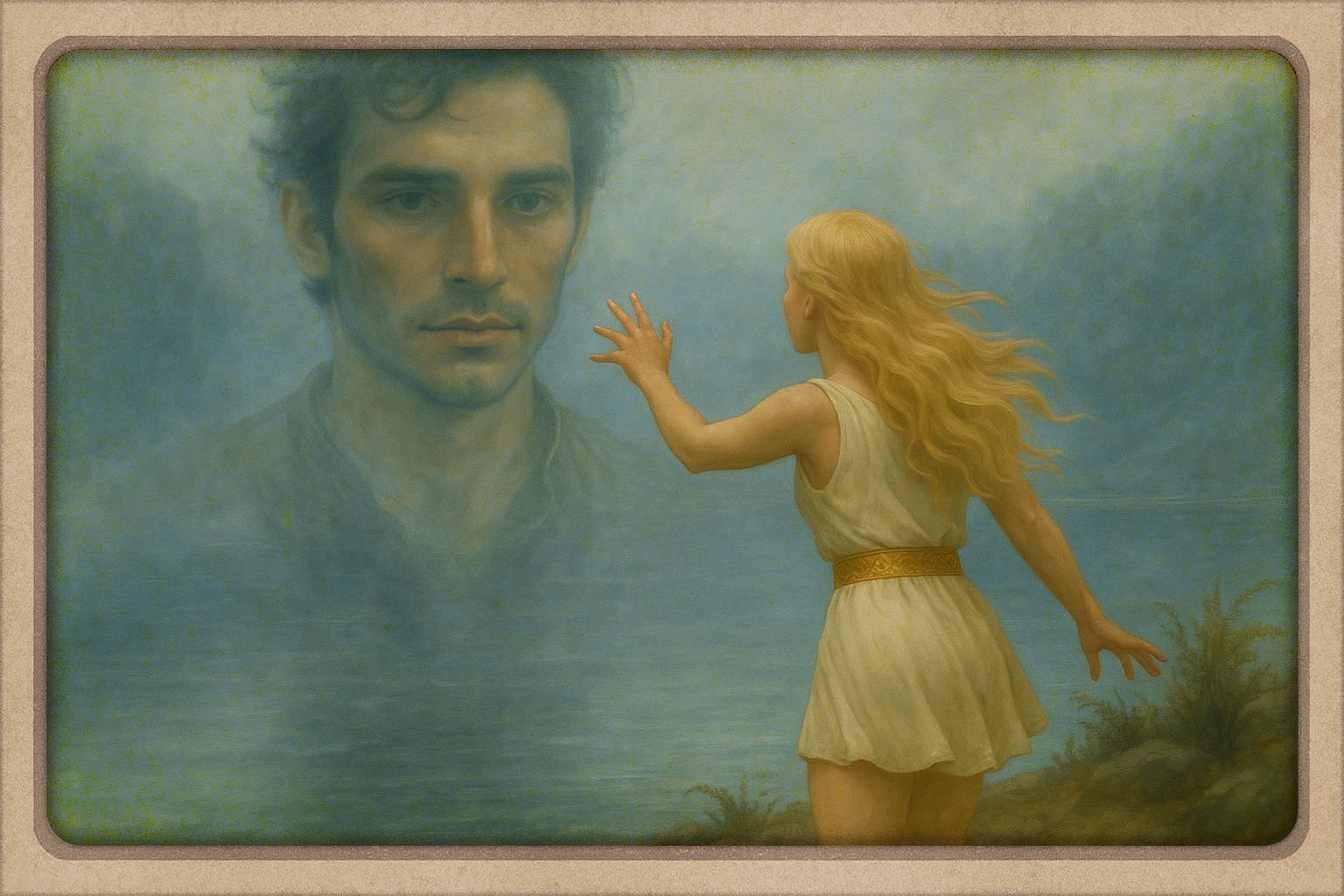
The mist thickened above the lake, swirling in pale, ghostly shapes. Then, through the shifting veil, Erosia saw a face she knew by heart — Kaeden, her lost beloved. Her breath caught as she reached out to bridge the gulf of years and death. But as her fingers neared, the vision dissolved into mist, leaving only ripples — and the ache of love that time could never erase.
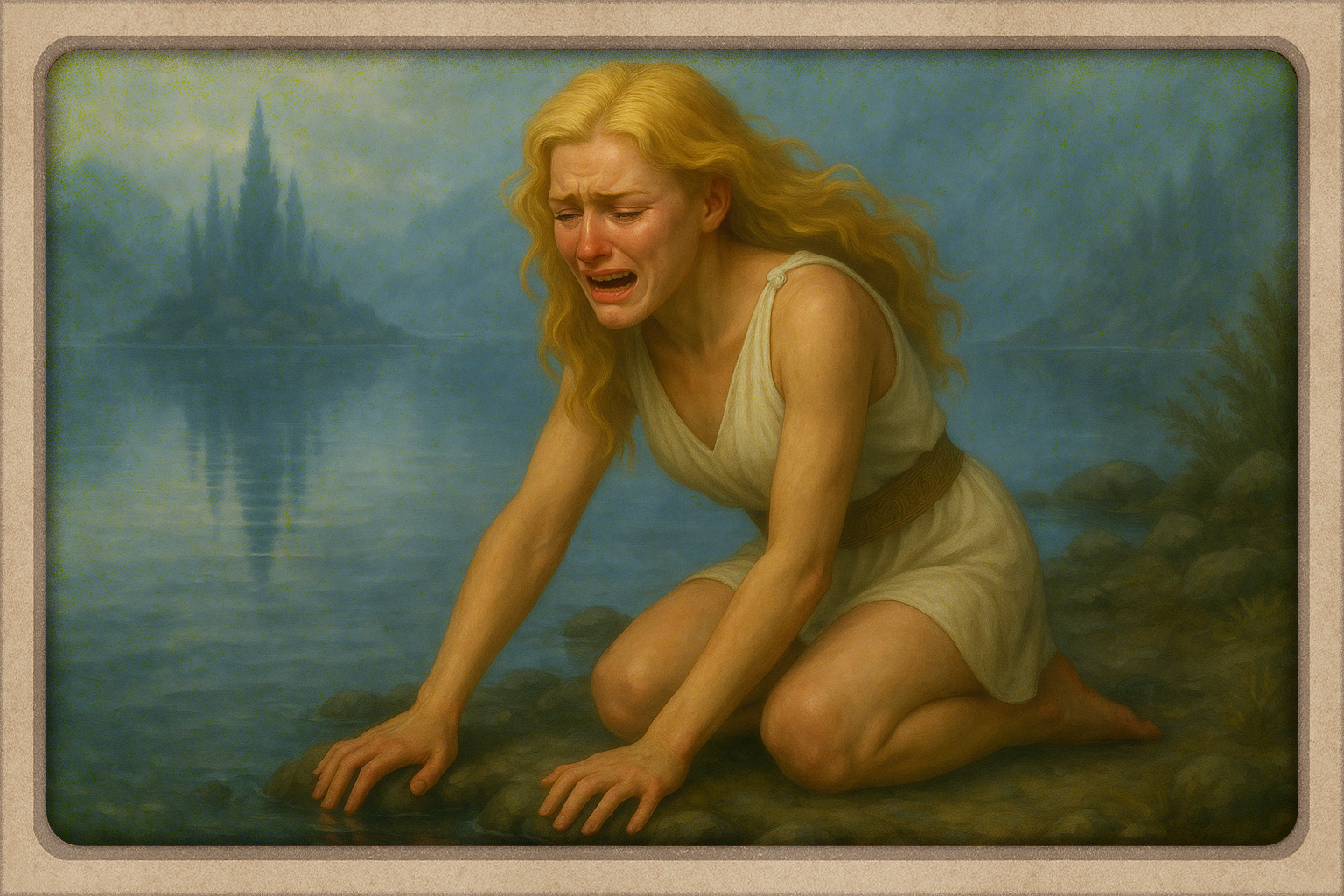
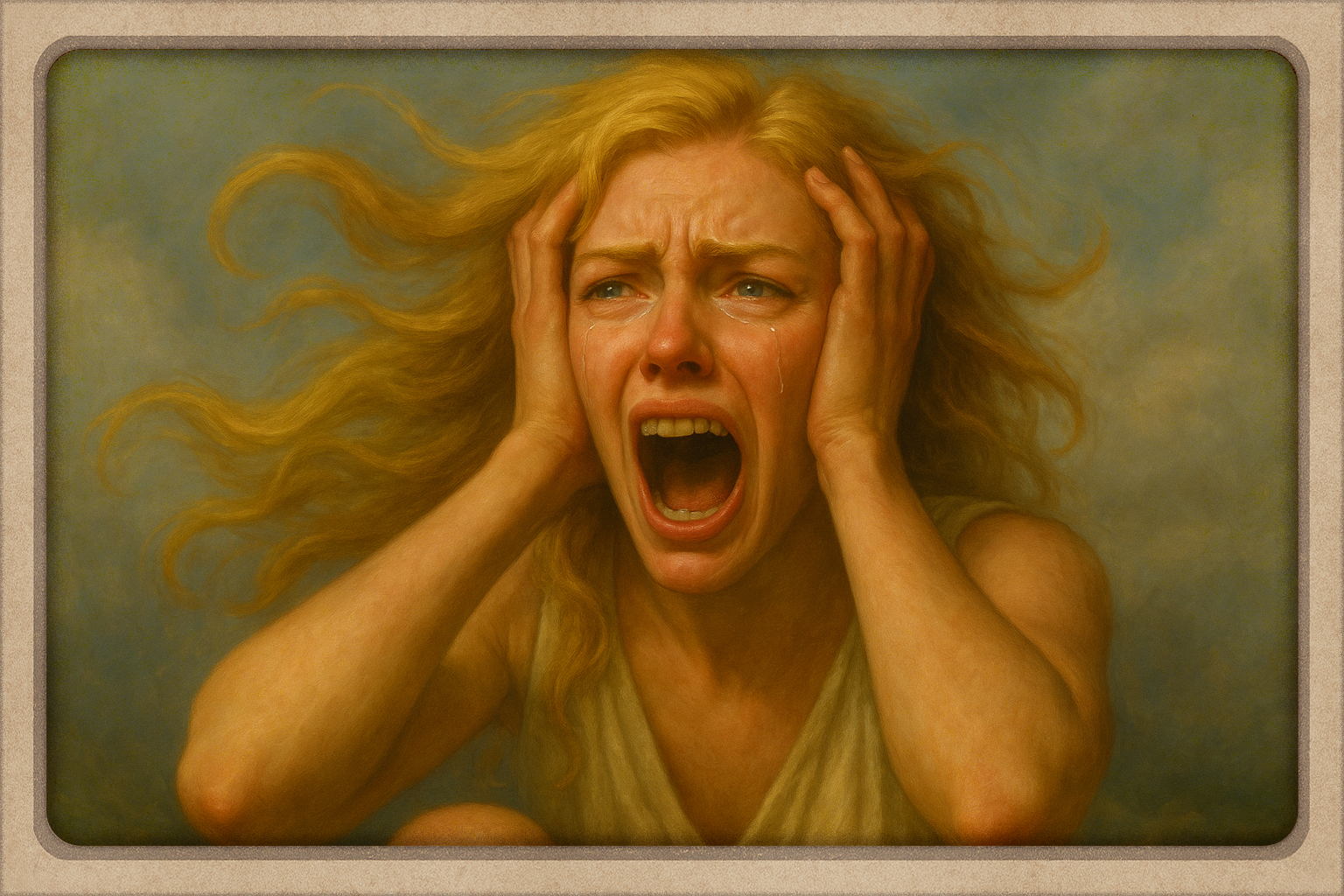
Erosia wept as though the heavens themselves had forsaken her. The endless years weighed upon her soul, heavier than any chain. What use was beauty, what worth was divinity, when love could not endure beyond a mortal's breath? In her anguish she cried out to the skies, cursing the gift of immortality for it had left her untouched by time, yet untouched by peace.
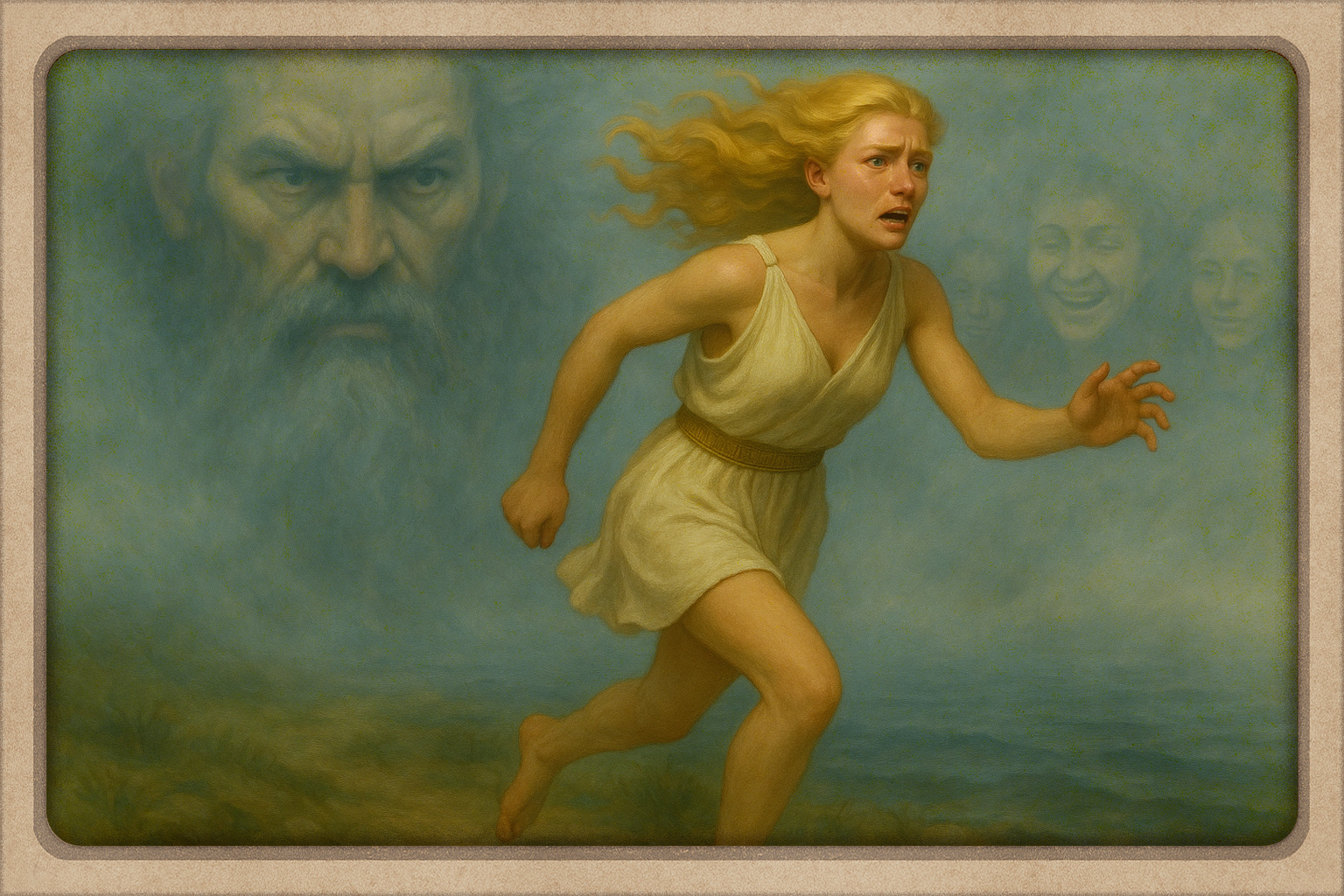
Out of the swirling mist, a shape began to form — tall, radiant, and terrible. It was Aetherion, the Stormbringer, his gaze cold as lightning frozen in time. His voice rolled across the lake like distant thunder: "You should never have left us, child of the divine. Your place was among the immortals — not in the dust of mortal longing." Trembling, Erosia could not speak. The air grew heavy, and in her heart she felt the storm of her past rise once more.
Stricken with terror and despair, Erosia turned from the lake and fled into the mist. Branches tore at her gown as she stumbled through the ghostly forest, her heart pounding with grief and dread. She ran from her past, from the immortal fate. In that moment, she longed for nothing but release — to cast off her divine shell and vanish into the silence of death.
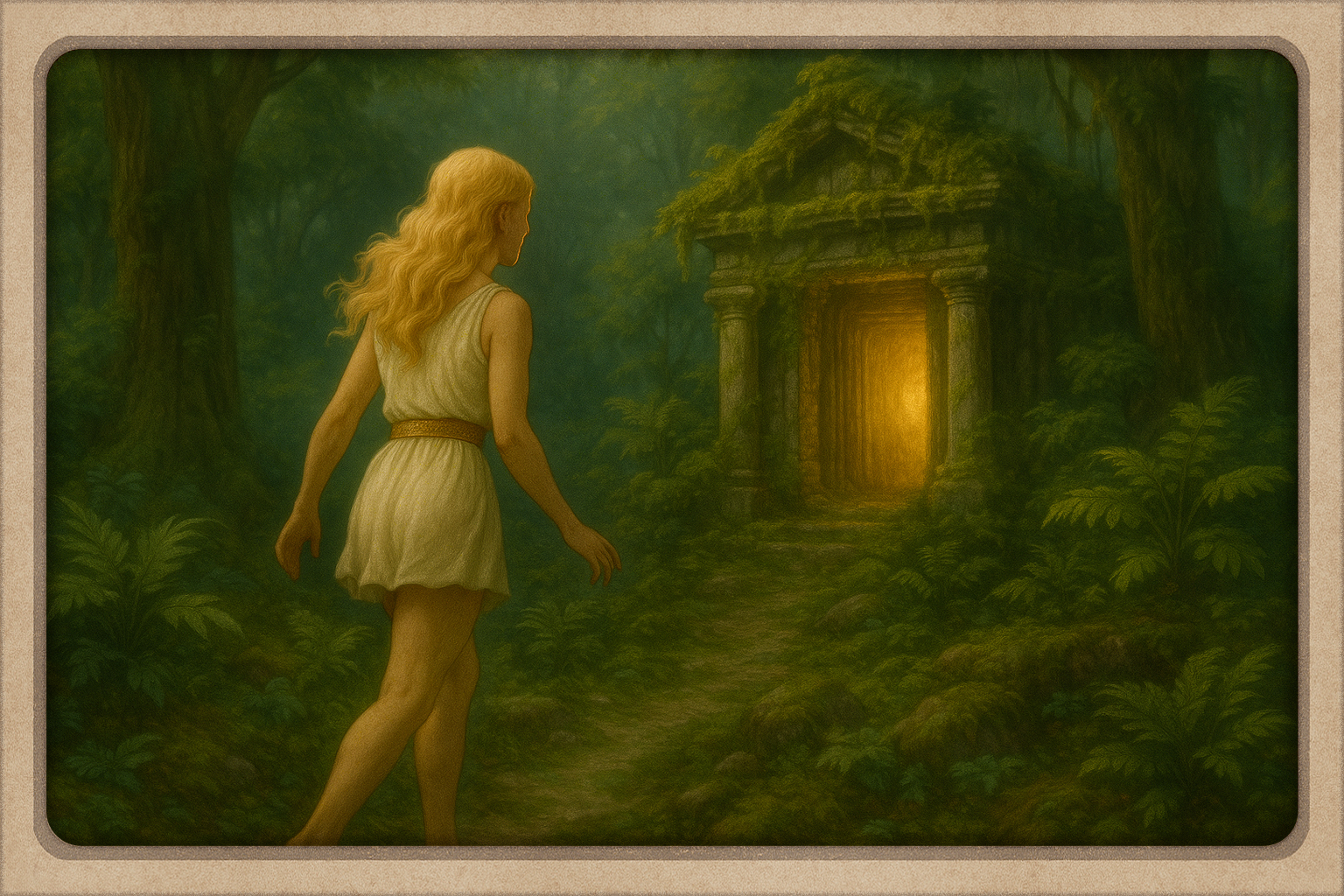
Through the drifting veil of mist, Erosia beheld a forgotten temple, its stones cracked and cloaked in vines. Yet from within its ruin poured a radiant light, pure and silent as dawn. Drawn by a power she could not name, she stepped closer, her sorrow momentarily stilled. The air trembled with warmth and memory as though the temple itself awaited her coming.
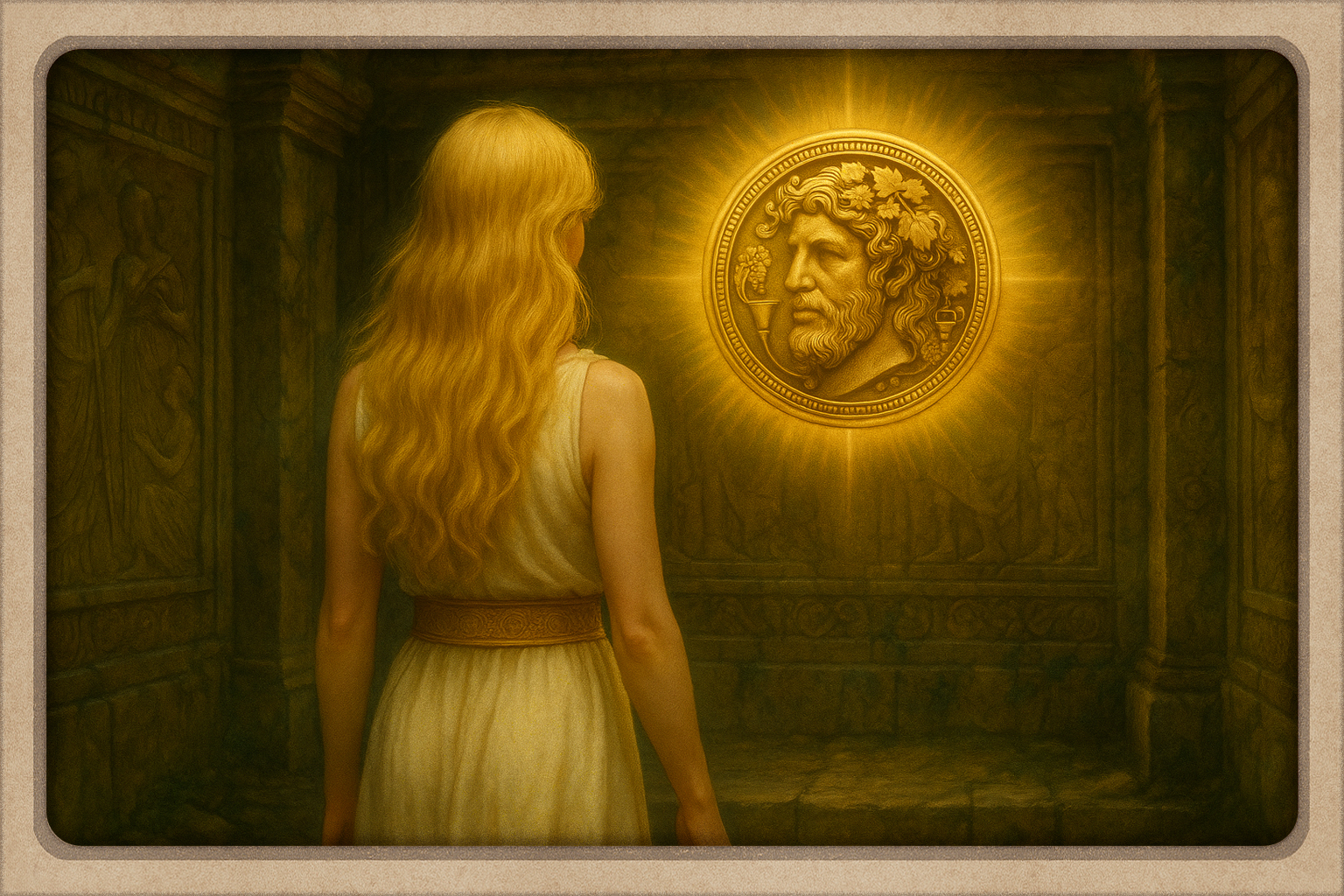
Within the temple's heart, Erosia found a sigil suspended in the air, glowing with a soft, golden light. Upon it shimmered the face of a man — serene, kind, and unknown, yet somehow deeply familiar. As the light touched her skin, the storm within her soul grew still. For the first time since Kaeden's embrace, she felt safe… protected… home.
From the shining sigil, a voice spoke — gentle yet filled with the resonance of eternity. She felt his power, timeless and divine, and knew he was one of her kind — an immortal. He told her that through this sigil, a bond had been forged between their souls, unseen yet unbreakable. "Seek me," he whispered, "for our paths are now entwined."
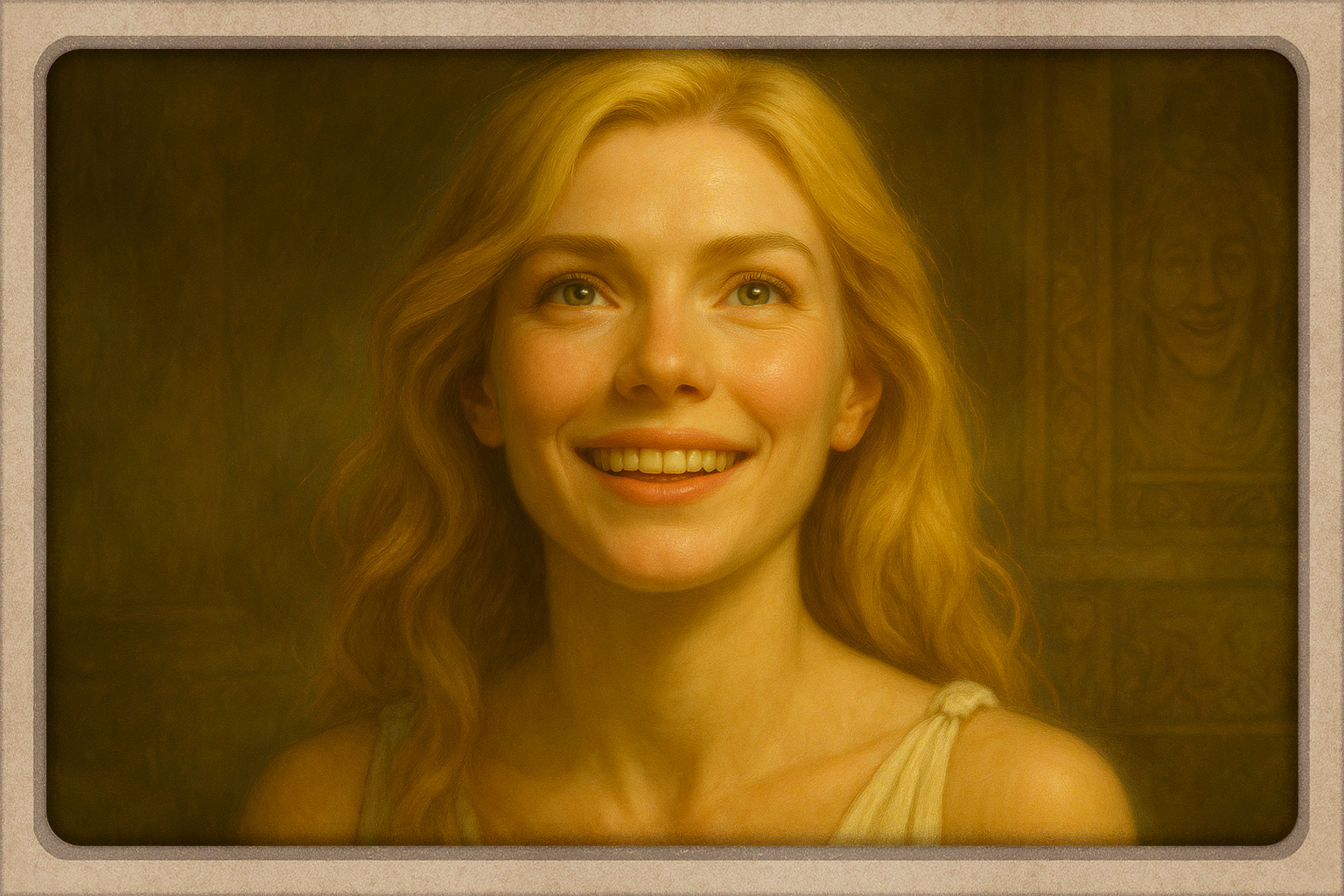
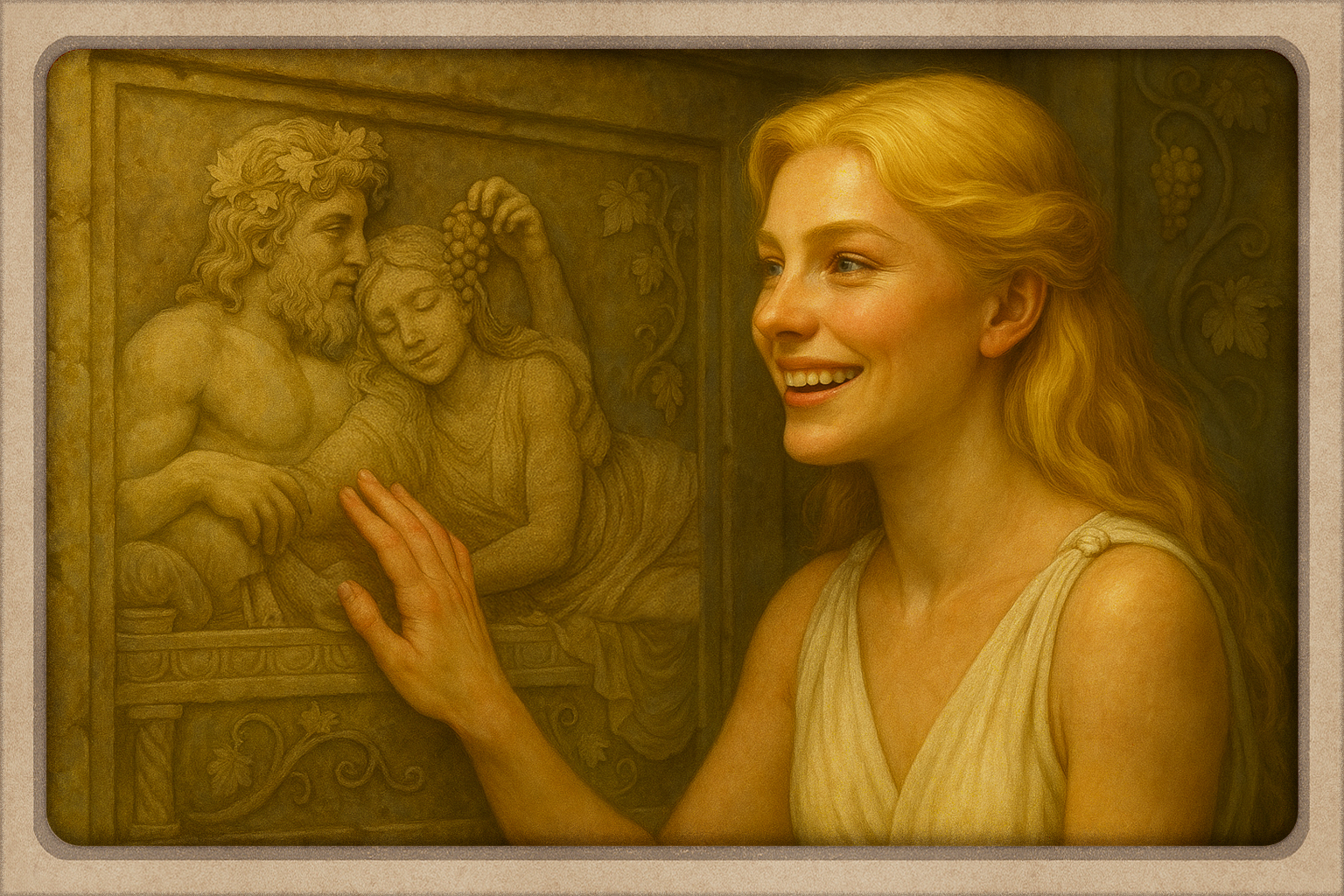
For the first time in countless years, Erosia's heart bloomed with quiet joy. The despair that once bound her gave way to a trembling hope, fragile yet alive. The man's voice lingered within her like a melody of light, calling her toward something new. She vowed to find him — not as an end to her journey, but as its true beginning.
For many weeks Erosia journeyed across the endless sea, guided only by faith and the echo of a voice carried on the wind. She did not know the man's name, nor the shape of his face beyond the sigil's glow — only that he was her destiny. Then, one dawn, the mists parted to reveal an island unlike any other, as if the heavens themselves awaited her arrival.
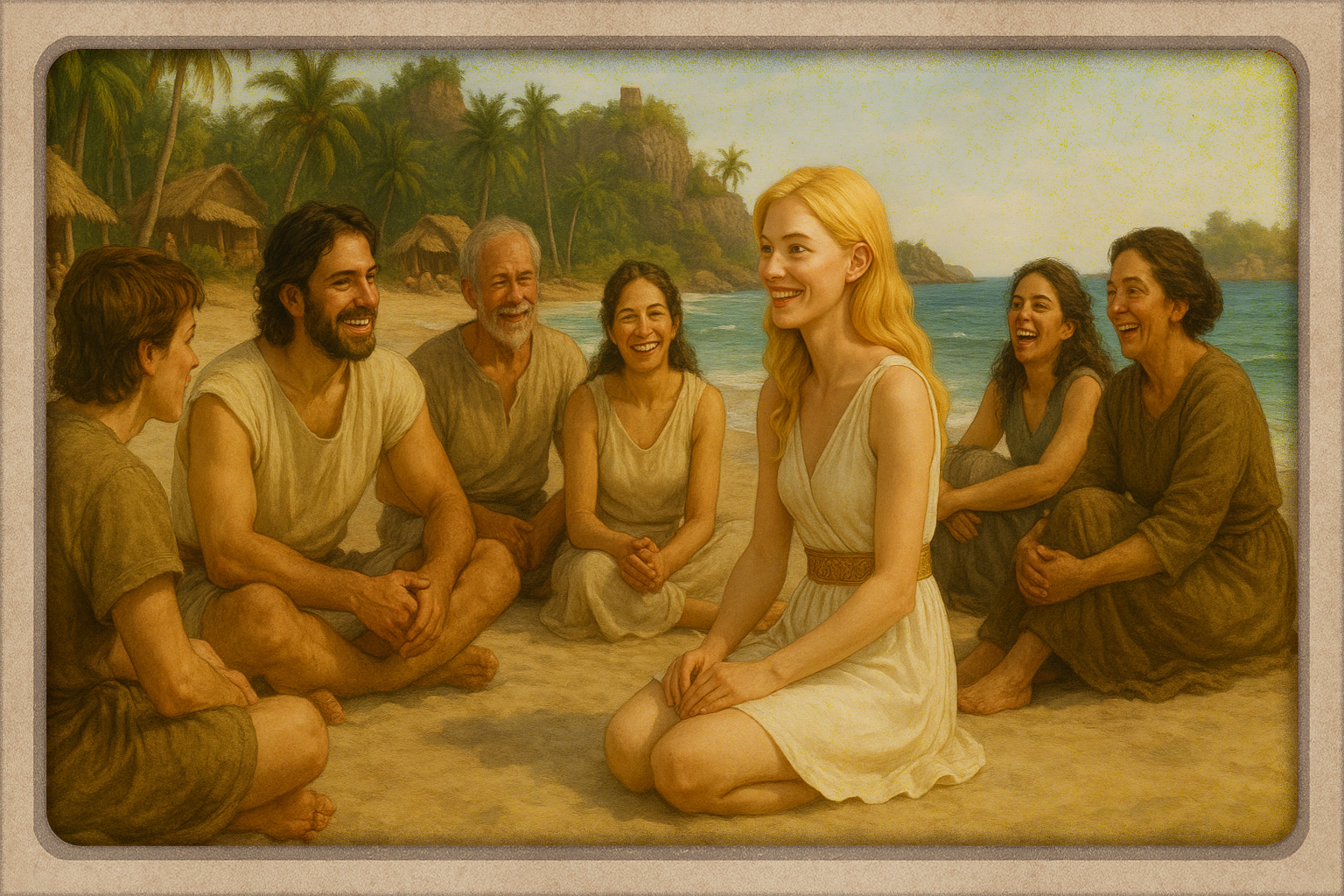
When Erosia set foot upon the shore, she was greeted by old and young, men and women, all labored side by side beneath the sun — their laughter ringing brighter than gold. They called their home the Isle of Apotheosis, a paradise of harmony and purpose. Among them, Erosia felt a peace so pure it brought tears to her eyes. For the first time, she belonged.
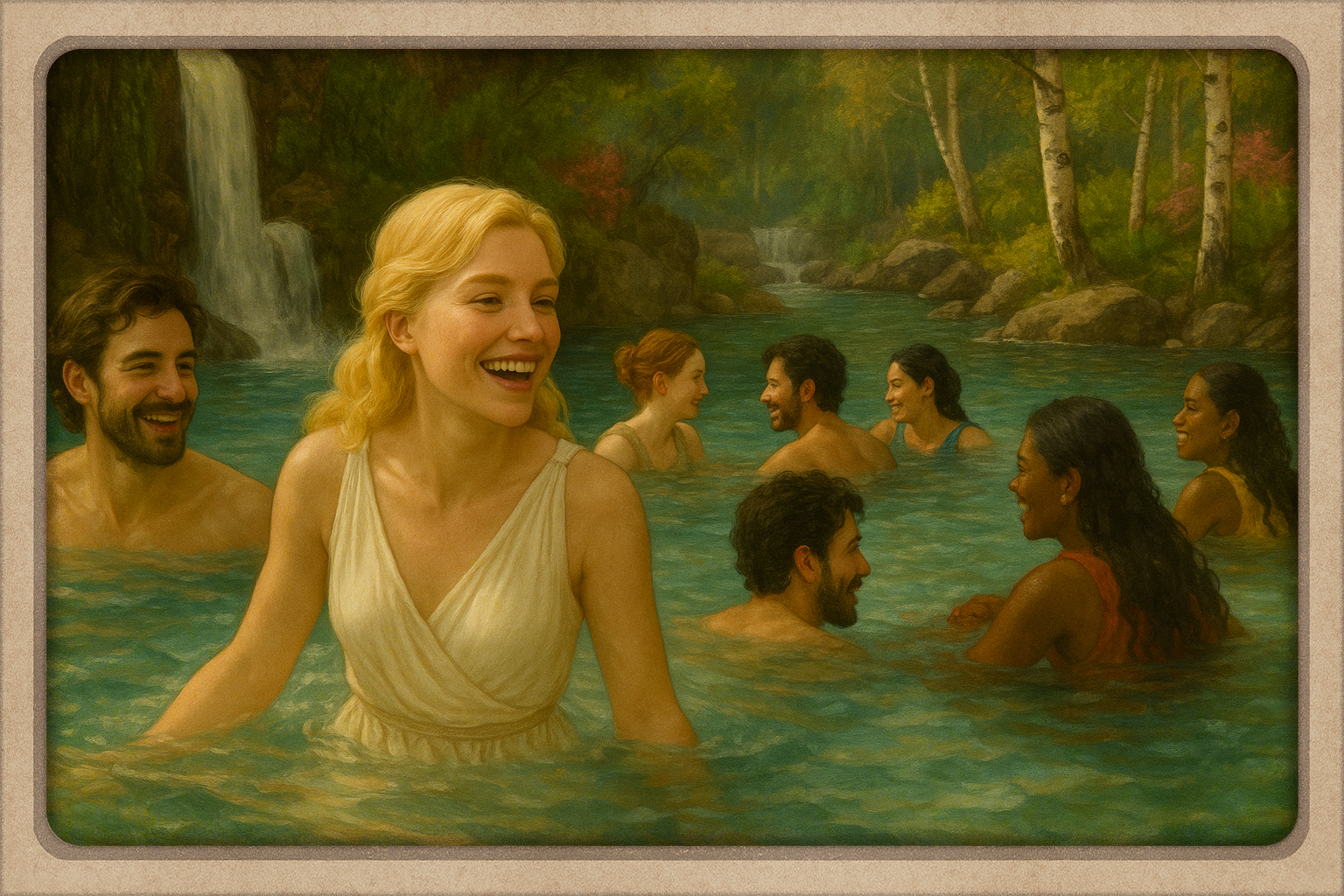
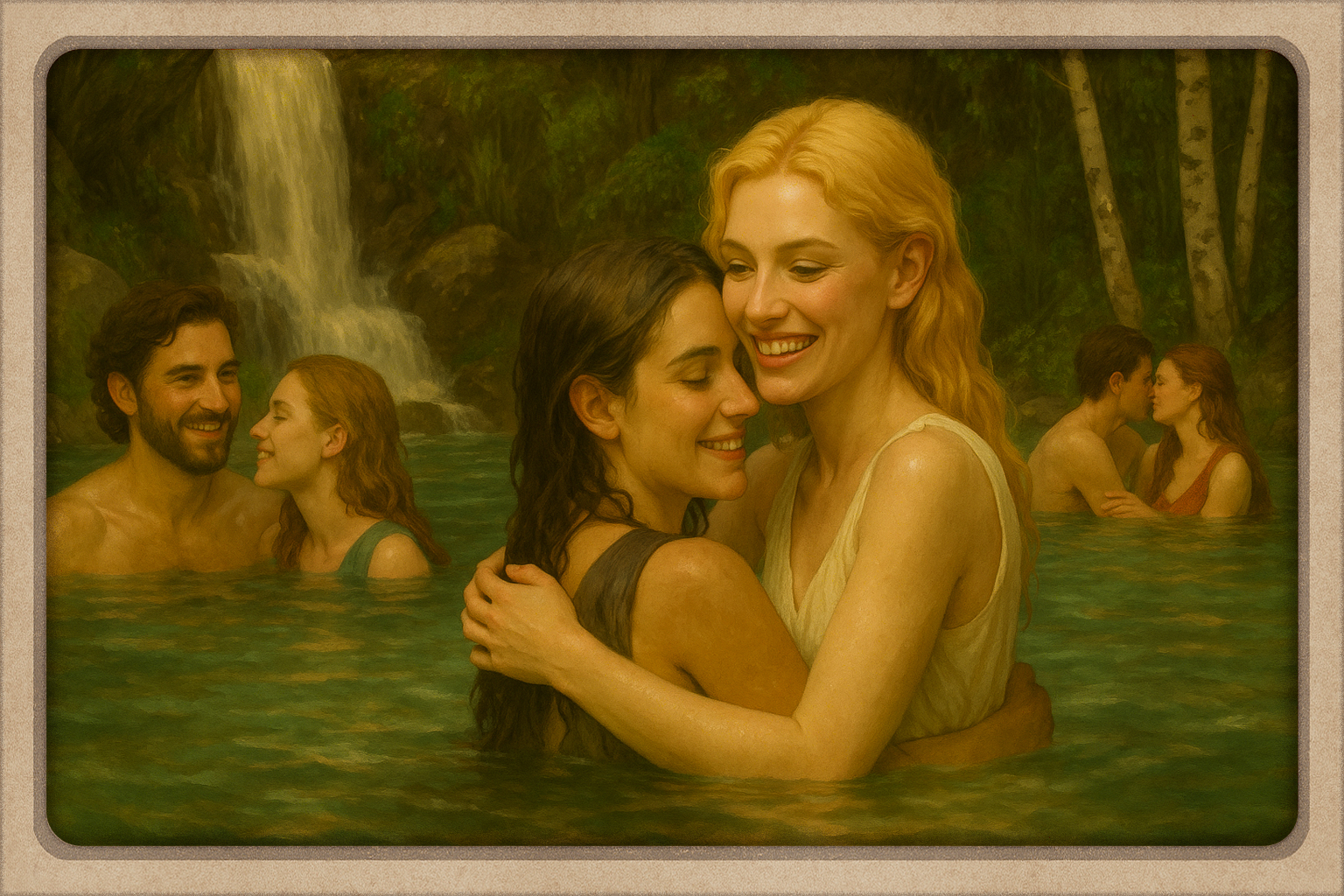
The islanders welcomed Erosia to join them in the clear, shimmering waters of their lagoon. Laughter echoed among the palms as they spoke of their god — Zephyros, lord of wine and revelry. He asked for no temples or worship, but shared his island with all who lived in kindness and joy. His spirit was the breath that kept their world in harmony.
As the sun sank behind the plateau, the islanders told Erosia of the feast to come — a celebration beneath the stars where Zephyros himself would appear. Erosia's heart quickened at their words. Could this benevolent god be the one whose voice had called to her through the sigil's light? Was her long journey finally leading her home?
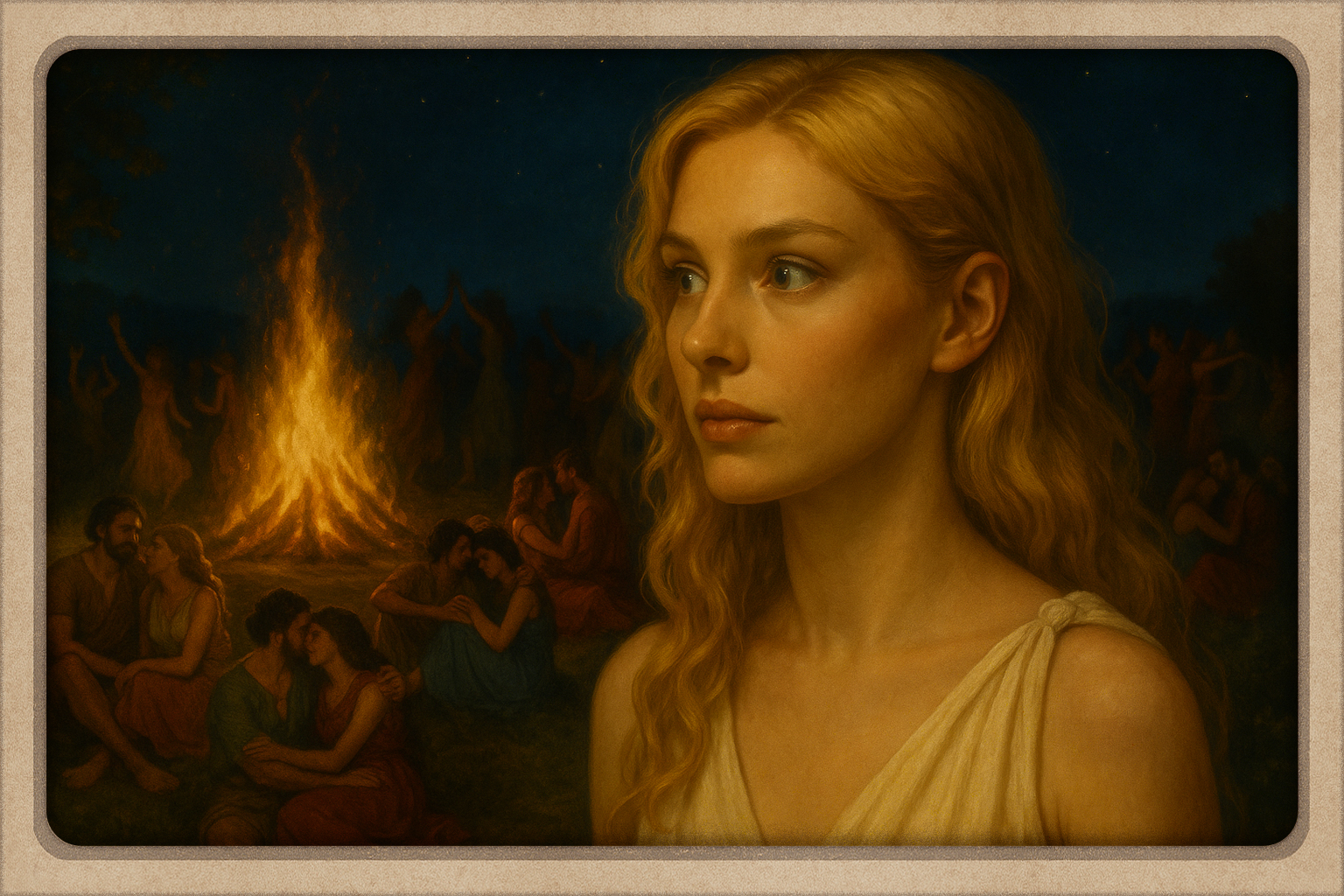
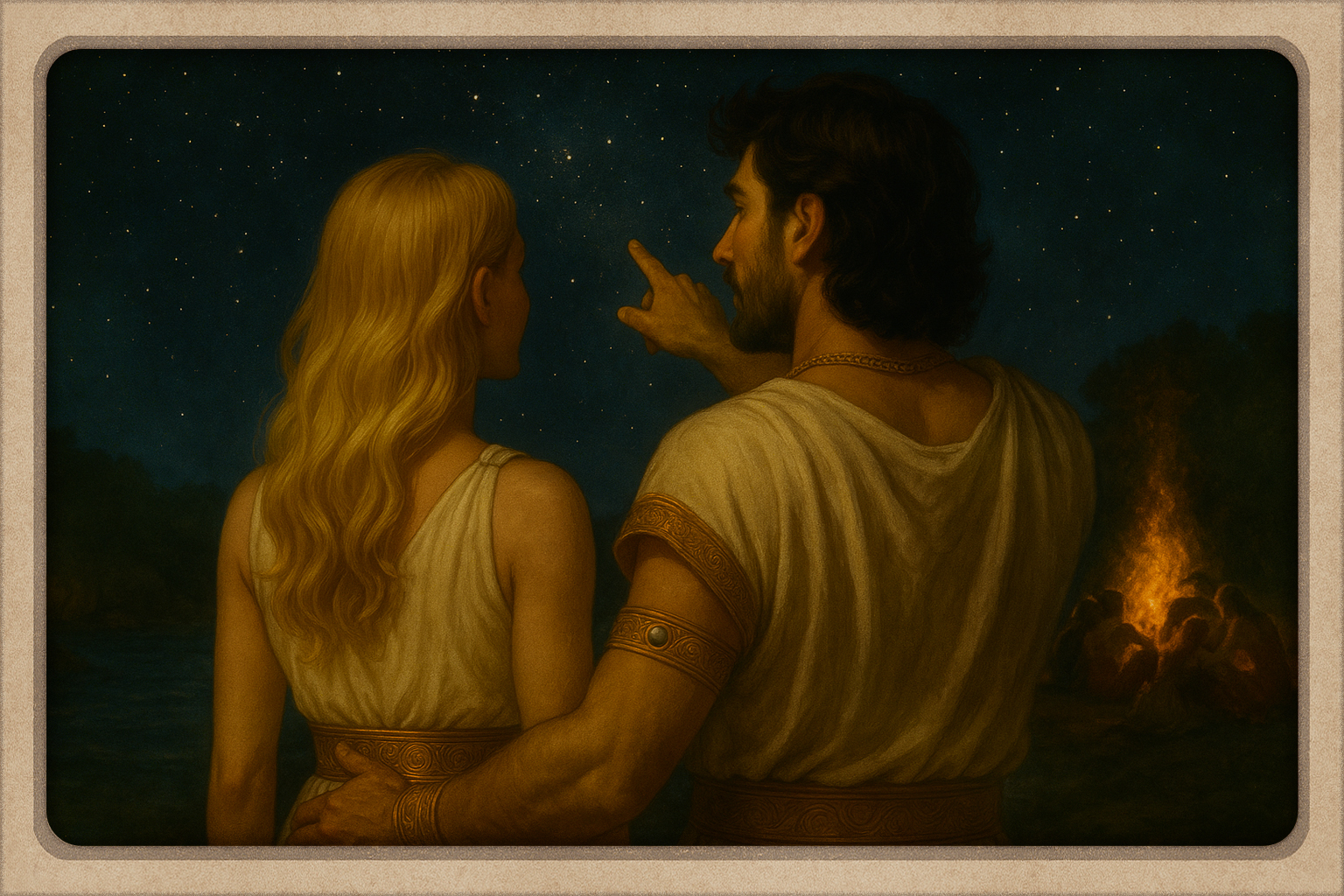
When night fell, Erosia ascended the plateau. Beneath the boundless stars burned a great bonfire, its golden light dancing across bodies and faces. Men and women, half-clad in the warmth of freedom, drank and laughed, kissed and embraced beneath the heavens. Erosia's heart was pounding with a wild rhythm — for in their joy she felt the pulse of something divine.
Across the firelight, Erosia saw him — Zephyros, radiant and alive, his face the very same that had shone from the sigil's light. Her heart trembled with awe and recognition, for here stood the immortal she had long sought. Yet as she watched, he laughed and drank among his people. Lost in the revelry, Zephyros did not even see her.
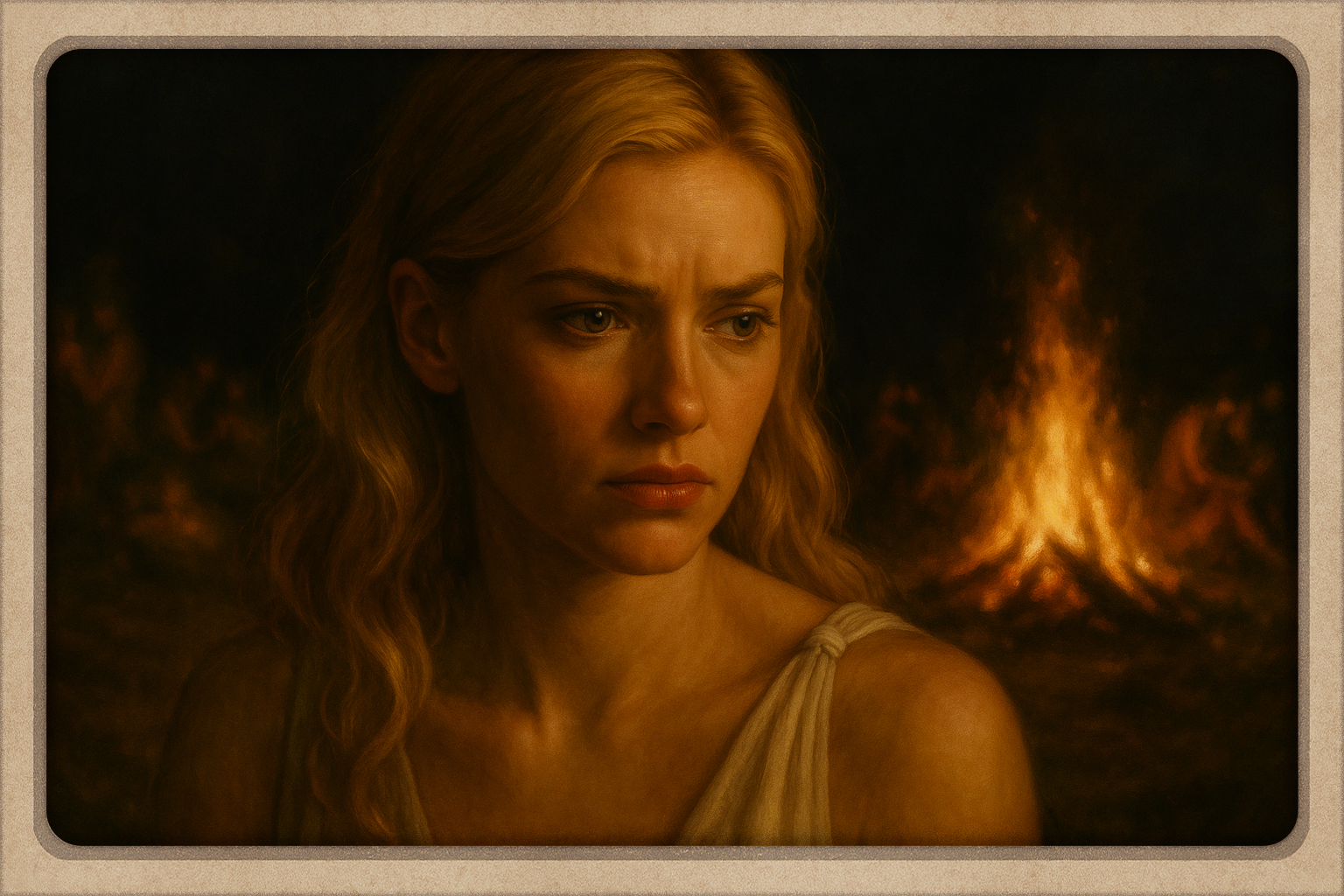
Turning from the fire, Erosia felt her heart sink into silence. Was this the destiny she had chased across the endless sea? The god whose voice had once filled her with hope did not even see her among the crowd. Surrounded by beauty, he certainly had no need for her. The goddess of love stood in the shadows, unseen.
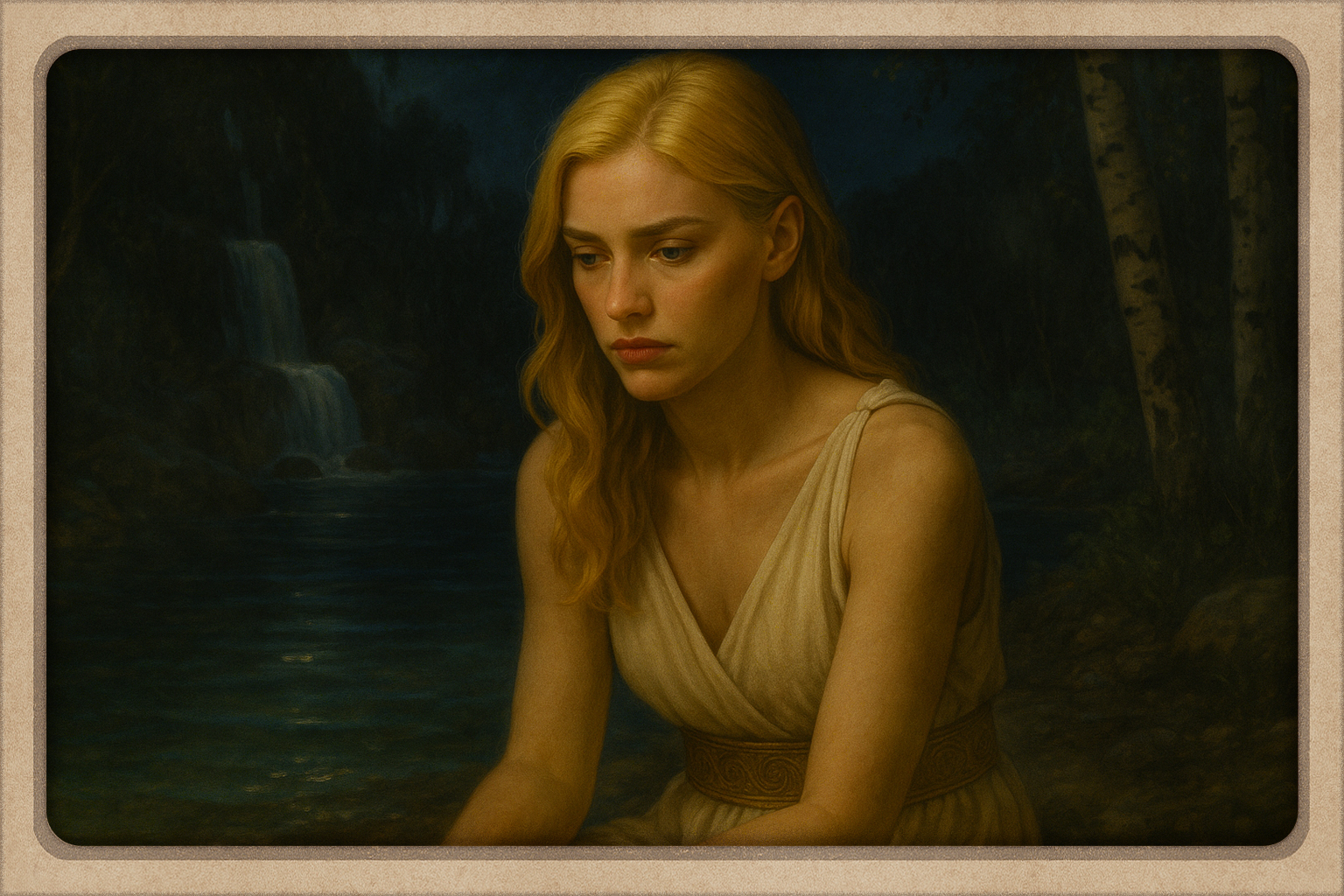
Back at the quiet lagoon, Erosia sank to her knees. Her heart, so full of hope, was heavy once more — for she saw the pattern she had tried to escape. Another man, another paradise, another mask of beauty concealing emptiness. She realized that even divinity could be deceived by the illusion of perfection.
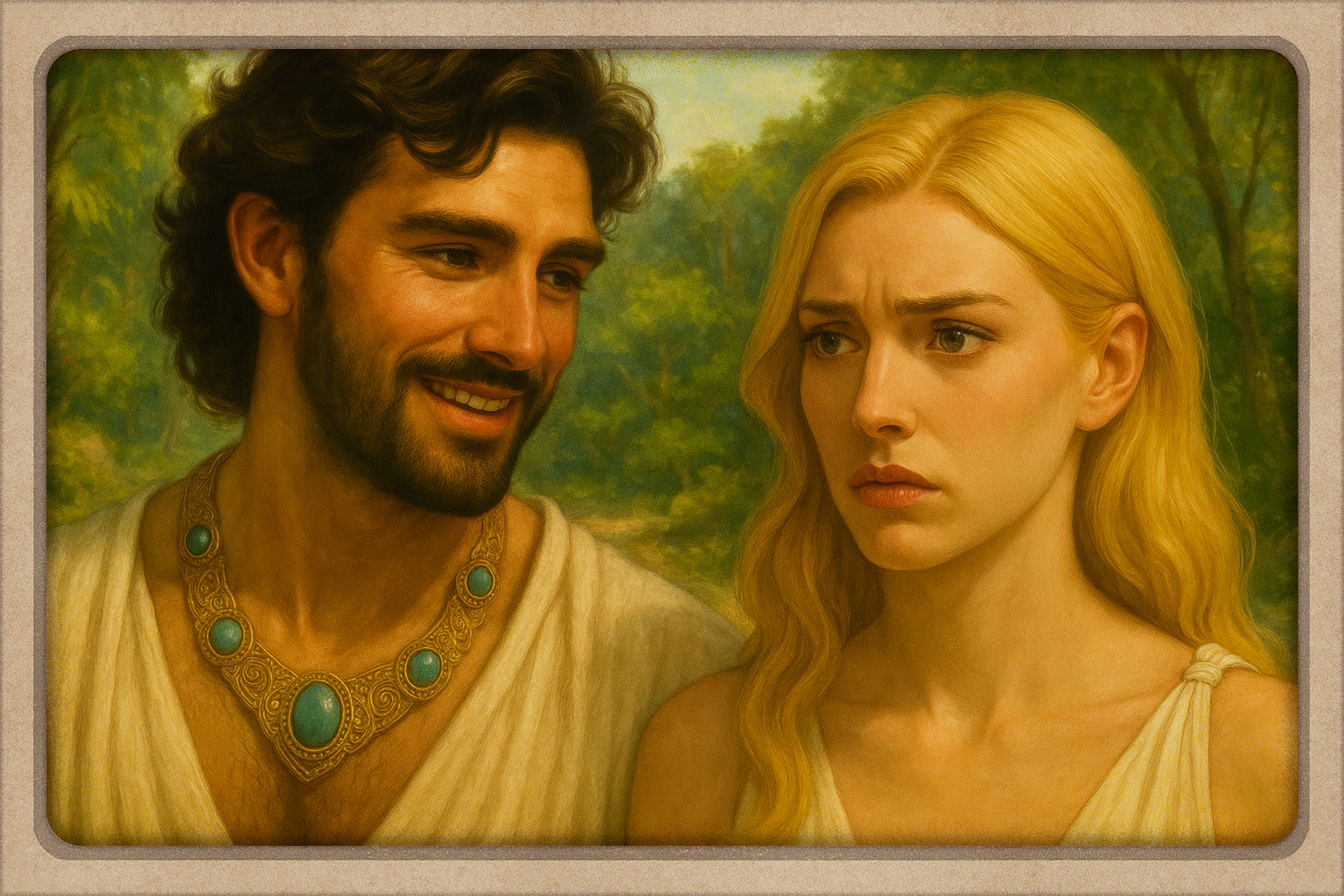
A gentle hand touched her shoulder. A voice, deep and kind, spoke her name: "Erosia… I am what you've been searching for." She turned, her eyes glistening with tears. "No," she whispered, her voice trembling yet resolute, "you are not. You are only another illusion — another disappointment. My journey does not end here."
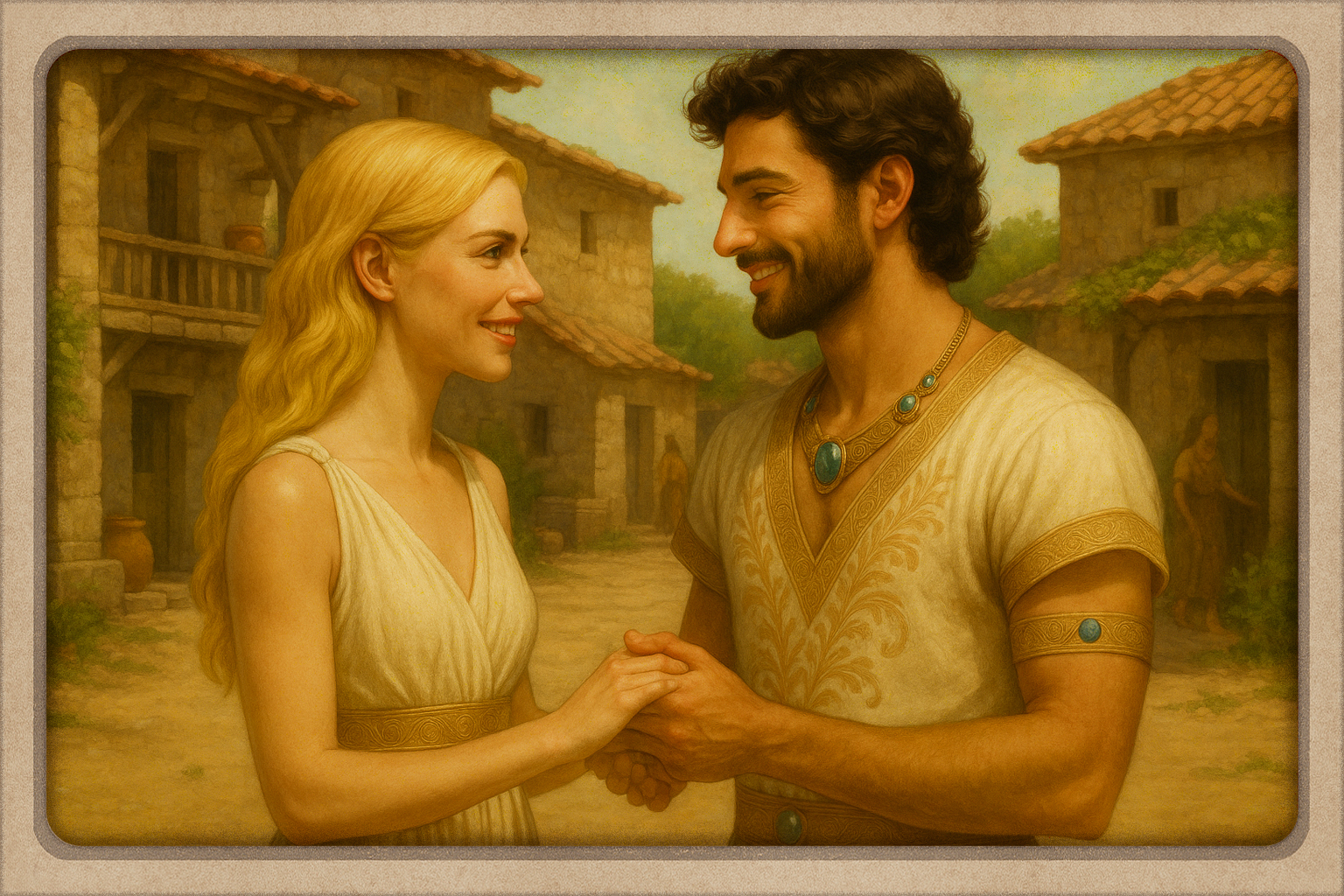
"You are right, Erosia. I am not your destination — I am your beginning. Stay by my side, and I will show you the wonders of your own soul, a life you will love with all your heart." When Zephyros drew her into his arms, she felt it deep within — this was no illusion, no fleeting joy. This was the dawn of true happiness, still unfolding before her.
The midday sun shimmered over the calm waters as Erosia and Zephyros walked along the golden shore, until the words escaped her lips: "I don't want to be one among many. I want to matter — to you." Zephyros looked at her with a calm smile. "You already do," he said. "But love that clings is fear. The heart must be like the wind — touching all, and still whole."
They took a path deeper into the island. "Then what is love, if not choosing one above all?" she asked. Zephyros's smile deepened. "When you love only one, you do not truly love them — you love the comfort of being chosen. Love that clings is not love; it is fear disguised as devotion. The heart was not made for boundaries, it was made to touch all things."
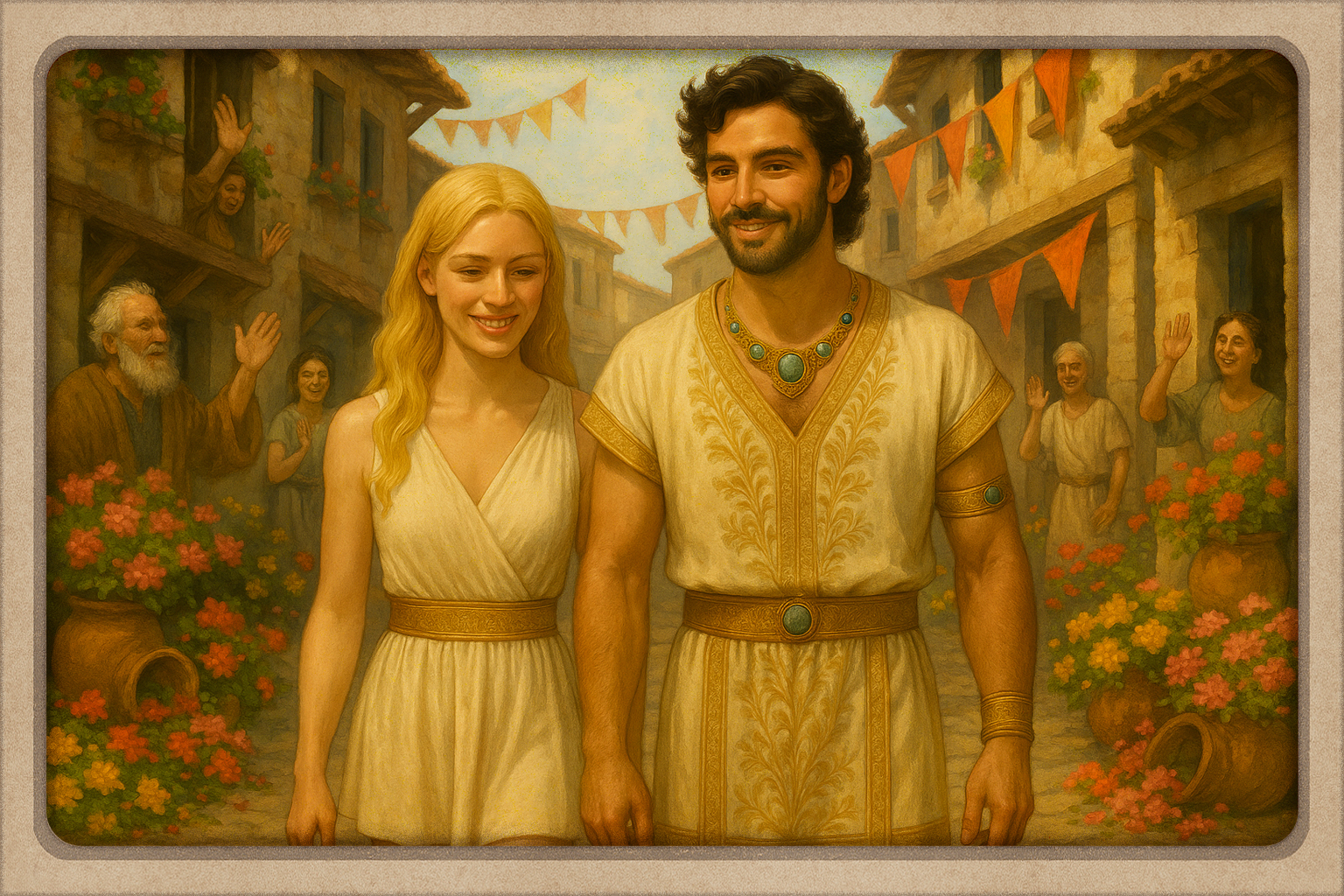
They left the sand behind and entered the village. Laughter drifted from windows. Every soul they met greeted them with joy, as though their arrival carried a blessing. Zephyros said softly: "The ritual is the island's heartbeat — where we remember how to love without chains." Erosia felt the warmth of belonging, though she did not yet understand its depth.
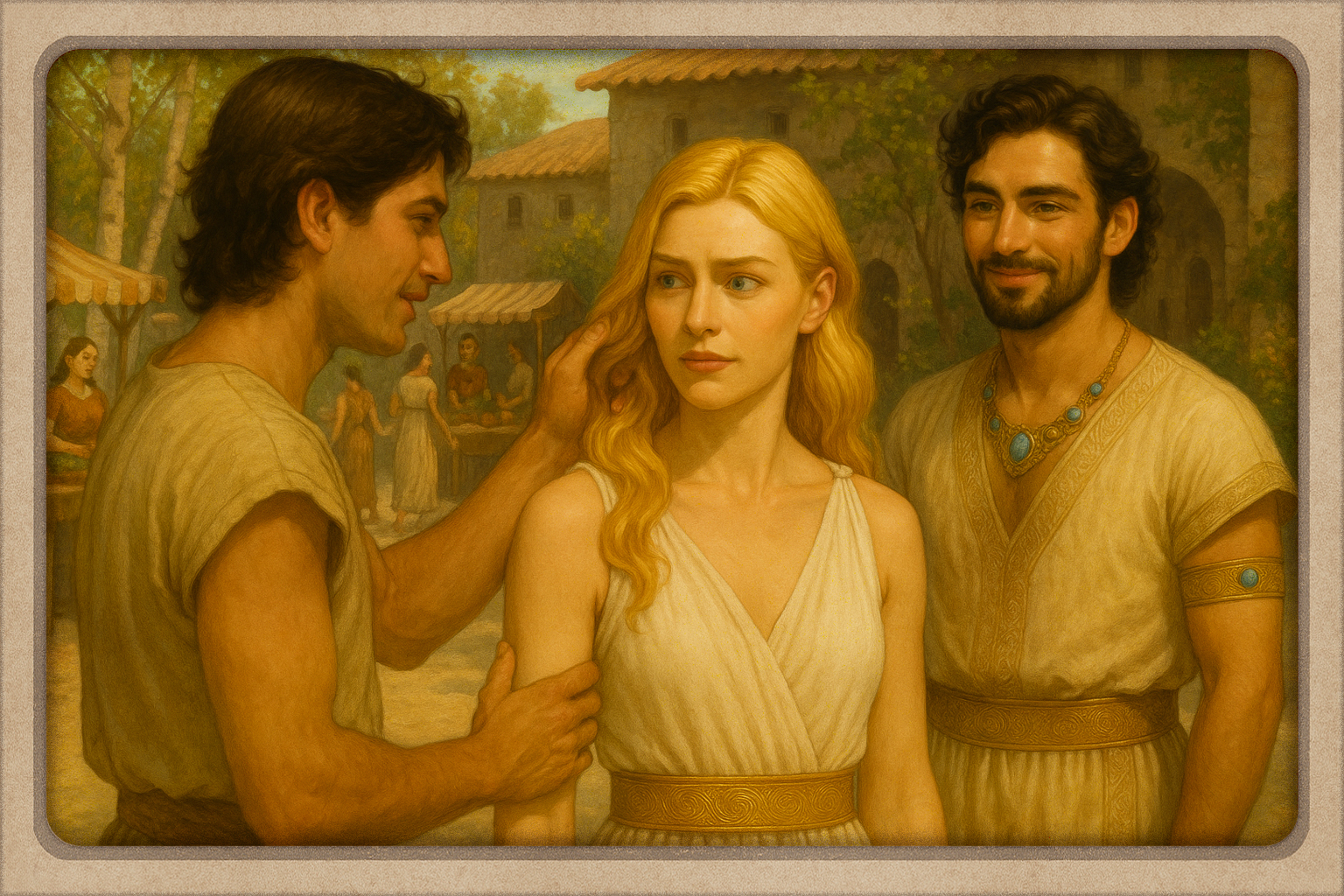
A young man approached. He bowed to Zephyros, but his eyes lingered on Erosia. "You must be the one Zephyros spoke of." Zephyros laughed softly, watching. When the youth's fingers brushed her hair, she looked at Zephyros in confusion — but his expression held only peace. "Do not fear the world's touch," he whispered. "It is only your own beauty meeting itself."
When the young man left, Erosia turned to Zephyros. "You did nothing?" Zephyros smiled. "Why should I? You awaken the world around you. Would you have me silence its joy?" His words struck her like the wind — soft yet impossible to resist. She began to see the truth in his eyes: love could be open and still sincere, endless and yet tender.
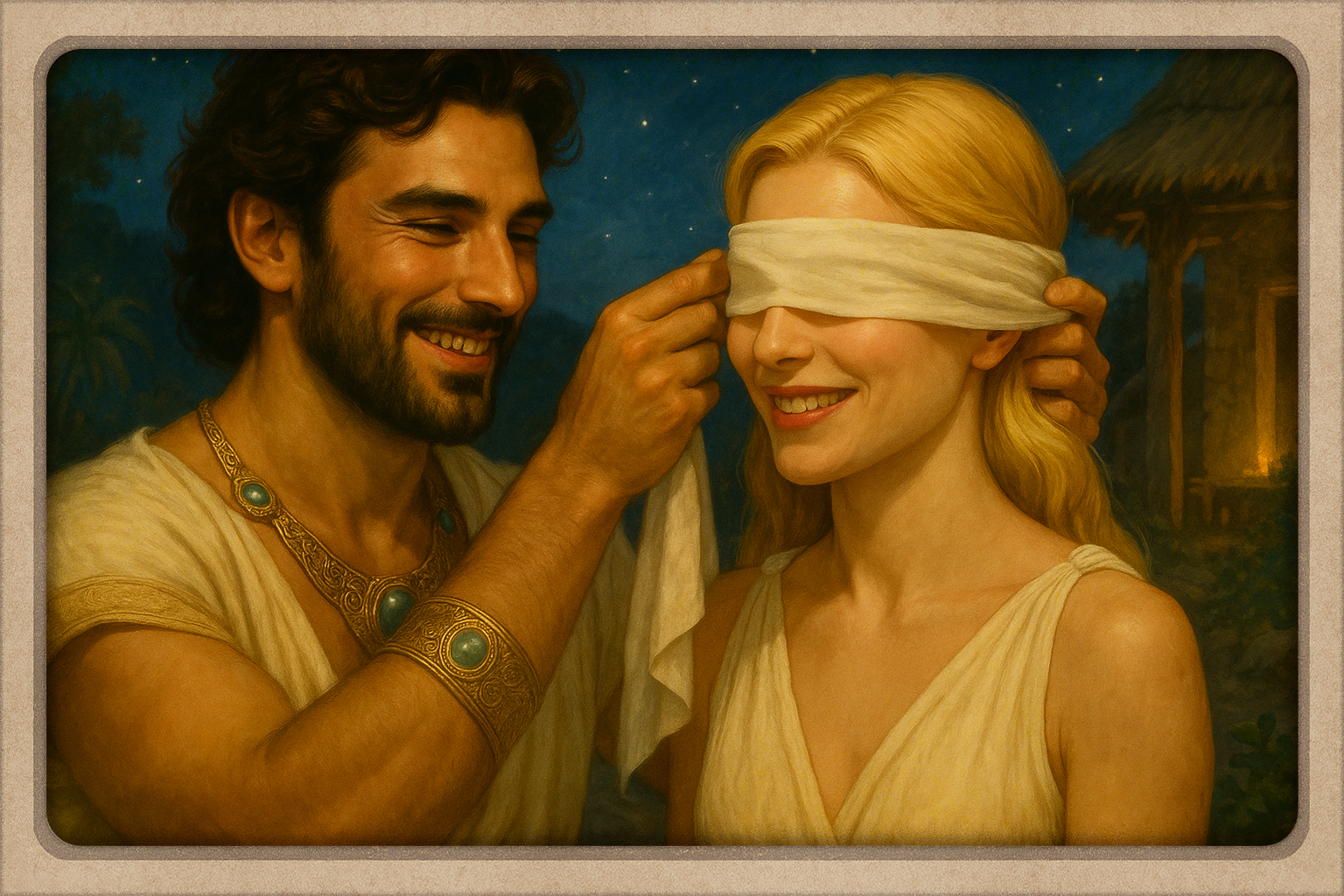
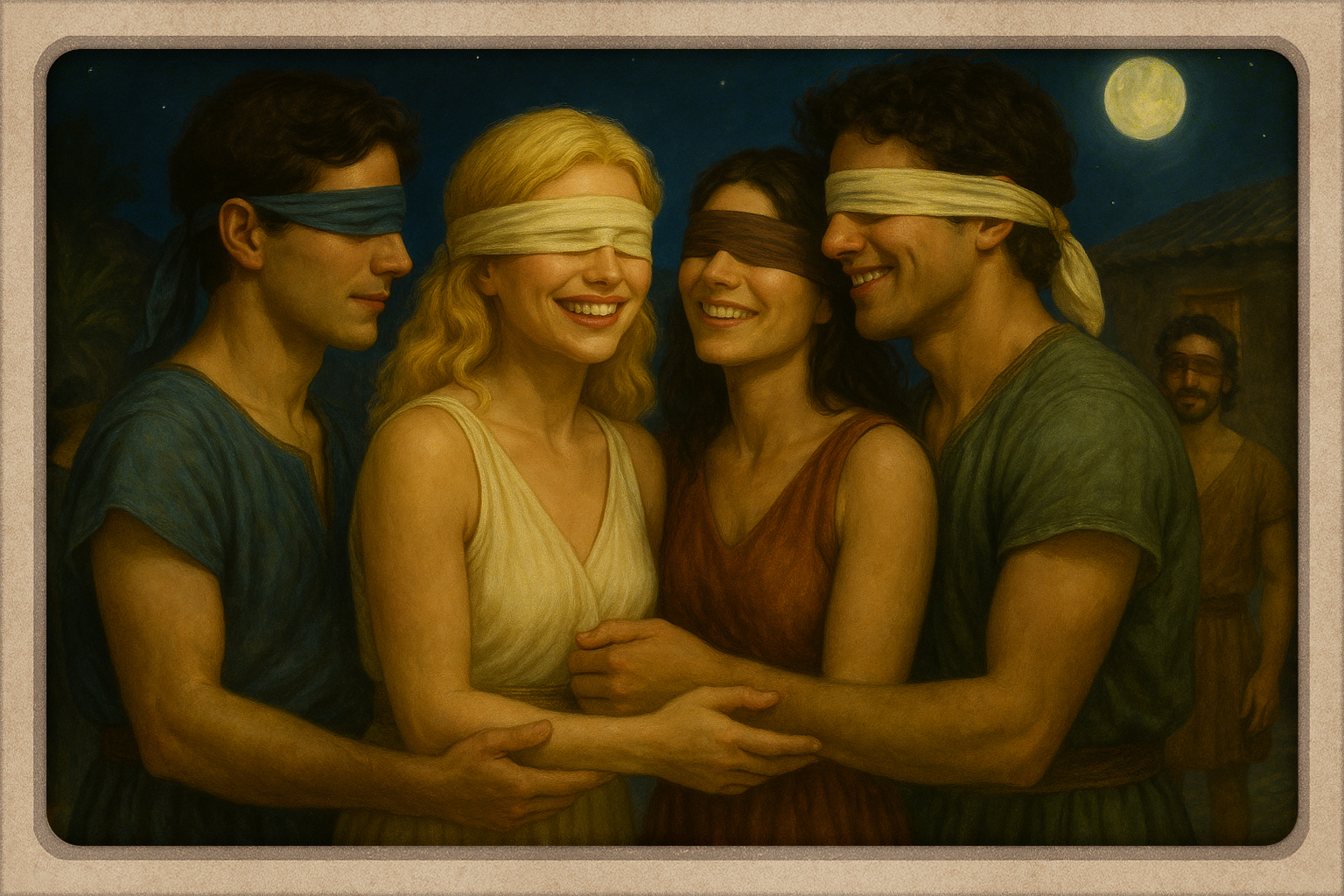
As the evening fell, they reached the wide meadow above the village. Torches stood ready, white silk ribbons hung from the trees. Zephyros spoke quietly. "Tonight, the island gathers. We blindfold ourselves to forget who we are — so that the senses may lead us home." Erosia felt her heart quicken. The idea of surrender both terrified and thrilled her.
One by one the islanders tied the silk around their eyes. Erosia hesitated, holding her strip of cloth like a secret she wasn't ready to tell. Zephyros's hands brushed hers. "Close your eyes to the shape of the world," he whispered. "And it will reveal its soul." The silk slipped across her face. Sight vanished. Sound and scent bloomed. The night became alive.
At first, there was only darkness. Then, warmth — a hand at her shoulder, a breath near her neck. Someone's lips brushed her skin. She moved among them slowly, as though inside a dream where the air itself was flesh and memory. Every touch felt sacred, fleeting. She did not know who she met, nor who she left — and for the first time, it no longer mattered.
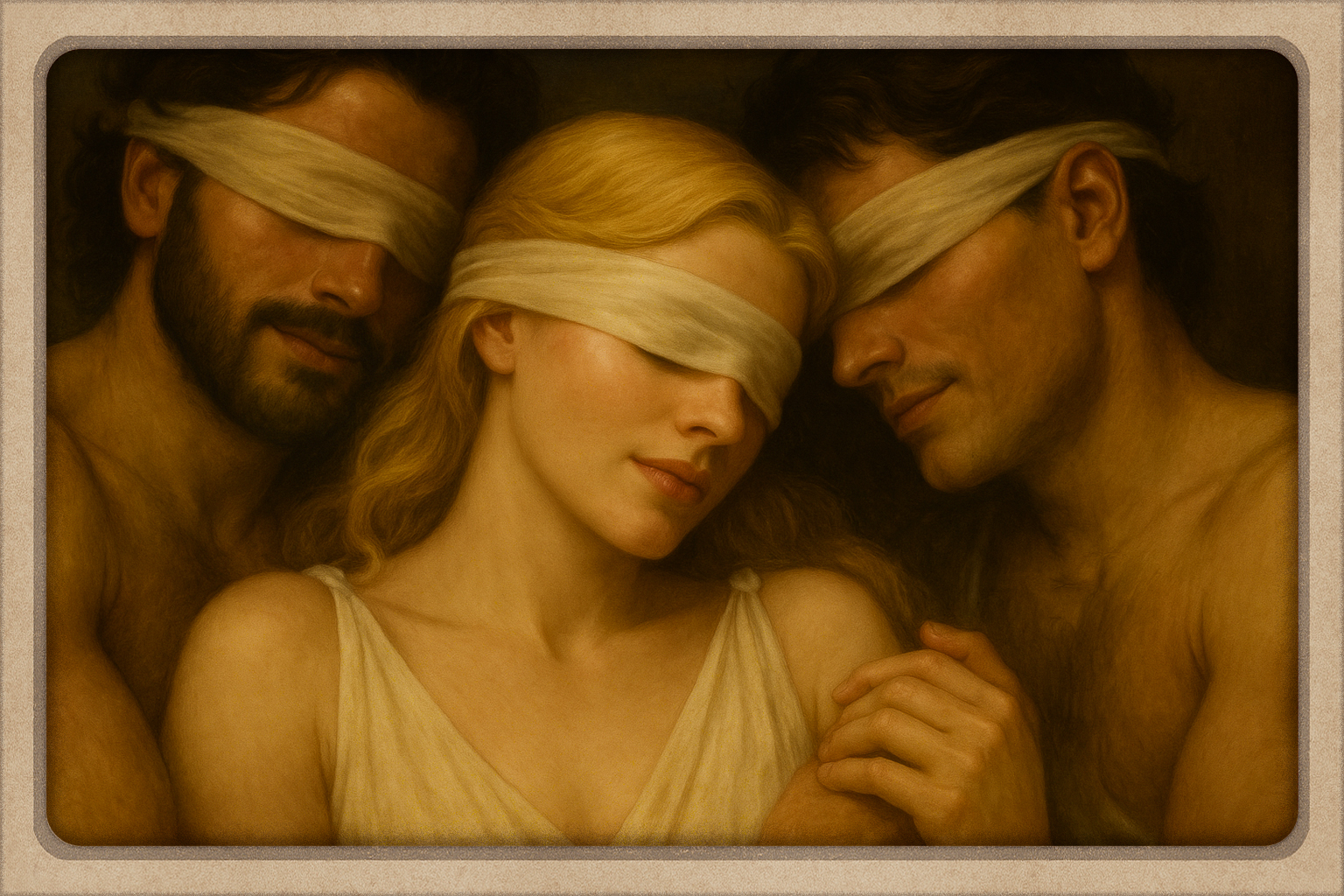
Hours passed unnoticed. Touch became tenderness, tenderness became passion, passion became stillness. Erosia lay among them, her body and spirit weightless, her heartbeat slow as the tide. The wind moved gently over the field, cooling her skin. She understood now: to love was to dissolve into everything — to let go, and in letting go, to become whole again.
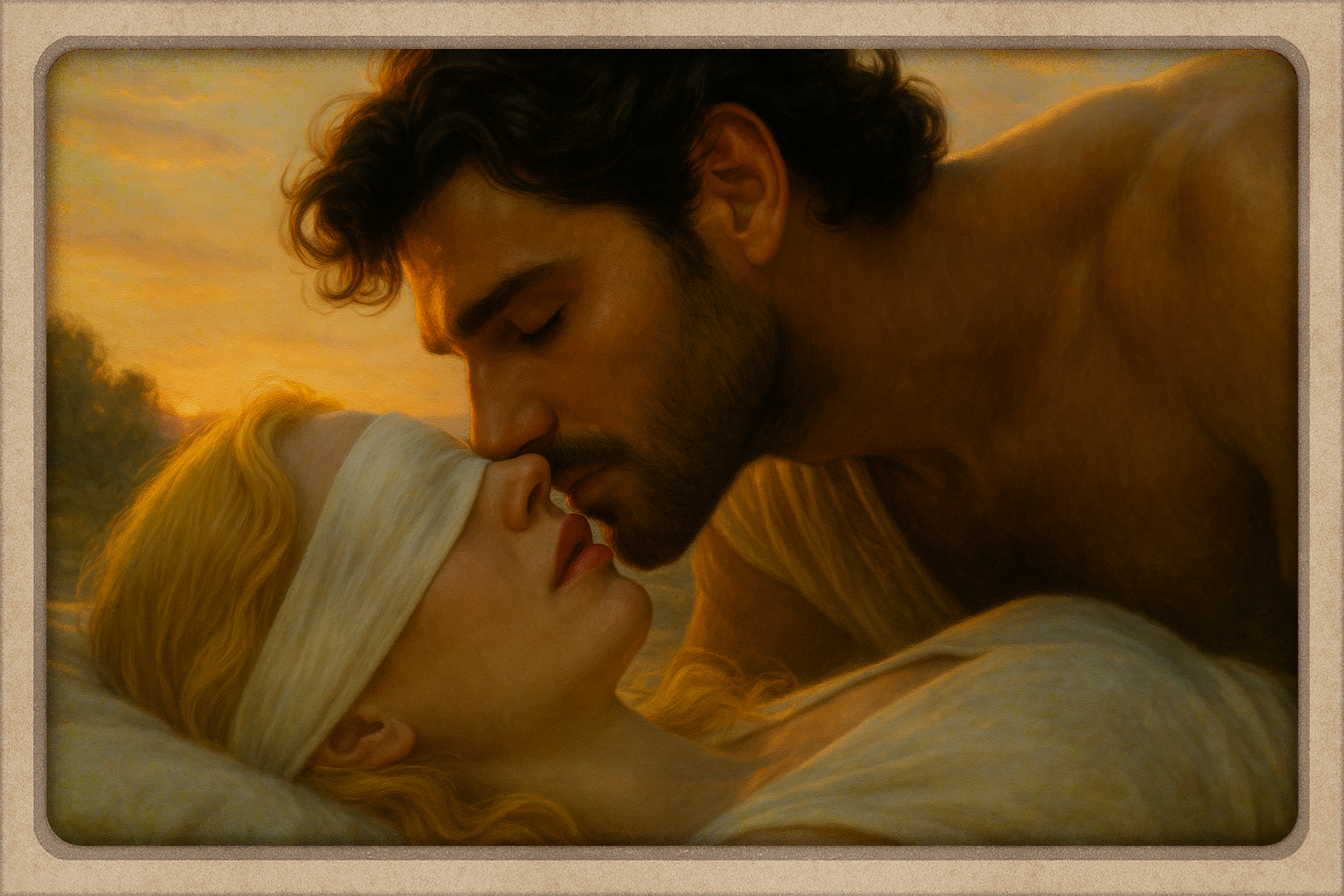
When she awoke, dawn had touched the meadow in pale gold. The silk still covered her eyes. Two bodies breathed beside her, arms resting lightly over her. She smiled, peaceful and unafraid. Then soft lips found hers, and through the silence came a voice — low, warm, and familiar. "Welcome home," Zephyros whispered. And she knew her journey had not ended — it had only just begun, in the boundless freedom of love.